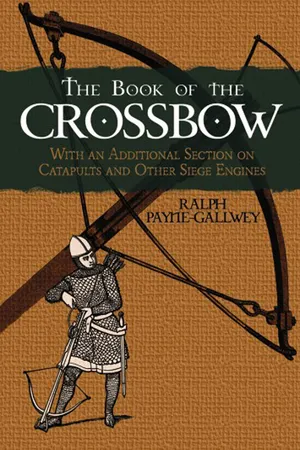
One of the most devastating weapons of the Middle Ages, the crossbow fired a 12-inch bolt capable of piercing all but the strongest armor. This fascinating illustrated study traces its use in both medieval and modern times as a military and sporting weapon. It also covers related weapons, including balistas, catapults, and the Turkish bow. Over 240 illustrations.
eBook - ePub
The Book of the Crossbow
With an Additional Section on Catapults and Other Siege Engines
- 400 pages
- English
- ePUB (mobile friendly)
- Available on iOS & Android
eBook - ePub
The Book of the Crossbow
With an Additional Section on Catapults and Other Siege Engines
About this book
Information
PART I
THE HISTORY OF THE CROSSBOW WITH NOTES COMPARATIVE ON THE LONGBOW, SHORTBOW, AND HANDGUN
CHAPTER
I. THE MILITARY CROSSBOW
II. THE SPORTING CROSSBOW .
III. THE GENERAL DIMENSIONS OF CROSSBOWS
IV. THE BOLTS USED WITH CROSSBOWS
V. THE RANGE OF THE MEDIÆVAL CROSSBOW AND HOW IT COMPARED IN THIS RESPECT WITH THE LONGBOW
VI. THE SHORTBOW AND LONGBOW IN RELATION TO THE CROSSBOW
VII. THE HAND-GUN IN RELATION TO THE CROSSBOW
VIII. SUMMARY OF THE DEVELOPMENT OF THE MEDIÆVAL HAND-GUN
IX. A SUMMARY OF THE HISTORY OF THE CROSSBOW
The MEDIÆVAL CROSSBOW was called by many names, most of which were derived from the word Balista. The Balista was a great siege engine on wheels that was used by the ancients, and which in appearance and mechanism resembled a crossbow, though so much larger in size, Chapter LVII.
THE CROSSBOWMAN WAS KNOWN AS 1—
Arbalista
Arbalistarius
Arbalistator
Arbalistanus
Arbalistrius
Arcubalistarius
Arcubalistus
Balistarius
Balistrarius
Balistrator
THE CROSSBOW—
Arbalet
Arbalist
Arbalista
Arbaliste
Arcubalist
Arcubalista
Arcubalistus
Arblast
Alablaste
Alblast
Arbelaste
Arowblaste
Arblat
Arbalestel 2
Manu-balista
CROSSBOW SHOOTING—
Arbalestry
Alblastrye
THE NAME OF THE CROSSBOW IN DIFFERENT COUNTRIES AT THE PRESENT DAY:

Belgium
Italy—Baléstra
Spain—Ballésta
Portugal—Bésta
Denmark—Flitsbue
Sweden—Armbost
Norway—Krydsbue
Russia—Samostrel
CHAPTER I
THE MILITARY CROSSBOW
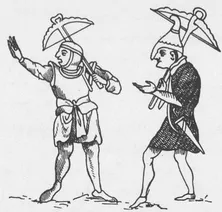
FIG. 1.—NORMAN CROSSBOWMEN.
From Manuscript of Matthew Paris.2
THE CROSSBOW was, probably, introduced into England as a military and sporting arm by the Norman invaders in 1066.
Early in the twelfth century, the construction of this weapon, the bow of which was not yet formed of steel, was so much improved that it became very popular in both English and Continental armies.
The wounds caused by the crossbow in warfare were, however, considered so barbarous, that its use, except against infidels, was interdicted by the second Lateran Council, in 1139, under penalty of an anathema, as a weapon hateful to God and unfit for Christians. This prohibition was confirmed, at the close of the same century,. by Pope Innocent III. Conrad III.. of Germany, 1138—1152, also forbad the crossbow in his army and kingdom.
The employment of crossbowmen, nevertheless, again became common in English and Continental armies in the reign of Richard I., 1189—1199, and the death of this king, which was caused by a bolt from a crossbow, (at the siege of the Castle of Chaluz, near Limoges, in France, in 1199,) was thought to be a judgment from Heaven inflicted upon him for his disobedience and impiety in permitting crossbowmen to enter his service.
Richard was an expert with the weapon. At the siege of Ascalon—though prostrated with fever—he is said to have been carried from his tent on a mattress, so that he might enjoy the pleasure of shooting bolts at the defenders of the town. In this case, however, as the enemy consisted of Turks and infidels, his act would have been sanctioned by the Church of Rome. Though among English soldiers, the longbow began to supersede the crossbow and the shortbow, during the reign of Edward I. in the last few years of the thirteenth century, crossbows continued to be held in some favour in our armies. In the list of troops mustered by Edward II., in 1319, for the siege of Berwick, crossbowmen are enumerated as part of the forces. In Scotland and Ireland, the crossbow was almost unknown, and even the bow was sparingly used, though in Wales, as in England, the latter was the common arm of the people in the fourteenth and fifteenth centuries.
For about two centuries and a half (1200—1460) the crossbow was the favourite weapon on the Continent. It was almost equally popular with English commanders and soldiers till about 1290, and several estates in this country were held by the service of delivering a crossbow when the king passed through them.
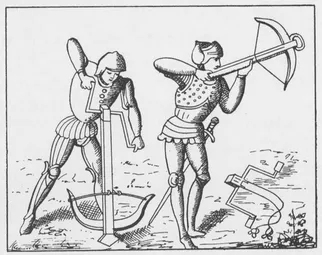
FIG. 2.—CROSSBOWMEN.
The soldiers carry windlass crossbows. One man is winding up his weapon; the other is shooting, with his windlass laid on the ground at his feet.
From Manuscript, Froissart‘s Chronicles.’
The Genoese were always famed for their skill in the construction and management of crossbows, and were hired for service by sea and land by all nations on the Continent. They are said to have used these weapons with success, even as early as 1099 at the siege of Jerusalem. In the naval engagement near Sluys, in Holland, where Edward III. defeated the French in 1340, the latter had as many as 20,000 Genoese crossbowmen on their ships, and the largest numbers of crossbowmen ever seen in order of battle on land, were probably the 15,000 Genoese who, according to Froissart,3 formed the front rank of the French army at Crécy in 1346. It is asserted by numerous historians, all of whom derive their information on the subject from a cursory statement by the second continuator of William of Nangis,4 that the crossbowmen at Crécy were unable to shoot with effect, because the strings of their weapons were slack owing to the great storm of rain that set in just before the battle. Muratori,5 the Italian antiquary, declares that the ground at Crécy was so boggy that the crossbowmen could not stand firm when they endeavoured to stretch the strings of their weapons; but as the field of Crécy consists of rather steep downs, and not of lowland, it is not probable that the state of the ground impeded the crossbowmen.
Although much doubt has been thrown on the statement that the crossbows of the Genoese failed to act on this occasion, owing to their strings being slackened by wet weather, it is possible that the incident occurred, without, however, in any measure influencing the result of the battle.
The strings might easily have been rendered less effective than usual by the heavy rain that fell just before the battle, and by the bright sun which is known to have succeeded the rain.
This combination of water and heat would certainly relax in some degree the strings of the crossbows used at the time of Crécy, if they were uncovered, and would make the strings too loose to be of good service, till they could be removed from the bows in order to be shortened by twisting, and then replaced; all of which would entail, of course, time and care.
It should be remembered that the bows of the Genoese crossbowmen at Crécy were doubtless composite ones, made of wood, horn, sinew, and glue, bows of steel being of later introduction.
The composite bow was straight, hence its bow-string was fixed to it in a necessarily rather slack condition; for this reason the threads composing its string, being more or less detached, were liable to absorb moisture.
On the other hand, the threads that composed the tightly strained string of a steel crossbow, lay closely packed together, and as in this case the string was always thickly smeared, both inside and outside, with beeswax to preserve it, it was impervious to water.
To test the matter, I have sunk a steel crossbow in a tank of water for a day and a night and have found no appreciable alteration in the tightness of its string. I have also placed in water a crossbow with a comparatively loose string—such as those which I believe were used by the Genoese at Crécy—and found that after half an hour’s submersion, the application of a lever to bend the bow caused the string subsequently to stretch down the stock an inch further than its proper position, its tautness, and consequent effectiveness, thus being lost.
The supposition that the crossbows of the Genoese at Crécy had bows of wood, or of wood and horn, is confirmed in a curious way by David-ap-Gwilym, a famous Welsh bard and archer of the fourteenth century. In one of his poems, the bard refers to a soldier who had sailed with Edward III. to fight at Crécy, and whom he had cause to hate, as he had supplanted the poet in the affections of his mistress. The poet calls upon the enemy to shoot his more fortunate rival, with the ‘arbalest’ or short stirrup stick. The translation of this passage, as rendered by A. J. Johns (the italics are mine), runs:
And thou crossbowman true and good,
Thou shooter with the faultless wood,
Haste with thy stirrup-fashioned bow
To lay the hideous varlet low.
Thou shooter with the faultless wood,
Haste with thy stirrup-fashioned bow
To lay the hideous varlet low.
As further proof that at Crécy the Genoese did not use the powerful steel crossbow which was bent by a windlass, I quote the following extract from Viollet-le-Duc (Dictionnaire raisonné du Mobilier français. Paris 1868—75). ‘John ...
Table of contents
- DOVER BOOKS ON HISTORY, POLITICAL AND SOCIAL SCIENCE
- Title Page
- Copyright Page
- PREFACE
- Table of Contents
- Table of Figures
- PART I - THE HISTORY OF THE CROSSBOW WITH NOTES COMPARATIVE ON THE LONGBOW, SHORTBOW, AND HANDGUN
- PART II - THE CONSTRUCTION AND MANAGEMENT OF CROSSBOWS
- PART III. - THE CONSTRUCTION AND MANAGEMENT OF CROSSBOWS (Continued)
- PART IV. - A TREATISE ON THE SIEGE ENGINES USED IN ANCIENT AND MEDIÆVAL TIMES FOR DISCHARGING GREAT STONES AND ARROWS
- INDEX - The numerals in parentheses refer to periods and dates
- APPENDIX - CONTENTS OF THE APPENDIX
- A TREATISE ON TURKISH AND OTHER ORIENTAL BOWS OF MEDIÆVAL AND LATER TIMES
Trusted by 375,005 students
Access to over 1.5 million titles for a fair monthly price.
Study more efficiently using our study tools.
Frequently asked questions
Yes, you can cancel anytime from the Subscription tab in your account settings on the Perlego website. Your subscription will stay active until the end of your current billing period. Learn how to cancel your subscription
No, books cannot be downloaded as external files, such as PDFs, for use outside of Perlego. However, you can download books within the Perlego app for offline reading on mobile or tablet. Learn how to download books offline
Perlego offers two plans: Essential and Complete
- Essential is ideal for learners and professionals who enjoy exploring a wide range of subjects. Access the Essential Library with 800,000+ trusted titles and best-sellers across business, personal growth, and the humanities. Includes unlimited reading time and Standard Read Aloud voice.
- Complete: Perfect for advanced learners and researchers needing full, unrestricted access. Unlock 1.5M+ books across hundreds of subjects, including academic and specialized titles. The Complete Plan also includes advanced features like Premium Read Aloud and Research Assistant.
We are an online textbook subscription service, where you can get access to an entire online library for less than the price of a single book per month. With over 1.5 million books across 990+ topics, we’ve got you covered! Learn about our mission
Look out for the read-aloud symbol on your next book to see if you can listen to it. The read-aloud tool reads text aloud for you, highlighting the text as it is being read. You can pause it, speed it up and slow it down. Learn more about Read Aloud
Yes! You can use the Perlego app on both iOS and Android devices to read anytime, anywhere — even offline. Perfect for commutes or when you’re on the go.
Please note we cannot support devices running on iOS 13 and Android 7 or earlier. Learn more about using the app
Please note we cannot support devices running on iOS 13 and Android 7 or earlier. Learn more about using the app
Yes, you can access The Book of the Crossbow by Ralph Payne-Gallwey in PDF and/or ePUB format, as well as other popular books in History & Military & Maritime History. We have over 1.5 million books available in our catalogue for you to explore.