Etching, Engraving and Other Intaglio Printmaking Techniques
eBook - ePub

Etching, Engraving and Other Intaglio Printmaking Techniques

  1. 240 pages
  2. English
  3. ePUB (mobile friendly)
  4. Available on iOS & Android
eBook - ePub

Etching, Engraving and Other Intaglio Printmaking Techniques

About this book

Intaglio printmaking involves engraving or incising a figure in stone or other hard material to obtain an impression from the subsurface design. In this thorough handbook, a noted printmaker and teacher offers complete up-to-date coverage of etching, engraving, drypoint, and other well-known intaglio techniques, as well as such less-familiar methods as tuilegraphs, collagraphs, and transfers.
The first part of the book is devoted to a thorough introduction to materials and tools, printing equipment, papers, presses—even how to set up your workshop for maximum safety and efficiency. In Part Two, the author proceeds to a detailed discussion of etching techniques, including formulas for grounds and inks, aquatint, white ground, hard ground, soft ground, sugar lift, and acids.
Once familiar with basic etching techniques, the student is then given precise illustrated instructions in printing techniques, including basic printing, double intaglio printing (the author's own method); color printing and embossing, the viscosity method, and viscosity and aquatint. For each procedure, clear, step-by-step directions cover the process itself, materials and equipment required, and cleanup. An especially helpful "what went wrong" section at the end of each chapter diagnoses problems and offers solutions.
In Part 4 Ms. Leaf details other mediums and methods: drypoint, notable for its characteristic velvety dark lines; engraving, one of the earliest forms of expression known to man, dating back to prehistoric times; collagraphs, plates made in the same way as collages and then printed; and the Blake Transfer Method, adapted from a technique developed by the English artist and poet William Blake (1757–1827).
A final Appendix treats such ancillary topics as framing and matting prints, storage, agents, and where to sell and show your work. Enhanced with over 220 illustrations, including works by Rembrandt, Callot, Dürer, Goya, and Brueghel, and a wealth of illustrative figures and photographs, this precise and detailed manual belongs at the side of any serious printmaker, novice, or ink-stained veteran.
"Excellent, comprehensive . . . superbly organized." — AB Bookman's Weekly.
Frequently asked questions

Yes, you can cancel anytime from the Subscription tab in your account settings on the Perlego website. Your subscription will stay active until the end of your current billing period. Learn how to cancel your subscription.
No, books cannot be downloaded as external files, such as PDFs, for use outside of Perlego. However, you can download books within the Perlego app for offline reading on mobile or tablet. Learn more here.
Perlego offers two plans: Essential and Complete
  • Essential is ideal for learners and professionals who enjoy exploring a wide range of subjects. Access the Essential Library with 800,000+ trusted titles and best-sellers across business, personal growth, and the humanities. Includes unlimited reading time and Standard Read Aloud voice.
  • Complete: Perfect for advanced learners and researchers needing full, unrestricted access. Unlock 1.4M+ books across hundreds of subjects, including academic and specialized titles. The Complete Plan also includes advanced features like Premium Read Aloud and Research Assistant.
Both plans are available with monthly, semester, or annual billing cycles.
We are an online textbook subscription service, where you can get access to an entire online library for less than the price of a single book per month. With over 1 million books across 1000+ topics, we’ve got you covered! Learn more here.
Look out for the read-aloud symbol on your next book to see if you can listen to it. The read-aloud tool reads text aloud for you, highlighting the text as it is being read. You can pause it, speed it up and slow it down. Learn more here.
Yes! You can use the Perlego app on both iOS or Android devices to read anytime, anywhere — even offline. Perfect for commutes or when you’re on the go.
Please note we cannot support devices running on iOS 13 and Android 7 or earlier. Learn more about using the app.
Yes, you can access Etching, Engraving and Other Intaglio Printmaking Techniques by Ruth Leaf in PDF and/or ePUB format, as well as other popular books in Art & Art Techniques. We have over one million books available in our catalogue for you to explore.

Information

eBook ISBN
9780486139241
Topic
Art

PART ONE

General Information

e9780486139241_i0004.webp
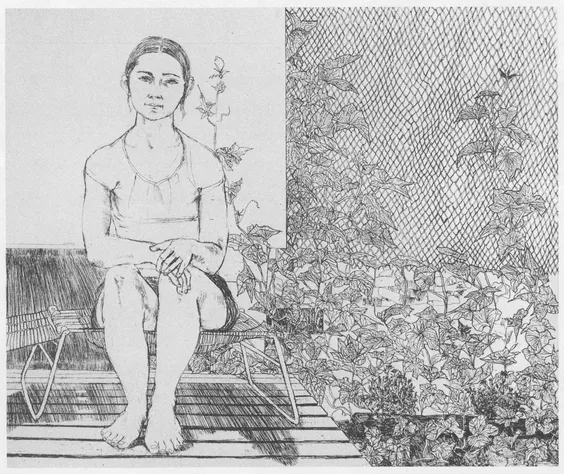
Barbara and the Cucumbers by Ruth Leaf. Hard ground. 20” × 24”.
e9780486139241_i0005.webp
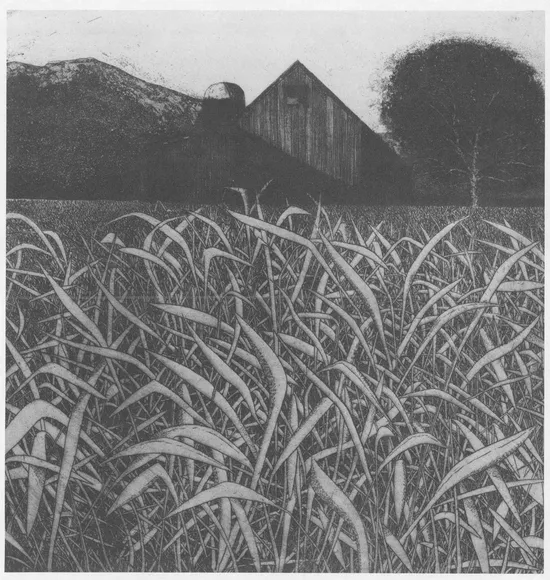
Summer Field by Bob Kuzyn. Intaglio and engraving, 20” × 20”.

ONE

Materials and Equipment

One of the most exciting aspects of printmaking is the great number of materials and pieces of equipment that you can use. There are, of course, certain things such as metal plates and acids that are indispensable—I describe them here so that you’ll be able to work with them in later chapters. (See Supplies and Suppliers for information on where to buy these materials.)
However, you’re not limited to the materials and equipment which I list. As you print, you may often discover new ways to use old objects—a scrap of lace may give you the texture you want, or spray paint may give you the fine aquatint you need.

PLATES

You can use many different kinds of plates when you print—plates can be made of metal, plastic, Masonite, vinyl, asbestos, and other materials. With the different materials you can achieve different effects.

Zinc. Zinc is the metal most commonly used for etching plates since zinc is easier to work with than steel and less expensive than copper. You’ll usually use nitric acid to etch zinc plates, the backs of which are coated with an acid-resistant material so the acid cannot react with the back surface of the plate.
When you etch a zinc plate, you can use any of the grounds described in this book. You can also use this kind of plate for engraving, although the burin will tend to slip: a sheet of zinc is not uniformly hard. Also, zinc is softer and coarser in structure than copper, the best metal to use for engraving.
You can buy zinc plates of .062 to 16 or 18 gauge. The 16 or 18 gauge is a standard commercial size and is therefore more easily obtained, although there are many other gauges—thicknesses—to choose from.
Finally, remember that zinc affects certain colors—yellow ink will turn greenish, and all other light colors such as white will turn slightly gray.

Steel. Polished or commercial grade mild steel—cold roll-.062 to 16 gauge is the best kind of steel to use for etching. You can pull many more prints on an etched or engraved steel plate than on a copper or zinc plate because steel is so much harder—lines and aquatints will wear down and hold less and less ink faster on copper and zinc than on steel. However, steel is very difficult to polish or scrape. Unless you purchase an already polished plate, your print will invariably have a darker tone than a print from a zinc plate bitten in the same manner. And if you want to remove scratches from the plate’s surface, you’ll have a very difficult time scraping them out.
The backs of steel plates are not usually acid-proof when purchased. Before placing a steel plate in acid—nitric acid—coat the back with a stopout solution, spray paint, or contact paper (see Chapter 12). Use any ground on a steel plate that you would use on a zinc plate, and also try using steel for engravings or drypoints.

Copper. The copper you use for etching and engraving should be cold-rolled, 16 or 18 gauge, and hard rather than soft. Soft copper, used for enameling, is less expensive.
The harder the copper, the better. Remember that rolled copper crystalizes in the direction in which it was rolled and will be harder in that direction. A hammered copper plate would be hard in all directions, but unfortunately, these plates are no longer available. Old copper plates, if you can find them, are as hard as hammered copper because copper crystalizes with time. Also, photoengravers work on copper plates-if you can find some of their used plates, polish the backs and use them.
Copper is very good for engraving and drypoint, as well as for etching. When you etch with copper use Dutch mordant, a solution that is made with hydrochloric acid. You can get very fine lines on a copper plate with hard ground. Soft ground, lift ground, and aquatint may also be used. Don’t, however, use white ground on copper.
Copper plates can be purchased with an acid-resistant coating on the back surface. If the plate is not coated, apply a stopout solution to the back of the plate before you put it into the acid.
When you print with color on copper, note that the copper will interact chemically with vermilion. You can use any other color, in general, without trouble.

Brass. Brass plates are more expensive than zinc, are etched with Dutch mordant, and don’t come with a acid-resistant coating on the back surface. They can be used in the same manner as copper plates.

Plastic. You can use plates made of Plexiglas, Lucite, or acetate for engravings and drypoints, but not for etching. Plastic plates are less expensive than metal, and they have the advantage of being transparent—you can place your plate directly over a drawing and engrave by tracing the design.
You can sand the surface of the plastic to give your prints some tone. For a variety of lines, try using a power tool to carve into the plate. Finally, remember that plastic scratches easily, so handle it carefully.

Masonite. Masonite can be carved with woodcutting tools and printed just like a metal plate. Or, you can use it as a base for a collagraph (see Chapter 20).

Vinyl Asbestos Tiles. These are the plates used in making tuilegraphs (see Chapter 21). The tiles are manufactured in three sizes: 9” × 18”, 9” × 9”, and 12” × 12”. They come in many colors and textures, some of which can be used for printing reliefs or intaglios. You’ll find that the light-colored, non-textured tile is the easiest to work with and draw on.

GROUNDS

Grounds are substances used to coat all or part of the plate’s surface. Some—such as hard ground, soft ground, and white ground—act as a stopout solution, an acid-resist. Other grounds—such as lift ground and aquatint—are used with stopouts to create the image on the plate. See Chapters 6, 7, 8, 9, 10, and 11 for further information.
Keep all of your grounds in containers with tight covers to keep dirt and metal particles out and to prevent the solvent in the grounds from evaporating. If the solvent evaporates, the remaining ground becomes hard.
Hard and soft grounds are both used with brushes kept in separate coffee cans
e9780486139241_img_8531.gif
full of varnolene (see Figure 1). Thus you can use the brush at any time. Don’t put the soft ground brush into the hard ground or vice versa. If, by mistake, you put the hard ground brush into the soft ground, clean the brush with varnolene and then wash it very thoroughly with mild soap and cold water. If you put the soft ground brush into the hard ground, skim off the surface of the hard ground to make sure that no soft ground remains. Clean the brush with varnolene, but don’t use soap and water.

ACIDS AND CHEMICALS

You’ll use acids to bite metal plates, and you’ll need various chemicals to make biting solutions (see Figure 2). Different acids react with different plates. Never put two plates of different metals in the same acid bath either at the same time or at different times. If you do, the acid will act as a conductor, depositing, for instance, zinc on steel and steel on zinc, and you’ll have to throw out both plates and the solution.

Nitric Acid. Combine ACS commercial grade nitric acid with water to bite zinc and steel plates. You can also use this acid to bite copper if you want a very rough bite.

...

Table of contents

  1. Title Page
  2. Copyright Page
  3. Dedication
  4. Acknowledgments
  5. Table of Contents
  6. Introduction
  7. PART ONE - General Information
  8. PART TWO - Etching Techniques
  9. PART THREE - Printing Techniques
  10. PART FOUR - Other Mediums and Methods
  11. PART FIVE - Appendix
  12. Things Every Printmaker Should Know and Doesn’t Know Whom to Ask
  13. Glossary
  14. Supplies and Suppliers
  15. Bibliography
  16. Index