HISTORICAL BACKGROUND
THE EARLY HOUSEWIVES of America, like their counterparts abroad, all lived in close affiliation with Nature, for tending their herb gardens must have promoted just such a relationship. As will be evident in the variety of recipes which follow, our grandmothers—and theirs—found countless ways in which to utilize herbs. The herb garden was an essential adjunct to the farmstead. One can imagine the delight with which these early homemakers set out their herb gardens, for they knew well three important uses to which these plants could be put—medicinal, culinary, and for their aromatic fragrance.
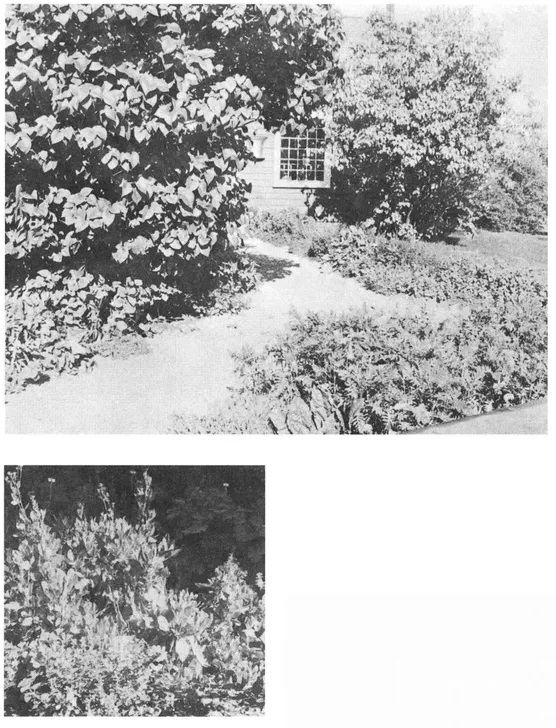
Those gardens which were carefully planned were most attractive. With relatively little effort an herb garden could be planted that would vie with any flower garden.
A number of writers on gardens and gardening had helpful suggestions as to planning. Hyll in 1577, Surflet in 1616, Lawson the following year, Blake in 1664, and Langley in 1728 all provided such information. Thomas Hyll in The Gardeners Labyrinth (1577) lists a great many herbs which should be grown, and says, “What rarer object can there be on earth, (the motions of the Celestial bodies except) than a beautiful and Odoriferous Garden plot Artificially composed. . . . But now to my Garden of Flowers and Sweet Hearbs and first the Rose. . . . Of all the flowers in the Garden, this is the chief for beauty and sweetness.” Richard Surflet in his Maison Rustique (1600) suggests that “The Garden shall be divided into two equall parts. The one shall containe the hearbes and flowers used to make nosegaies and garlands. . . . . .
The other part shall have all the sweet-smelling hearbes, whether they be such as beare no flowers, or if they beare any, yet they are not put in Nosegaies alone, but the whole hearbe with them. . . . and this may be called the Garden for hearbes of a good smell.”
Lawson in his Country House-wifes Garden (1617) points out that “the number of formes, mazes and knots is so great and men are so diversely delighted, that I leave every House-wife to herselfe, especially seeing to set down many, had been but to fill much paper; yet lest I deprive her of all delight and direction, let her view these few choyse, new formes and note this generall, that all plots are square, and all are bordered about with Privet, Raisins, Feaberries, Roses, Thorns, Rosemary, Bee-flowers, Isop, Sage or suchlike.”
Lawson explains why it is necessary to have two sorts of gardens. “Herbs are of two sorts, and therefore it is meet (they requiring divers manners of Husbandry) that we have two Gardens; a Garden for flowers, and a Kitchin garden; or a Summer garden: not that we mean so perfect a distinction, that we mean the Garden for flowers should or can be without herbs good for the Kitchin, or the Kitchin garden should want flowers, nor on the contrary; but for the most part they would be severed: first, because your Garden-flowers shall suffer some disgrace, if among them you intermingle Onions, Parsnips, etc.” William Lawson adds, “Though your Garden for flowers doth in a sort peculiarly challenge to itself a perfect, and exquisite form to the eyes, yet you may not altogether neglect this, where your herbs for the pot do grow: And therefore some here make comely borders with the herbs aforesaid; the rather, because abundance of Roses and Lavender, yield much profit and comfort to the senses: Rosewater, Lavender, the one cordial (as also the Violets; burrage (borage) and Bugloss) the other reviving the spirits by the sense of smelling, both most durable for smell, both in flowers and water.
Stephen Blake in The Compleat Gardener’s Practise, (1664), mentions a few patterns or designs for gardens but urges the gardener to create his own, “which probably may please your fancy better than mine.” One of the designs which appeared in Blake’s book was a favorite called “the Lover’s Knot.” Underneath it, he wrote:
Here I have made the true Lovers Knott
To try it in Mariage was never my Lott.
It is obvious from the writings of Batty Langley in his New Principles of Gardening, (1728), that he did not find attractive the formal designs of parterres and knots. “Since the pleasure of a Garden depends on the variety of its parts, ’tis therefore that we should well consider of their disposition to present new and delightful scenes at every step which regular Gardeners are incapable of doing. Nor is there anything more shocking than a stiff regular Garden; where, after we have seen one quarter thereof the same is repeated.”
There are interesting listings of available and desirable herbs in England in the late sixteenth and early seventeenth centuries. In 1577, Hyll lists angelica, anise, chamomile, clary, costmary, Dutchbox, elecampane, fennel, feverfew, hyssop, lovage, marjoram, mints, rosemary, rue, sage, savory, tansy, and thyme.
Richard Surflet in his Maison Rustique, (1600), includes among his herb listing: anise, balm, basil, chamomile, costmary, Good King Henry, horehound, hyssop, jasmin, lavender, marjoram, mints, mugwort, nepeta, pellitory, pennyroyal, rosemary, rue, sage, savory, southernwood, sweet balm, tansy, thyme, wild marjoram, and worm-wood.
William Lawson in The Country House-wife’s Garden, (1617), notes bee-flowers (borage), clove-gilliflowers, cowslips, daisies, hyssop, lavender, lilies, pinks, rosemary, roses, sage, southernwood, and thyme, thus including also a number of herbs as well as “ roses”.
Four years prior to Lawson’s publication, Markham in his English Husbandman suggests, “Germander, Issope, Pinke-gilly flowers, Time, but of all hearbes Germander is the most principallest best for this purpose.”
Dr. Catherine Fennelly, editor of the Old Sturbridge Village Booklet Series, and Rudy Favretti in one of these booklets entitled, Early New England Gardens concur as to those herbs known to have been available in New England prior to 1800. Included in their listing are the following: anise, angelica, balm, sweet basil, borage, catmint, camomile, chervil, chicory, chives, clary (Salvia sclarea), coriander, costmary, dill, fennel, horehound, hyssop, marjoram, mustard, parsley, pennyroyal, pepper-grass, purslane, rosemary, rue, sage, winter savory, sorrel, tansy, thyme, teasel, watercress, woad, wormwood.
One would do well today to duplicate such an early New England garden or at least have an herb border or a delightfully scented “Lavender Walk.” Guests will never cease to be charmed by the beauty of the soft mauve blossoms backed by the silver leaves and their beautiful spikes, as they exude their exquisite scent in an early fall evening—re—calling other evenings long ago!
John Winthrop did just that, when he recalled memories of old England as he remarked in his Journal, “And there came a smell off the Shore like the Smell of a Garden.”
If one examines the early Plymouth records, assignment of mesesteads and garden plots will be noted. Surflet refers to just such a delight, when he writes of the “Garden for hearbes of a good smell,” in his Maison Rustique, (1600).
No one housewife was likely to grow all herbs known to exist in the early days. Her basic ones were probably mint, sage, parsley, thyme, and marjoram, for they were easy to grow and had so many culinary uses.
Curious folklore has come down through the ages regarding some herbs. For example, sage is supposed to grow well only where “the woman rules”—perhaps the supposed hen-pecked husband was consoled when he detected its flavour in the turkey stuffing. To transplant parsley meant bad luck, so this had to be grown from seed, planted very deep, “for it must visit the ‘nether’ regions three times to obtain permission to grow in the earth.” Hyssop, said to “avert the Evil Eye,” was also an attractive and aromatic herb to be included in the garden.
The mandrake, or May apple, was supposed to bring good fortune, if it were left untouched for three days, then soaked in warm water which was later sprinkled over the household and farm belongings. This practice was performed four times a year. In between dunking ceremonies, the dry herb was kept wrapped in a silk cloth among one’s best possessions. The demand for mandrake became so great, that the basic herb began to be transformed commercially into various forms and figures. Someone thought of planting grass seed in the root’s top to make hair for a mandrake’s head. Despite the fake, man-made, mandrake figures, people continued to consider them good luck and went on purchasing them. Herbalists like William Turner were disgusted. In 1568, he wrote, “The rootes which are conterfited and made like little puppettes and mammettes, which come to be sold in England in boxes with heir, and such forme as a man hath, are nothying elles but folishe feined trifles, and not naturall. For they are so trymmed of crafty theves to mocke the poor people with all, and to rob them both of theyr wit and theyr money.”
Gerard in 1597 shows his disgust, also, when he criticizes those “idle drones that have little or nothing to do but eate and drinke” and have dedicated “some of their time in carving the roots of Brionie forming them to the shape of men and women.”
In 1710, Dr. Salmon adds, “Sometimes (tho not often) three of those Roots have been observed, which some by Transplanting have Occasionally cut off for humor or admiration sake, and to amuse Fools . . . ”
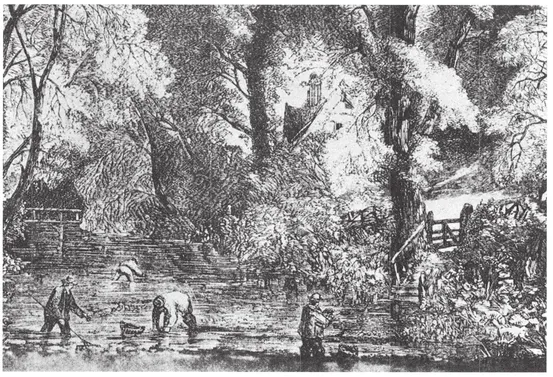
Plate 3. “Gathering Watercresses,” reproduced from the March 1864 issue of Peterson’s Magazine.
Gerarde wrote in his herbal (1597), “But this is to be reckoned among the old wives fables . . . touching the gathering of Spleene-woort in the night, and other most vaine things, which are founde heere and there scattered in the old writers books from which most of the later writers do not abstaine, who many times fill up their pages with lies and frivolous toies, and by so doing do not a little deceive yoong students.”
Despite all the folk lore and unavailability of all the herbs she may have wanted, nevertheless in those days when womenfolk lived very busy but often lonely lives, their herb gardens were a source of pleasant recreation as well as a supply of vital medicinal and culinary ingredients.