In the 1920s, fashion magazines were the principal source for news of the latest Paris couture. One of the most famous and long-lived of these journals was L'Art et la Mode, published from 1880 to 1967. L'Art et la Mode captured the glamor that was Paris in the Twenties, from days at the races to nights at the opera, from Sundays at the Ritz to Saturdays at the Folies-Bergère, and it followed the glittering circuit that flourished from Longchamps to Deauville to Cannes to Biarritz. The magazine was read avidly not only by the rich who patronized the couture, but also by the woman who relied on her "little dressmaker" to copy the styles depicted in the periodical.
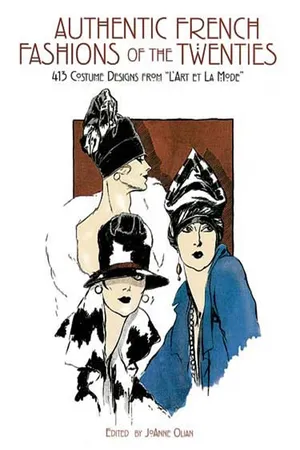
This lavishly illustrated volume offers 138 dazzling pages from L'Art et la Mode featuring fashions for all occasions by the great French couturiers of the Twenties—Patou, Worth, Molyneux, Doucet, Paquin, Vionnet, Lanvin, and Chanel among them. Selected by JoAnne Olian, curator of the famed Costume Collection at the Museum of the City of New York, a wealth of designs include stylish outfits for winter sports, hunting season, tennis, golf, and other athletic pursuits, as well as high-fashion ensembles for soirées and all manner of chic divertissements.
In addition to choosing the plates, Ms. Olian has also provided an excellent introduction discussing the magazine, the period, and its fashion trends. The result is a beautifully illustrated, sumptuous look back at one of haute couture's most influential decades. It is also an outstanding and inexpensive source of copyright-free fashion illustrations for use by designers and craftspeople.
eBook - ePub
Authentic French Fashions of the Twenties
413 Costume Designs from "L'Art Et La Mode"
- 144 pages
- English
- ePUB (mobile friendly)
- Available on iOS & Android
eBook - ePub
About this book
Information
Topic
DesignSubtopic
Fashion DesignINTRODUCTION
The glossy fashion magazines of today trace their origins to the costume books of the sixteenth century, when voyages of exploration and discovery created an avid curiosity about the constantly widening world. So popular was the subject that these books were published all over Europe, but principally in Venice and Germany. The first such volume appeared in 1562 in Paris. Unlike modern publications, these books did not predict fashion, but depicted foreign dress and described the customs and manners of both the Old and the New World.
In the second half of the seventeenth century the focus shifted to France, where Jean-Baptiste Colbert, finance minister of Louis XIV, determined to build a strong economy, and, cognizant of the national predilection for fashion and luxury, based one aspect of this ambitious program on the manufacture of French textiles, instituting steep protective tariffs, prohibiting the wearing of foreign silks and establishing over 100 factories under crown patronage. The results of these measures were strikingly evident at the palace of Versailles, the showcase of the Sun King.
Court fashions appeared in Le Mercure Galant, but it was not until the last quarter of the eighteenth century, in response to the insatiable contemporary demand for novelty, that Galerie des Modes initiated new styles fresh from the dressmakers. Published from 1778 to 1787, it depicted the mercurial fashions of a society so obsessed with style and change that Abigail Adams, in a letter from Paris, wrote, “To be out of fashion is more criminal than to be seen in a state of nature—to which the Parisians are not averse.”
In the nineteenth century, fashion periodicals, embraced by a growing middle class, proliferated rapidly. From 1840 to 1870 over 100 new magazines appeared in England, Germany and America as well as France. Adhering to a more or less uniform format, they covered social events, published new works of fiction and poetry, offered ideas for needlework projects and provided both color plates and black-and-white engravings of the latest fashions, which were invariably French.
The virtually simultaneous appearance on the fashion scene of Charles Frederick Worth and the Empress Eugénie assured permanent supremacy for French fashion. By her endorsement of Worth in the late 1850s, Eugénie was indirectly responsible for the creation of the haute-couture industry. Emperor Napoleon III, in the tradition of Louis XIV, limited the wearing of a gown at court to a single occasion, keeping mills and seamstresses busy producing a stream of novelties for a nouveau-riche society to wear to the palace of the Tuileries. As principal dressmaker to the glittering court of the Second Empire, Worth was responsible for the extravagant, hoop-skirted opulence of the Empress, who, by imperial command, dressed exclusi...
Table of contents
- DOVER BOOKS ON FASHION
- Title Page
- Copyright Page
- Table of Contents
- INTRODUCTION
Trusted by 375,005 students
Access to over 1.5 million titles for a fair monthly price.
Study more efficiently using our study tools.
Frequently asked questions
Yes, you can cancel anytime from the Subscription tab in your account settings on the Perlego website. Your subscription will stay active until the end of your current billing period. Learn how to cancel your subscription
No, books cannot be downloaded as external files, such as PDFs, for use outside of Perlego. However, you can download books within the Perlego app for offline reading on mobile or tablet. Learn how to download books offline
Perlego offers two plans: Essential and Complete
- Essential is ideal for learners and professionals who enjoy exploring a wide range of subjects. Access the Essential Library with 800,000+ trusted titles and best-sellers across business, personal growth, and the humanities. Includes unlimited reading time and Standard Read Aloud voice.
- Complete: Perfect for advanced learners and researchers needing full, unrestricted access. Unlock 1.5M+ books across hundreds of subjects, including academic and specialized titles. The Complete Plan also includes advanced features like Premium Read Aloud and Research Assistant.
We are an online textbook subscription service, where you can get access to an entire online library for less than the price of a single book per month. With over 1.5 million books across 990+ topics, we’ve got you covered! Learn about our mission
Look out for the read-aloud symbol on your next book to see if you can listen to it. The read-aloud tool reads text aloud for you, highlighting the text as it is being read. You can pause it, speed it up and slow it down. Learn more about Read Aloud
Yes! You can use the Perlego app on both iOS and Android devices to read anytime, anywhere — even offline. Perfect for commutes or when you’re on the go.
Please note we cannot support devices running on iOS 13 and Android 7 or earlier. Learn more about using the app
Please note we cannot support devices running on iOS 13 and Android 7 or earlier. Learn more about using the app
Yes, you can access Authentic French Fashions of the Twenties by JoAnne Olian in PDF and/or ePUB format, as well as other popular books in Design & Fashion Design. We have over 1.5 million books available in our catalogue for you to explore.