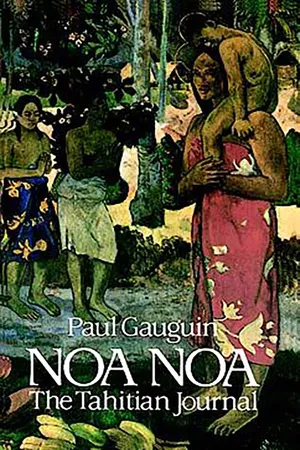
Paul Gauguin fled what he called "filthy Europe" in 1891 to what he hoped would be an unspoiled paradise, Tahiti. He painted 66 magnificent can vases during the first two years he spent there and kept notes from which he later wrote Noa Noa — a journal recording his thoughts and impressions of that time.
Noa Noa — the most widely known of Gauguin's writings — is reproduced here from a rare early edition (1919), in a lucid translation capturing the artist's unpretentious style. Page after page reveals Gauguin's keen observations of Tahiti and its people, and his passionate struggle to achieve the inner harmony he expressed so profoundly on canvas. Gauguin's prose is as seductive as his paintings, filled with descriptions of warm seas, hidden lagoons, lush green forests, and beautiful Maori women.
The journal is captivating reading, offering a compelling autobiographical fragment of the soul of a genius and a rare glimpse of Oceanian culture. The brief periods of happiness Gauguin found among the Tahitians are eloquently expressed in his narrative. We understand the motives that drove him and gain a deeper appreciation of his art.
Today the manuscript provides unparalleled insight into Gauguin's thoughts as he strove to achieve spiritual peace, and into the wellsprings of a singular artistic style which changed the course of modern art. This wonderfully affordable edition — enhanced by 24 of Gauguin's South Seas drawings — makes a unique and passionate testament accessible to all art lovers.
- 96 pages
- English
- ePUB (mobile friendly)
- Available on iOS & Android
eBook - ePub
About this book
Information
Topic
ArtSubtopic
Artist Monographs“Dites, qu’avez-vous vu?”
On the eighth of June, during the night, after a sixty-three days’ voyage, sixty-three days of feverish expectancy, we perceived strange fires, moving in zigzags on the sea. From the somber sky a black cone with jagged indentions became disengaged.
We turned Morea and had Tahiti before us.
Several hours later dawn appeared, and we gently approached the reefs, entered the channel, and anchored without accidents in the roadstead.
The first view of this part of the island discloses nothing very extraordinary; nothing, for instance, that could be compared with the magnificent bay of Rio de Janeiro.
It is the summit of a mountain submerged at the time of one of the ancient deluges. Only the very point rose above the waters. A family fled thither and founded a new race—and then the corals climbed up along it, surrounding the peak, and in the course of centuries builded a new land. It is still extending, but retains its original character of solitude and isolation, which is only accentuated by the immense expanse of the ocean.
Toward ten o’clock I made my formal call on the governor, the negro Lacascade, who received me as though I had been an important personage.
I owed this distinction to the mission with which the French government—I do not know why—had entrusted me. It was an artistic mission, it is true. But in the view of the negro, however, this word was only an official synonym for espionage, and I tried in vain to undeceive him. Every one about him shared this belief, and when I said that I was receiving no pay for my mission no one would believe me.
Life at Papeete soon became a burden.
It was Europe—the Europe which I had thought to shake off—and that under the aggravating circumstances of colonial snobbism, and the imitation, grotesque even to the point of caricature, of our customs, fashions, vices, and absurdities of civilization.
Was I to have made this far journey, only to find the very thing which I had fled?
Nevertheless, there was a public event which interested me.
At the time King Pomare was mortally ill, and the end was daily expected.
Little by little the city had assumed a singular aspect.
All the Europeans, merchants, functionaries, officers, and soldiers, laughed and sang on the streets as usual, while the natives with grave mien and lowered voice held converse among themselves in the neighborhood of the palace. In the roadstead there was an abnormal movement of orange sails on the blue sea, and often the line of reefs shone in a sudden silvery gleam under the sun. The natives of neighboring islands were hastening hither to attend at the last moments of their king, and at the definite taking possession of their empire by France.
By signs from above they had had report of this, for whenever a king was about to die the mountains in certain places became covered with dark spots at the setting of the sun.
The king died, and lay in state in the palace in the uniform of an admiral.
There I saw the queen, Maraü—such was her name—decorating the royal hall with flowers and materials. When the director of public works asked my advice about the artistic arrangements of the funeral, I pointed out the queen to him. With the beautiful instinct of her race she dispersed grace everywhere about her, and made everything she touched a work of art.
I understood her only imperfectly at this first meeting. Both the human beings and the objects were so different from those I had desired, that I was disappointed. I was disgusted by all this European triviality. I had disembarked too recently yet to distinguish how much of nationality, fundamental realness, and primitive beauty still remained in this conquered race beneath the artificial and meretricious veneer of our importations. I was still in a manner blind. I saw in this queen, already somewhat mature in years, only a commonplace stout woman with traces of noble beauty. When I saw her again later, I revised my first judgment. I fell under the spell of her “Maori charm.” Notwithstanding all the intermixture, the Tahitian type was still very pure in her. And then the memory of her ancestor, the great chief Tati, gave her as well as her brother and all her family an appearance of truly imposing grandeur. She had the majestic sculptural form of her race, ample and at the same time gracious. The arms were like the two columns of a temple, simple, straight; and the whole bodily form with the long horizontal line of the shoulder, and the vast height terminating above in a point, inevitably made me think of the Triangle of the Trinity. In her eyes there sometimes burned something like a vague presentiment of passions which flared up suddenly and set aflame all the life round about. Perhaps it is thus that the island itself once rose from the ocean, and that the plants upon it burst into flower under the first ray of the sun . . . .
All the Tahitians dressed in black, and for two days they sang dirges of grief and laments for the dead. It seemed to me that I was listening to the Sonata Pathétique.
Then came the day of the funeral.
At ten in the morning they left the palace. The troops and the authorities were in white helmet and black dress-coat, the natives in their mourning costume. All the districts marched in order, and the leader of each one bore a French flag.
At Aruë they halted. There an indescribable monument rises—a formless mass of coral stones bound together by cement. It forms a painful contrast with the natural decorative beauty of vegetation and atmosphere.
Lacascade pronounced a discourse of conventional pattern, which an interpreter translated for the benefit of the Frenchmen present. Then the Protestant clergyman delivered a sermon to which Tati, the brother of the queen, responded. That was all. They left; the functionaries crowded into the carriages. It reminded one somewhat of a “return from the races. ”
In the confusion on the way the indifference of the French set the key, and the people, since a number of days so grave, recovered their gayety. The vahinas again took the arms of their tanés, chattered actively, and undulated their hips, the while their strong bare feet stirred up heavily the dust of the road.
Close to the river Fatü, there was a general scattering. Concealed among the stones the women crouched here and there in the water with their skirts raised to waist, cooling their haunches and legs tired from the march and the heat. Thus cleansed with the bosom erect and with the two shells covering the breasts rising in points under the muslin of the corsage, they again took up the way to Papeete. They had the grace and elasticity of healthy young animals. A mingled perfume, half animal, half vegetable emanated from them; the perfume of their blood and of the gardenias—tiaré—which all wore in their hair.
“Téiné merahi noa noa (now very fragrant),” they said.

. . . The princess entered my chamber where I lay, half-ill on the bed, dressed only in a paréo.1 What a dress in which to receive a woman of rank!
“Ia orana (I greet thee), Gauguin,” she said. “Thou art ill, I have come to look after thee.”
“And what is your name?”
“Vaïtüa.”
Vaïtüa was a real princess, if such still exist in this country, where the Europeans have reduced everything to their own level. In fact, however, she had come as a simple ordinary mortal in a black dress, with bare feet, and a fragrant flower behind the ear. She was in mourning for King Pomare, whose niece she was. Her father, Tamatoa, in spite of the inevitable contacts with officers and functionaries, in spite of the receptions at the house of the admiral, had never desired to be anything other than a royal Maori. He was a gigantic brawler in moments of wrath, and on evenings of feasting a famous carouser. He was dead. Vaïtüa, according to report, was very like him.
With the insolence of a European only recently landed on the island in his white helmet, I looked with a skeptical smile on the lips at this fallen princess. But I wanted to be polite.
“It is very kind of you to have come, Vaïtüa. Shall we drink an absinthe together?”
I pointed with the finger to a bottle, which I had just bought, standing on the ground in a corner of the room.
Showing neither displeasure nor eagerness she went to the place indicated, and bent down to pick up the bottle. In this movement her slight, transparent dress stretched taut over her loins—loins to bear a world. Oh, surely, she was a princess! Her ancestors? Giants proud and brave. Her strong, proud, wild head was firmly planted on her wide shoulders. At first I saw in her only the jaws of a cannibal, the teeth ready to rend, the lurking look of a cruel and cunning animal, and found her, in spite of her beautiful and noble forehead, very ugly.
I hoped it wouldn’t occur to her to sit down on my bed! So feeble a piece of furniture would never support both of us . . . .
It is exactly what she did.
The bed creaked, but it held out.
In drinking we exchanged a few words. The conversation, however, did not want to become animated. It finally lagged entirely, and silence reigned.
I observed the princess secretly, and she looked at me out of a corner of the eye. Time passed, and the bottle gradually emptied. Vaïtüa was a brave drinker.
She rolls a Tahitian cigarette and stretches out on the bed to smoke. Her feet with a mechanical gesture continually caress the wood of the foot-end. Her expression becomes gentler, it visibly softens, her eyes shine, and a regular hissing sound escapes from her lips. I imagine that I am listening to a purring cat that is meditating on some bloody sensuality.
As I am changeable, I find her now very beautiful, and when she said to me with a throbbing voice, “You are nice,” a great trouble fell upon me. Truly the princess was delicious . . . .
Doubtless in order to please me, she began to recite a fable, one of La Fontaine’s, The Cricket and the Ants—a memory of her childhood days with the sisters who had taught her.
The cigarette was entirely alight.
“Do you know, Gauguin,” said the princess in rising, “I do not like your La Fontaine.”
“What? Our good La Fontaine?”
“Perhaps, he is good, but his morals are ugly. The ants . . .” (and her mouth expressed disgust). “Ah, the crickets, yes. To sing, to sing, always to sing!”
And proudly without looking at me, the shining eyes fixed upon the far distance, she added,
“How beautiful our realm was when nothing was sold there! All the year through the people sang . . . .To sing always, always to give! . . .”
And she left.
I put my head back on the pillow, and for a long time I was caressed by the memory of the syllables:
“Ia orana, Gauguin.”
This episode which I associate in my memory with the death of King Pomare left deeper traces than that event itself and the public ceremonies.
The inhabitants of Papeete, both native and white, soon forgot the dead king. Those who had come from the neighboring islands to take part in the royal obsequies left; again thousands of orange sails crossed the blue sea, then everything returned to the customary routine.
It was only one king less.
With him disappeared th...
Table of contents
- DOVER BOOKS ON FINE ART
- Title Page
- Copyright Page
- Table of Contents
- “Dites, qu’avez-vous vu?”
Trusted by 375,005 students
Access to over 1.5 million titles for a fair monthly price.
Study more efficiently using our study tools.
Frequently asked questions
Yes, you can cancel anytime from the Subscription tab in your account settings on the Perlego website. Your subscription will stay active until the end of your current billing period. Learn how to cancel your subscription
No, books cannot be downloaded as external files, such as PDFs, for use outside of Perlego. However, you can download books within the Perlego app for offline reading on mobile or tablet. Learn how to download books offline
Perlego offers two plans: Essential and Complete
- Essential is ideal for learners and professionals who enjoy exploring a wide range of subjects. Access the Essential Library with 800,000+ trusted titles and best-sellers across business, personal growth, and the humanities. Includes unlimited reading time and Standard Read Aloud voice.
- Complete: Perfect for advanced learners and researchers needing full, unrestricted access. Unlock 1.5M+ books across hundreds of subjects, including academic and specialized titles. The Complete Plan also includes advanced features like Premium Read Aloud and Research Assistant.
We are an online textbook subscription service, where you can get access to an entire online library for less than the price of a single book per month. With over 1.5 million books across 990+ topics, we’ve got you covered! Learn about our mission
Look out for the read-aloud symbol on your next book to see if you can listen to it. The read-aloud tool reads text aloud for you, highlighting the text as it is being read. You can pause it, speed it up and slow it down. Learn more about Read Aloud
Yes! You can use the Perlego app on both iOS and Android devices to read anytime, anywhere — even offline. Perfect for commutes or when you’re on the go.
Please note we cannot support devices running on iOS 13 and Android 7 or earlier. Learn more about using the app
Please note we cannot support devices running on iOS 13 and Android 7 or earlier. Learn more about using the app
Yes, you can access Noa Noa by Paul Gauguin in PDF and/or ePUB format, as well as other popular books in Art & Artist Monographs. We have over 1.5 million books available in our catalogue for you to explore.