Essentials of Landscape Composition
eBook - ePub

Essentials of Landscape Composition

  1. 112 pages
  2. English
  3. ePUB (mobile friendly)
  4. Available on iOS & Android
eBook - ePub

Essentials of Landscape Composition

About this book

Anyone who has mastered the art of writing can learn to draw, according to this accomplished artist and author of several fine art books. Confident that most people have the ability to express themselves artistically once they have acquired the right techniques, Richmond offers his tried-and-true methods of drawing and composition in this easy-to-follow guide.
"The short road to success" begins with a brush. Richmond advises novices to forego the use of a pencil, since it demands a higher degree of accuracy than the beginner possesses. When a brush is used, the ink glides over the paper easily and is more likely to bring desired results. Starting with simple lines and curves, then moving on to various elements—from clouds and trees to castles and cottages—Richmond offers exercises to train the eyes and hand to work together. In step-by-step pictorial sequences, he effectively illustrates how to construct a successful landscape, offers tips on perspective—and even uses several great works of art for lessons in composition. Invaluable for students and teachers, this guide will help artists at every level bring landscapes to life.

Frequently asked questions

Yes, you can cancel anytime from the Subscription tab in your account settings on the Perlego website. Your subscription will stay active until the end of your current billing period. Learn how to cancel your subscription.
No, books cannot be downloaded as external files, such as PDFs, for use outside of Perlego. However, you can download books within the Perlego app for offline reading on mobile or tablet. Learn more here.
Perlego offers two plans: Essential and Complete
  • Essential is ideal for learners and professionals who enjoy exploring a wide range of subjects. Access the Essential Library with 800,000+ trusted titles and best-sellers across business, personal growth, and the humanities. Includes unlimited reading time and Standard Read Aloud voice.
  • Complete: Perfect for advanced learners and researchers needing full, unrestricted access. Unlock 1.4M+ books across hundreds of subjects, including academic and specialized titles. The Complete Plan also includes advanced features like Premium Read Aloud and Research Assistant.
Both plans are available with monthly, semester, or annual billing cycles.
We are an online textbook subscription service, where you can get access to an entire online library for less than the price of a single book per month. With over 1 million books across 1000+ topics, we’ve got you covered! Learn more here.
Look out for the read-aloud symbol on your next book to see if you can listen to it. The read-aloud tool reads text aloud for you, highlighting the text as it is being read. You can pause it, speed it up and slow it down. Learn more here.
Yes! You can use the Perlego app on both iOS or Android devices to read anytime, anywhere — even offline. Perfect for commutes or when you’re on the go.
Please note we cannot support devices running on iOS 13 and Android 7 or earlier. Learn more about using the app.
Yes, you can access Essentials of Landscape Composition by Leonard Richmond in PDF and/or ePUB format, as well as other popular books in Art & Art Techniques. We have over one million books available in our catalogue for you to explore.

Information

eBook ISBN
9780486139005
Topic
Art

CHAPTER I

SIMPLE LINES AND CURVES

VERY few artists’ materials are necessary for the numerous examples in this book. All that is required is paper, a bottle of vandyke brown waterproof ink, four paint brushes, and a bottle of water.
For the paper a light buff or yellowish tinted writing-pad, priced at one shilling, is sufficient. The vandyke brown waterproof ink is about the same price, whilst the four small sable brushes should be numbers 0, 1, 2, and 3. A bottle of pure water is essential, as the water-colour brushes occasionally need cleansing during the making of a picture, and always require a thorough wash before being put away for future use. The slightest suggestion of any gritty material in the brush will prevent it from working smoothly.
e9780486139005_i0003.webp
FIG. 2
e9780486139005_i0004.webp
FIG. 3
e9780486139005_i0005.webp
FIG. 4
e9780486139005_i0006.webp
FIG. 5
e9780486139005_i0007.webp
FIG. 6
e9780486139005_i0008.webp
FIG. 7
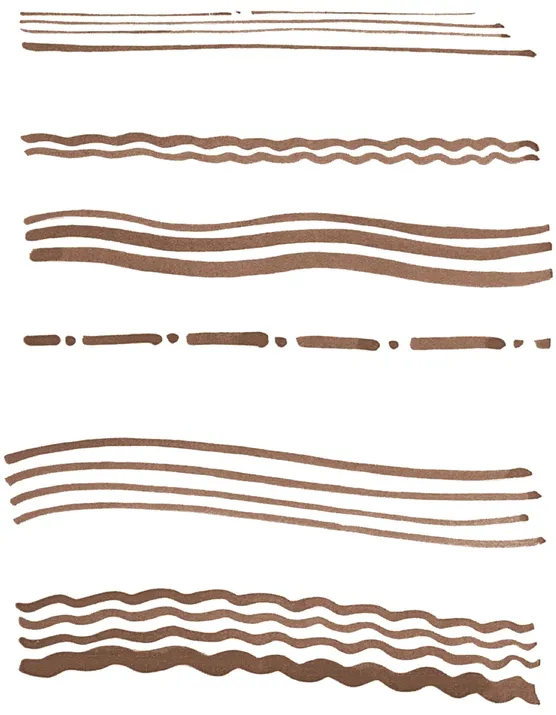
The line examples in Fig. 2 should be practised without making any attempt at drawing. Use a No. 2 sable brush, and let it move very easily and swiftly along the smooth surfaced paper. A series of quickly executed lines somewhat parallel in direction is admirable practice for the beginner. Take the brush rapidly off the paper when nearing the end of a line or curve. It helps to give a decisive finish, whereas if it is taken slowly off the paper the result will be a heavy finish.
It is surprising how many expressive forms can be made with horizontal lines and curves as shown in Fig. 3; similar variations can be obtained with lines sloping vertically or at different angles.
The same easy method of brush drawing should be used for this example as before, and experiments tried to achieve different types of lines and curves.
The next demonstration consists of curves which radiate from a given point as depicted in Fig. 4. Here again rapidity in handling is of great importance. Mistakes do not matter at first. Confidence will soon come if there is no struggling to achieve perfection.
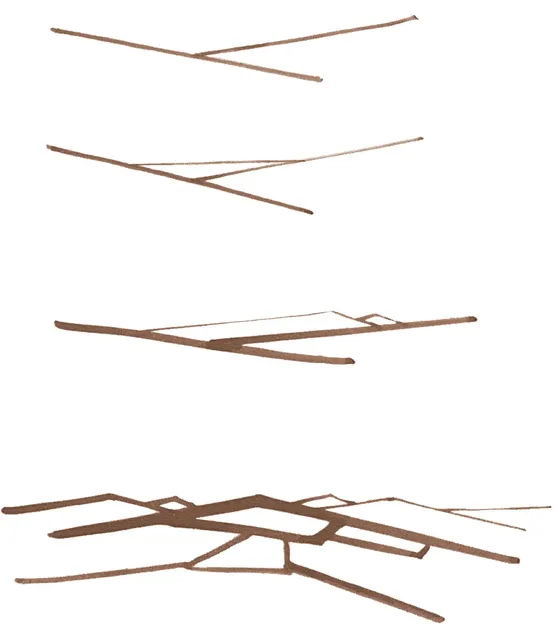
Next try a series of intersecting lines as seen in Fig. 5, once more allowing the brush to move at ease, and letting the drawing take care of itself.
When practising vary the thickness of your lines.
Now draw similar shapes, using curves only (see Fig. 6).
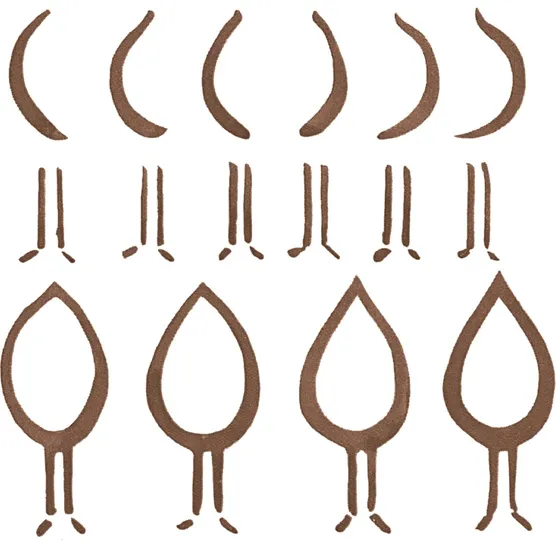
Thoroughly master Figs. 5 and 6, and then become acquainted with the demonstrations in Fig. 7 by practising in the first instance the six inverted curves and the straight lines as seen in the first and second row, and finally fitting together the elements above, so as to complete the study as depicted in the four examples at the foot.
Memorize all the elements of brush drawing in this chapter so that no further reference will be necessary.

CHAPTER II

ELEMENTARY SPACE FILLING

IF the precaution has been taken of thoroughly practising all the demonstrations in Chapter I, no difficulty will be found in handling the various examples of simple space filling set out in Chapter II.
e9780486139005_i0009.webp
FIG. 8
It is advisable to work on a fairly large scale, as small drawings are not only difficult to manage but are apt to cripple a sense of freedom or fluency in brush handling.
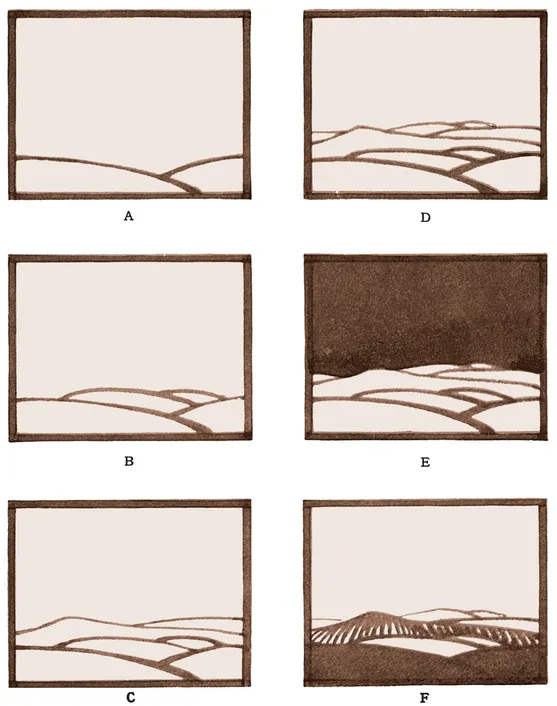
The rectangle marked A in Plate I shows two intersecting curves. (See also Fig. 6 in Chapter I.) In example B the same two curves are shown with two smaller but similar curves placed on top of the first-named curves.
Example C, like B, is reinforced with another pair of intersecting curves. D has also received the same treatment. The two pictorial looking demonstrations, E and F, are most instructive, as the drawing of each is exactly the same as D.
e9780486139005_i0010.webp
PLATE I
It is astonishing how two drawings which are precise replicas of each other can be made so different in appearance. The flat dark tone in E gives solidity to the space occupied by the intersecting curves in front. In F the flat shadow in the lower part of the drawing, supported by the parallel line treatment, presents a totally different aspect to the example immediately above.
e9780486139005_i0011.webp
FIG. 9
In the six drawings in Plate II the same arrangement of curves as seen in Plate I was used, but placed in the top portion of each rectangle instead of the lower end as before. A similar formula was also adopted of additional curves, whilst the same scheme of flat tones was used in E and F.
The three drawings in Plate III, A, B...
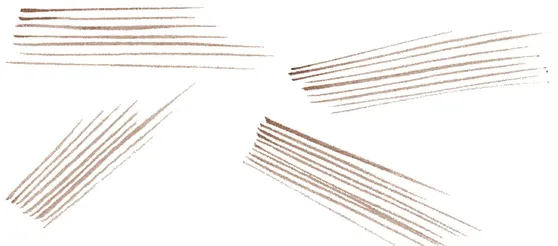
Table of contents

  1. Title Page
  2. Bibliographical Note
  3. Copyright Page
  4. PREFACE
  5. Table of Contents
  6. CHAPTER I - SIMPLE LINES AND CURVES
  7. CHAPTER II - ELEMENTARY SPACE FILLING
  8. CHAPTER III - ADVANCED SPACE FILLING
  9. CHAPTER IV - ELLIPTICAL FORMS
  10. CHAPTER V - CLOUD COMPOSITIONS
  11. CHAPTER VI - OLD CASTLES AND COTTAGES
  12. CHAPTER VII - COAST SUBJECTS
  13. CHAPTER VIII - ROAD SCENES AND TREES
  14. CHAPTER IX - RIVERS
  15. CHAPTER X - BRIDGES
  16. CHAPTER XI - HILLS AND MOUNTAINS
  17. CHAPTER XII - MISCELLANEOUS
  18. CHAPTER XIII - FAMOUS PICTURES