![]()
1
Introductory Remarks
The purpose of these notes is to set forth the essentials of the mathematics of quantum mechanics with only enough mathematical rigor to avoid mistakes in the physical applications.
In various parts of quantum theory it is appropriate to use mathematical methods that at first sight are quite different and unconnected. Thus in dealing with potential barriers or the hydrogen atom, the techniques of ordinary or partial differential equations in coordinate space are employed, whereas for a problem such as the harmonic oscillator, the use of abstract linear operator methods leads to an elegant solution. The chief aims of the present discussion are to show the underlying unity of all the methods and to build up enough familiarity with each of them so that in the subsequent treatment of quantum mechanics as a subject of physics the best method can be applied to each problem without apology and without the need to explain new mathematics.
Quantum theory was originally developed with two different mathematical techniques—Schrödinger wave mechanics (differential equations) and Heisenberg matrix mechanics. The equivalence of the two approaches was soon demonstrated, and the mathematical methods were generalized by Dirac, who showed that the techniques of Heisenberg and Schrödinger were special representations of the formalism of linear operators in an abstract vector space.
The concept of discreteness is central in quantum theory. Physically measurable quantities (called “observables”) are often found to take on only certain definite values, independent of external conditions (e.g., preparation of light source, detailed design of deflecting magnet, etc.). Important examples of discrete observables are energy (Ritz combination principle and Rydberg formula, Franck-Hertz experiment) and angular momentum (Stern-Gerlach experiment). In mathematical language the discrete, allowed values of an observable are called eigenvalues (sometimes called characteristic or proper values). The physicist is often interested in predicting and correlating the eigenvalues for a given physical system. Provided he has an appropriate mathematical description of the physical system, he wants to solve “the eigenvalue problem.” Thus the mathematical eigenvalue problem is an important aspect of quantum mechanics. This problem can be phrased in terms of differential equations, in terms of matrices, or in terms of linear vector spaces. We shall consider the various techniques and explore their essential unity below. Not all of quantum mechanics concerns itself with discrete eigenvalues, of course. Hence some of the mathematical discussion will not bear directly on the eigenvalue problem. Furthermore, a number of topics, such as perturbation theory and variational methods, will be omitted from these notes, to be dealt with separately.
References
Since only the bare essentials will be presented in these notes, the student will wish to consult more complete treatments. Some useful references are the following:
R. Courant and D. Hilbert, “Methods of Mathematical Physics,” Vol. I, Interscience, New York, 1953. Chapter 2 on orthogonal expansions; Chap. 5 on eigenvalue problems; Chap. 7 on special functions.
B. Friedman, “Principles and Techniques of Applied Mathematics,” Wiley, New York, 1956. A very useful, if formal, treatment.
G. Goertzel and N. Tralli, “Some Mathematical Methods of Physics,” McGraw-Hill, New York, 1960.
P. R. Halmos, “Finite Dimensional Vector Spaces,” Princeton University Press, Princeton, N.J., 1942; “Introduction to Hilbert Space,” Chelsea, New York, 1951. These books present a rigorous mathematical discussion of vector spaces.
F. B. Hildebrand, “Methods of Applied Mathematics,” Prentice-Hall, Englewood Cliffs, N.J., 1952. The first 100 pages deal with matrices and vector spaces.
H. Margenau and G. M. Murphy, “Mathematics of Physics and Chemistry,” 2nd ed., Van Nostrand, Princeton, N.J., 1956. Chapters 2, 3, 7, 8, 10, and 11 have particular relevance.
P. M. Morse and H. Feshbach, “Methods of Theoretical Physics,” 2 vols., McGraw-Hill, New York, 1953. Very complete, with valuable appendices at the end of each chapter.
V. Rojansky, “Introductory Quantum Mechanics,” Prentice-Hall, Englewood Cliffs, N.J., 1946. Chapter IX has a useful review of matrices. Parts of Chaps. X and XI are also relevant.
H. Sagan, “Boundary and Eigenvalue Problems in Mathematical Physics,” Wiley, New York, 1961.
A. Sommerfeld, “Partial Differential Equations,” Academic, New York, 1949. The emphasis is on orthonormal expansions, special functions, eigenfunctions, and eigenvalues.
Special mention must be made of one extremely useful reference on special functions;
W. Magnus and F. Oberhettinger, “Formulas and Theorems for the Special Functions of Mathematical Physics,” Chelsea, New York, 1949. This book will be referred to often and will be denoted as “MO.”
A much more elaborate collection of information on special functions and various transforms is contained in the Bateman volumes,
Bateman Manuscript Project, “Higher Transcendental Functions,” 3 vols., A. Erdelyi (Ed.), McGraw-Hill, New York, 1953.
Bateman Manuscript Project, “Tables of Integral Transforms,” 2 vols., A. Erdelyi (Ed.), McGraw-Hill, New York, 1954.
Note, however, that MO has quite useful tables of Fourier and Laplace transforms.
When it comes to tables of integrals and numerical values of the elementary functions, personal preference takes over. Useful, inexpensive references include the following:
H. B. Dwight, “Tables of Integrals and Other Mathematical Data,” Macmillan, New York.
B. O. Pierce and R. M. Foster, “A Short Table of Integrals,” 4th ed., Ginn, Boston.
Handbook of Chemistry and Physics, “Mathematical Tables,” McGraw-Hill, New York.
E. Jahnke and F. Emde, “Tables of Functions” (paperback), Dover, New York, 1945. Tabulation and graphs of special functions.
As a final introductory remark let me say that it is assumed that the student has some familiarity with ordinary differential equations, the method of separation of variables for partial differential equations, the elements of Fourier series, the elementary properties of matrices, and the notions of vectors in three dimensions, rotations, etc. Furthermore, it is assumed that his knowledge of classical mechanics is at the level of the books by Symon (K. R. Symon, “Mechanics,” 2nd ed., Addison-Wesley, Reading, Mass., 1960) or by Slater and Frank (J. C. Slater and N. H. Frank, “Mechanics,” McGraw-Hill, New York, 1947).
![]()
2
Eigenvalue Problems in Classical Physics
Eigenvalue problems dominate quantum mechanics, but they were well known and understood in classical physics. They occur for mechanical systems with a finite number of degrees of freedom (discrete systems), or for mechanical or electromagnetic systems with an infinite number of degrees of freedom (continuous systems). We shall discuss briefly a few examples to recall the mathematical methods used, and to see how and why eigenvalues arise.
2-1 VIBRATING STRING
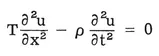
A string of uniform mass density ρ, tension T, fastened at the points x = 0 and x = a, can move in the xy plane with a displacement measured perpendicular to the x axis equal to u(x,t). The equation of motion for small oscillations of the string is a linear, second-order, partial differential equation of the form
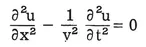
If we define a quantity with dimensions of velocity v = (T/ρ)1/2, the equation can be written
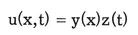
Using the separation-of-variables technique, we assume a solution
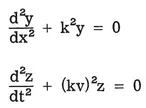
and find that y(x) and z(t) must satisfy the separate ordinary differential equations
where k2 is some as yet undetermined constant. We note that y(x) and z(vt) satisfy the same equation whose solution is sines and cosines.
So far there has been no mention of an eigenvalue problem. That comes with the imposition of the boundary conditions. These are
1. Spatial: u(O,t) = u(a,t) = 0, for all t.
2. Temporal: u(x,0) = F(x),
u/
t(x,0) = G(x), for 0 < x < a. First we consider the spatial boundary condition. The solution for y(x) is
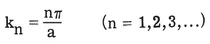
To satisfy boundary condition 1 it is necessary that y(0) = y(a) = 0. Hence B = 0 and, if A ≠ 0, then ka = nπ. The unknown parameter k has thus been found to have a countably infinite set of discrete eigenvalues,
The most general solution consi...