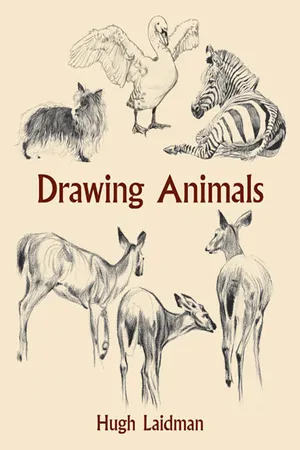
A valuable guide by a well-known teacher and artist, this volume abounds in expert advice on methods and techniques for drawing animals, offering 26 lessons with step-by-step drawings of wild and domestic creatures. Author Hugh Laidman directed the U.S. Marine Corps art program, was commissioned by the National Gallery of Art to do work for NASA, and was a successful syndicated cartoonist. In Drawing Animals, his breadth of skill and experience has been successfully distilled into a concise, easy-to-follow and beautifully illustrated guide.
Laidman offers knowledgeable advice on methods and techniques before proceeding to the heart of the book: expertly rendered instructional drawings of more than two dozen animals, from cats and dogs to elephants and gorillas. The emphasis throughout the text is on understanding animal anatomy and behavior as a guide to creating natural, expressive drawings, while developing an individual style and approach. Artists at all levels, beginner to expert, will find this book a source of inspiration as well as instruction.
- 160 pages
- English
- ePUB (mobile friendly)
- Available on iOS & Android
eBook - ePub
Drawing Animals
About this book
Information
Topic
ArtSubtopic
Art Techniques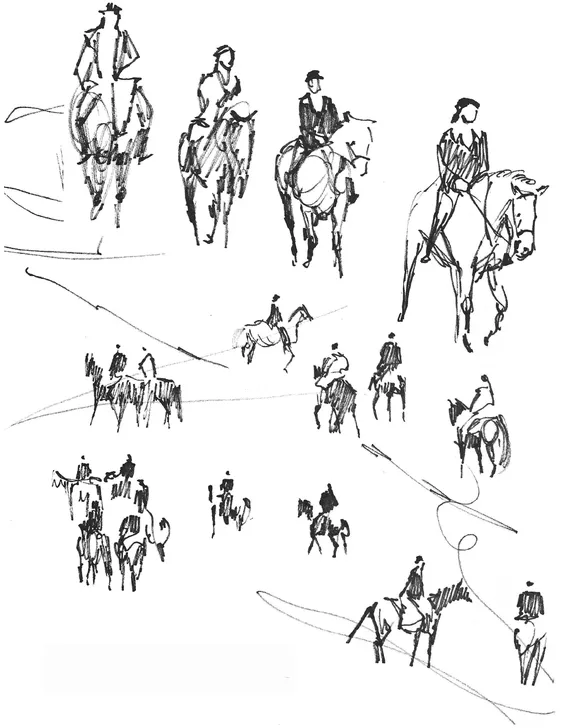
On-the-spot felt pen sketches at the Genessee Valley Hunt.
Introduction
There is no singularly “right” or “wrong” way to draw animals. Three great American artists, Edward Hicks, John James Audubon, and Frederick Remington, differed widely in their approaches, yet all three left us memorable paintings of animals.
Hicks’s paintings were essentially copied, in whole or in part, from paintings and engravings of the day. Audubon moved a step closer to the real thing. Not content with observing animals in their wild state, he shot them, hung them on wires—sometimes in positions that would have been impossible for the animal while alive—and painted them magnificently.
Remington went still further. He believed that only through close observation of the living animal could an artist make a creditable painting of it. He spent much of his time living with the cowboys and the military in the American West, drawing hundreds of on-the-spot sketches of the animals. These, in turn, became the foundation of his great works.
This book suggests that you avoid the “swipe” method employed by Hicks, and the “shoot-‘em-string-’em-up” procedure of Audubon, and follow more closely the on-the-spot observation practices of Remington. Hicks’s copying system generally leads to disaster for the would-be artist while Audubon’s method is impractical in today’s society. Remington’s approach to the drawing of animals is not only practical but singularly effective and enjoyable.
Readily available to the artist who would draw animals are hundreds of reproductions of great paintings of today and yesterday. These should be studied by the aspiring animal artist. Stuffed animals are also excellent objects for study, as are statues of animals. Seeing how someone else handled the problem of depicting a particular animal helps to develop your own approach to technique and materials. You will want, too, to study photographs of animals, both those you yourself have taken and those taken by professional animal photographers.
These methods of study combined with hundreds of on-the-spot sketches lead to good animal drawing. But knowledge and study are, in themselves, not enough. The artist does not just draw a cat or a dog or a chimpanzee. He must draw with a feeling for the animal. This he develops through long hours of observation of its habits, its movements, and its personality. As the artist watches the animal in motion and at rest, he makes notes and sketches his observations. The more he learns about the animal, the better able he is to draw it.
A knowledge of animal anatomy can be most helpful, but such knowledge is best if it is absorbed gradually. An overemphasis on anatomy in the early stages of learning to draw animals can be frustrating and discouraging. Once you are sketching with relative proficiency, it is time enough to look more deeply into what goes on underneath the surface.
If you become well grounded in anatomy, you must then avoid the pitfall of letting your knowledge become too obvious in your final drawings.
There is no magic formula for the making of a good animal artist. Hours of hard, and frequently frustrating, work go into the completion of a good animal drawing. Not everyone can make it—only those who appreciate the animal kingdom and have a talent for keen observation along with the ability, developed through intelligent practice, to translate their observations of a living creature into graphic form.
Knowing What to Look For
You will more easily understand the likenesses and differences in animals if you know something about how the animal functions.
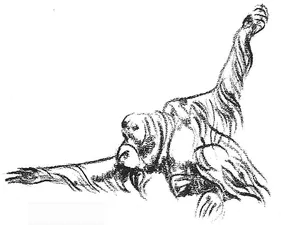
Orangutan
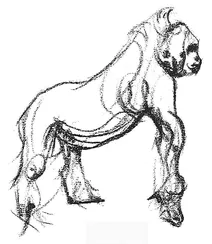
Gorilla
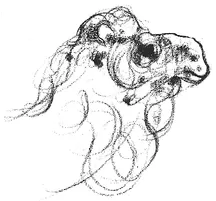
Camel
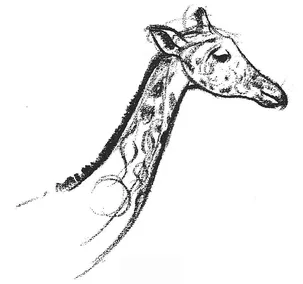
Giraffe
The orangutan spends a great part of its life in trees. Its arms are long and its hands strong and well adapted for grasping branches. The gorilla spends considerably more time on the ground. Its arms are also long and its hands powerful, but it has adapted its body to surface locomotion. The human, standing erect, has proportionately much stronger legs than either of these fellow primates.
Study the camel and the giraffe. The basic structure and typical stance of the animal do more to identify it than does the surface pattern or detail. Viewed from a distance, where color, humps, or long neck might not be distinguishable, there still would be little difficulty in identification. Consider how quickly you can identify someone a great distance away even though you can’t tell the color of his eyes or the shape of his features. In drawing animals, think first about the overall form or structure and the identifying stance, not the detail.
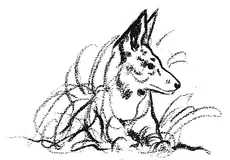
Jackal
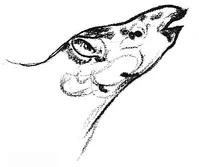
Tapir
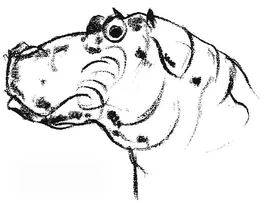
Hippopotamus
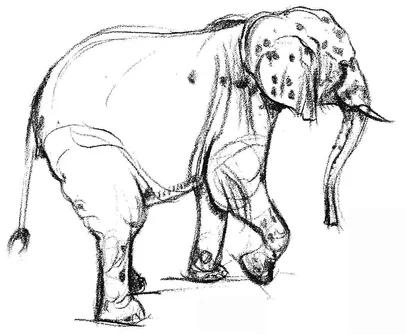
Elephant
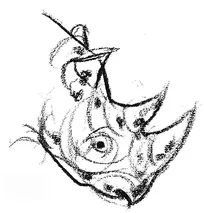
Rhino
A tapir’s snout has been compared to an elephant’s trunk. Knowing this, yo...
Table of contents
- Title Page
- Copyright Page
- Acknowledgment
- Dedication
- Table of Contents
- Introduction
- A Word about Photography
- Birds
- Cats
- Canines
- Horses
- Farm Animals
- Pigs
- Llama
- Camels
- Giraffes
- Elephants
- Hippos
- Rhinos
- Tapir
- Deer and Antelope
- Kangaroos
- Anteaters
- Pandas
- Raccoons
- Primates
Trusted by 375,005 students
Access to over 1.5 million titles for a fair monthly price.
Study more efficiently using our study tools.
Frequently asked questions
Yes, you can cancel anytime from the Subscription tab in your account settings on the Perlego website. Your subscription will stay active until the end of your current billing period. Learn how to cancel your subscription
No, books cannot be downloaded as external files, such as PDFs, for use outside of Perlego. However, you can download books within the Perlego app for offline reading on mobile or tablet. Learn how to download books offline
Perlego offers two plans: Essential and Complete
- Essential is ideal for learners and professionals who enjoy exploring a wide range of subjects. Access the Essential Library with 800,000+ trusted titles and best-sellers across business, personal growth, and the humanities. Includes unlimited reading time and Standard Read Aloud voice.
- Complete: Perfect for advanced learners and researchers needing full, unrestricted access. Unlock 1.5M+ books across hundreds of subjects, including academic and specialized titles. The Complete Plan also includes advanced features like Premium Read Aloud and Research Assistant.
We are an online textbook subscription service, where you can get access to an entire online library for less than the price of a single book per month. With over 1.5 million books across 990+ topics, we’ve got you covered! Learn about our mission
Look out for the read-aloud symbol on your next book to see if you can listen to it. The read-aloud tool reads text aloud for you, highlighting the text as it is being read. You can pause it, speed it up and slow it down. Learn more about Read Aloud
Yes! You can use the Perlego app on both iOS and Android devices to read anytime, anywhere — even offline. Perfect for commutes or when you’re on the go.
Please note we cannot support devices running on iOS 13 and Android 7 or earlier. Learn more about using the app
Please note we cannot support devices running on iOS 13 and Android 7 or earlier. Learn more about using the app
Yes, you can access Drawing Animals by Hugh Laidman in PDF and/or ePUB format, as well as other popular books in Art & Art Techniques. We have over 1.5 million books available in our catalogue for you to explore.