![]()
CHAPTER 1
THE LOG CABIN AND THE PIONEER JACK-OF-ALL-TRADES
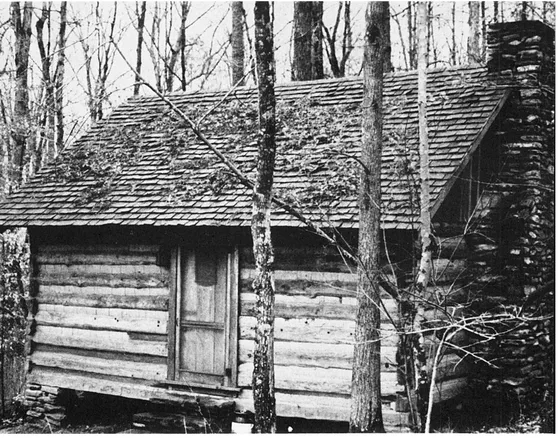
If ever there has been a symbol of the early American frontier, it is the formerly ubiquitous log cabin.
It could be built quickly and relatively easily, entirely from the trees of American forests, and with a minimum of tools. When built well it lasted for generations, providing shelter against the most severe weather and serving as a sturdy fortress against Indian attacks.
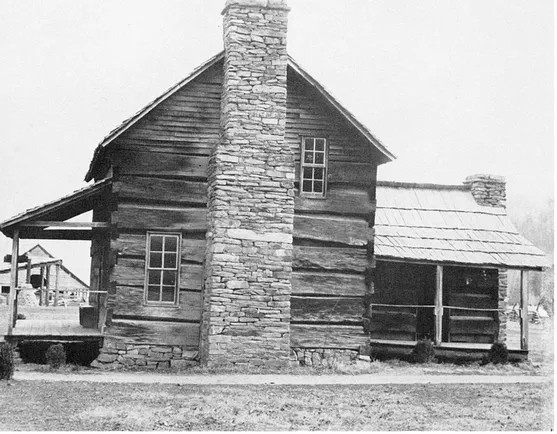
Like most cultural expressions in America, the log cabin reflected European origins. It is thought to have been introduced to the New World by the Swedish colonists who first settled Delaware as the most far-flung outpost of King Gustavus Adolphus. Familiar also to the Germans who emigrated to Pennsylvania in the early eighteenth century, the log cabin soon was adopted by English and Scotch-Irish settlers as they populated the empty, forested reaches southward along the foothills of the Appalachians. These Britons, seeking in the New World a comfort and opportunity they had not known in the Old, adapted the construction of the Swedish cabin to the simple floor plans of the stone and timbered cots they had known for generations in England, Scotland, and Ireland. Often one could determine the Old World provenance of a man’s ancestors by examining the plan of his cabin and the presence of dovetails or saddle notches.
Finer cabins with multiple rooms and stories might require a few more sophisticated tools, such as a mortising chisel and mallet for fitting floor and ceiling joists. An auger was necessary to bore holes for pegs and treenails which fastened door and window framing or provided a place to hang clothes. Since all log cabins in the old days had split shingle roofs, a froe and maul, the latter, invariably handmade, were necessities.
To minimize the number of trees needed for a cabin the builder usually split his logs in half with such simple tools as the iron wedge and sledge, or the wooden wedge, called a glut, which was driven in with a homemade maul. The German settlers of Pennsylvania introduced to the American frontier the holzaxt, a specialized splitting ax which was adopted by southern pioneers and given the name “go-devil.”
So, equipped with tools that could be carried by one man, the American pioneer built his own houses almost entirely by his own efforts, and did such a good job that his cabin outlasted himself and even his grandsons.
AXES
Ancient in design, inefficient in function, the felling ax was the first weapon used by Europeans against the virgin forests of a newly discovered continent. It equipped the gentlemen woodcutters of Jamestown, the laboring pilgrims of Plymouth, and the mission Indians of St. Augustine. Relatively long-bladed and lacking a poll, this imperfectly balanced tool nevertheless enabled the colonists of England, Spain, France, Holland, and Sweden to carve a foothold and establish a new society. It was improved upon only in the middle of the eighteenth century by settlers who needed new tools to meet the problems of a vast frontier.
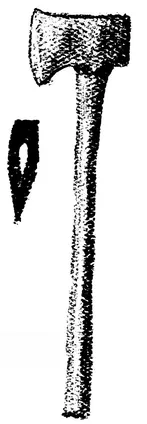
After a century or more of cutting huge trees and clearing land with a tool which had not changed since the Stone Age, American colonists anticipated the industrial age by modifying the ancient felling ax into a more efficient tool. Some backwoods blacksmith, somewhere, perhaps executing the concept of a weary woodcutter, produced an ax that had a shorter, broader blade and a poll attached to the eye opposite the blade. The result was an ax with well-nigh perfect balance that could be swung easily for hours with no effort required to keep the blade aligned with the kerf. Its poll provided more weight behind the edge, allowing the momentum to push the sharpened edge into the resistant tree; its wide, rather thick, blade made a bigger cut and more easily removed the chips, some as large as a dinner plate, from the kerf. With it an experienced axman could fell a two-foot tree in less than half an hour. The genius behind its design, mostly unnoticed in the sophisticated atmosphere of an industrial society, was reflected in its adoption in most countries of the civilized world. The building of America rested far more on this prosaic tool than on the more romantic symbols of long rifle and six-shooter and locomotive. Its rudimentary influence was probably more important to the future of America than any manned moonshot.
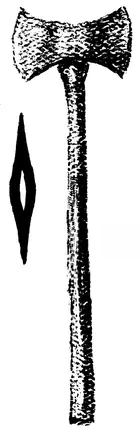
As America entered the industrial age around 1840, and the population exploded, creating a vast need for housing and transportation, mostly made of wood, the incipient lumber industry was strained to supply the country’s needs. Maine, with its largely untouched forests, was where wholesale commercial timber cutting for the lumber mills began. There the uniquely American polled ax was discarded for the double-bit ax that later was used almost exclusively to clear the forests of Michigan, Wisconsin, Minnesota, the Appalachian regions, the virgin pine forests of Georgia, and finally the heavily forested slopes of California and the Northwest Coast, where it has only recently been supplanted by the horrendous gasoline power saw. Actually the double-bit ax developed in Maine was a reinvention of a most ancient tool. Minoans and Romans used a double-bit ax in ancient times; and Danish woodcutters in the nineteenth century were also known to use a double-bit ax. Perhaps it was Scandinavian lumberjacks who developed the form in Maine. Regardless of its history or past forms, the American double-bit ax developed into a graceful, efficient tool, well-balanced and providing two sharp blades. With the crosscut saw, it was an important factor in the settlement of the Midwest and the northwestern sections of the country and in the building of America’s cities.
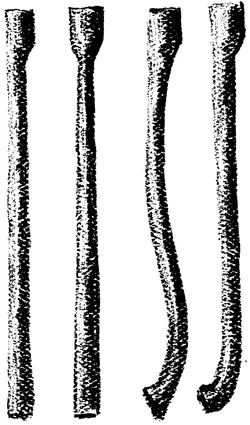
Another peculiarly American modification of the ax was the curved handle developed for the single-bit felling ax shortly after the Civil War. These graceful appendages, known as colt’s foot or fawn’s foot handles, replaced the straight handles used on axes since prehistoric times. The curve, with a knot on the end, allowed improved control over the swing of the axhead and provided additional accuracy. The curved handle, like the polled head, has gained recognition through its acceptance all over the world. Straight handles, of course, continue to be required on double-bit axes.
Logs too large to be used for specific purposes in pioneer times were reduced by splitting to supply properly dimensioned timber. Fence rails, cabin logs, puncheons, corner posts for well houses, billets for shingles were all split by using a club to pound a wedge through the log. Iron wedges have been used since olden times, but where iron was scarce a wooden wedge, known as a “glut” in eastern America, was used. These wedges were forced in with mauls, clubs with a heavy head and fairly short handle chopped from a single log, or by beetles, a giant-sized ...