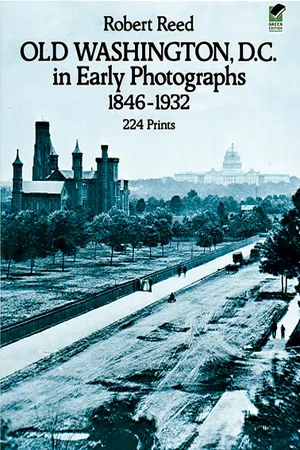
The rise and growth of Washington, D. C., in the nineteenth century closely paralleled the invention and development of photography — a felicitous circumstance that made possible this valuable photographic record of the early years of the nation's capital. Culled from the archives of the Library of Congress, Smithsonian, Columbia Historical Society, and other sources, these 224 rare prints (including works by such Victorian-era cameramen as Brady, Bishop, Plumbe, Hiller, Peale, et al.) constitute a vivid and enduring record of a city in progress — from sparsely settled provincial southern town to majestic seat of national power and influence.
In spite of their vintage (over half are pre-1900; the earliest a striking 1846 daguerreotype of the Capitol under construction), these priceless views retain an undiminished precision and clarity of detail that brings old Washington into sharp focus — timeless reminders of how a city and its people looked as a metropolis of pomp and power grew up about them. From the slums of Purdy Court to the turreted mansions of Dupont Circle, from the massive marble monuments of "Federal" Washington, to the humble shops and saloons of 7th Street, these rare pictures recall places and events steeped in meaning for a nation and its citizens: Lincoln's first inauguration (1861); Ford̍'s Theater draped in mourning (1865); Grand Review of the Union Army (1865); Old Willard Hotel (housed Nathaniel Hawthorne, Lincoln, Grant, Tyler, Pierce); portrait of Frederick Douglass and family (1885); homes of Dolley Madison and Francis Scott Key; Women’s Suffrage Parade (1913); and many other historic, social, and geographic landmarks.
This rich gallery of contemporary views also reveals nineteenth-century Washington as a showplace of architectural styles (Gothic Revival, Romanesque, Classical, Italian Renaissance, Victorian, etc.) employed to stunning effect by the master builders of the age: James Renwick (Smithsonian, Corcoran Gallery of Art); Benjamin Latrobe and Charles Bulfinch (Capitol); Robert Mills (Old Post Office, Patent Office, Treasury Building); Andrew Jackson Downing (Francis Dodge House); Henry Hobson Richardson (Henry Adams House), and many others.
Side by side with its architectural splendor, the mundane life of the city is recaptured in remarkable images of an era when beer was a nickel a bottle and cows still grazed within sight of the Capitol. Here are turn-of-the-century schoolchildren admiring the newly opened Library of Congress; summer crowds mingling on the White House lawn in the administration of Chester Arthur; an Easter Monday egg-roll in 1898; Marine Band concerts; idyllic outings at Rock Creek Park; bone-shaking rides on a velocipede; parades, celebrations, inaugurations, and many other vignettes of people, neighborhoods, and daily life.
The photos are arranged in an east-to-west geographic sequence (Capitol Hill to Georgetown) that roughly parallels the historic development of the city. Robert Reed has provided an informative introduction and captions, enhancing the unique and irreplaceable value of this collection. Historians, photographers, architects, visitors — anyone interested in the process by which a muddy village on the banks of the Potomac became one of the great capitals of the world — will want to have this book.
In spite of their vintage (over half are pre-1900; the earliest a striking 1846 daguerreotype of the Capitol under construction), these priceless views retain an undiminished precision and clarity of detail that brings old Washington into sharp focus — timeless reminders of how a city and its people looked as a metropolis of pomp and power grew up about them. From the slums of Purdy Court to the turreted mansions of Dupont Circle, from the massive marble monuments of "Federal" Washington, to the humble shops and saloons of 7th Street, these rare pictures recall places and events steeped in meaning for a nation and its citizens: Lincoln's first inauguration (1861); Ford̍'s Theater draped in mourning (1865); Grand Review of the Union Army (1865); Old Willard Hotel (housed Nathaniel Hawthorne, Lincoln, Grant, Tyler, Pierce); portrait of Frederick Douglass and family (1885); homes of Dolley Madison and Francis Scott Key; Women’s Suffrage Parade (1913); and many other historic, social, and geographic landmarks.
This rich gallery of contemporary views also reveals nineteenth-century Washington as a showplace of architectural styles (Gothic Revival, Romanesque, Classical, Italian Renaissance, Victorian, etc.) employed to stunning effect by the master builders of the age: James Renwick (Smithsonian, Corcoran Gallery of Art); Benjamin Latrobe and Charles Bulfinch (Capitol); Robert Mills (Old Post Office, Patent Office, Treasury Building); Andrew Jackson Downing (Francis Dodge House); Henry Hobson Richardson (Henry Adams House), and many others.
Side by side with its architectural splendor, the mundane life of the city is recaptured in remarkable images of an era when beer was a nickel a bottle and cows still grazed within sight of the Capitol. Here are turn-of-the-century schoolchildren admiring the newly opened Library of Congress; summer crowds mingling on the White House lawn in the administration of Chester Arthur; an Easter Monday egg-roll in 1898; Marine Band concerts; idyllic outings at Rock Creek Park; bone-shaking rides on a velocipede; parades, celebrations, inaugurations, and many other vignettes of people, neighborhoods, and daily life.
The photos are arranged in an east-to-west geographic sequence (Capitol Hill to Georgetown) that roughly parallels the historic development of the city. Robert Reed has provided an informative introduction and captions, enhancing the unique and irreplaceable value of this collection. Historians, photographers, architects, visitors — anyone interested in the process by which a muddy village on the banks of the Potomac became one of the great capitals of the world — will want to have this book.


