
- 144 pages
- English
- ePUB (mobile friendly)
- Available on iOS & Android
eBook - ePub
Ways with Watercolor
About this book
In simple, direct language, accompanied by purposeful illustrations, teacher and master watercolorist Ted Kautzky shows beginners how to handle the medium. Widely regarded as the author's best work, the book discusses color pigments, paper, and other supplies; washes, strokes, and the use of accessories for special effects. Important chapters follow on the characteristics and techniques of handling limited and full palettes. Valuable instructions on composition and related subjects are interwoven throughout the text. In addition to many demonstrations, there is also challenging practice material.
Information
Topic
ArtSubtopic
Art TechniquesMORE PRACTICE
At most schools it is traditional to test the student’s knowledge at the end of a course. Here, you are asked to test yourself—to discover your own strengths, and weaknesses, to find out how well you have learned your lessons. Then you are given opportunity to overcome your weaknesses and to solidify your strengths, through review and practice.
1. Start out by simply leafing through the illustrations; don’t bother to read the captions at this time.
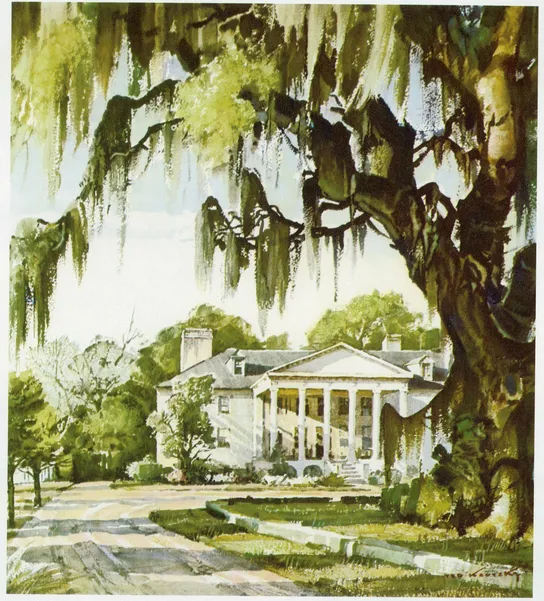
2. Then leaf through again, stopping to analyze pictures that seem familiar. You will find a number of these, both in black and white and in color. They will look familiar because they are composed of subject matter that has been used in the book before —from a different viewpoint, at a different time of day, a different season of the year, or, perhaps, just a different mood. The sketch at the bottom of the facing page, for instance, will probably prick your memory. It is one of many studies made for the painting reproduced on page 26. And the sketches on page 120 should certainly recall one of the subjects on page 71. On page 132 there is a picture seen from a different viewpoint but the subject is the same as that in the practice sketch on page 97. Try comparing your treatment with this one. One note of reassurance. Don’t be unduly alarmed, if, when using the same palette, your color results are slightly different from the reproduction in the book. You are comparing your result with a reproduction, not with the original painting itself. Because the process of reproduction is largely a mechanical procedure with definite limitations, it is almost impossible to achieve a reproduction that is an exact replica of the original. You may even detect colors not included in the palette or possible to get through mixtures of palette colors. But don’t use this as an excuse, in over-all effect your painting should closely resemble the reproduction.
3. Now leaf through once more, stopping at illustrations that seem less familiar (and probably more challenging) and try analyzing them. If you have been able to paint these pictures mentally, with a reasonable degree of assurance, start testing yourself on paper. Pick a group of 5 or 6 pictures, those that appeal to you most, and try doing versions of your own.
If you start with a color reproduction, try duplicating it without reference to text or caption. If you want to change the composition a bit, or the mood, don’t forget your preliminary value sketch. When finished, check your palette and procedure with the caption and related text. Or, if you start with a black-and-white illustration, try doing a color version.
But don’t copy for the sake of copying. Copy to improve your technique and to underline what you have learned, or not learned, so far. Remember that you are testing yourself. Think as you work and keep asking yourself questions.
Why does this road curve as it does and what would happen if its direction was changed?
Was this sky done on wet or dry paper? With a single wash or with superimposed washes?
Why are the puddles on this road shaped as they are?
Was this tree modeled with a brush? With a rag? With a pocket knife? And why?
Why is this water reflection dark and that one light?
Why is one object reflected in the water while another is not?
Why is there a rather bright spot of color under the roof of a porch in shadow?
If you have practiced enough, if you have reviewed text whenever necessary, if you have analyzed all pictures in this section, while giving a confident answer to every question you could think of, then the book has served its purpose. You are now ready to work independently.
Once on your own, keep an open mind, absorbing knowledge wherever you look. Keep an objective, analytical attitude toward the work of others—but mostly, at this stage, toward your own. And paint, paint. PAINT; only in this way will your talent develop to its fullest potential.
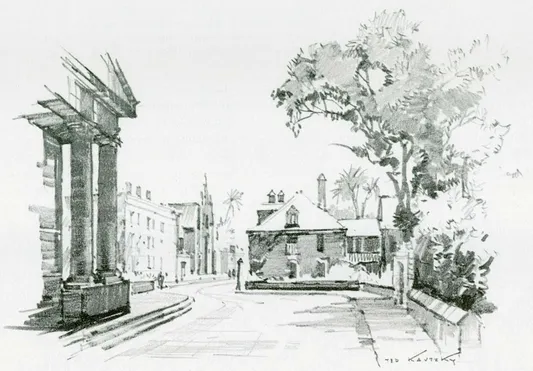
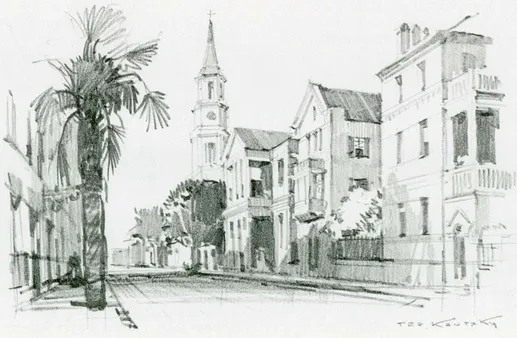
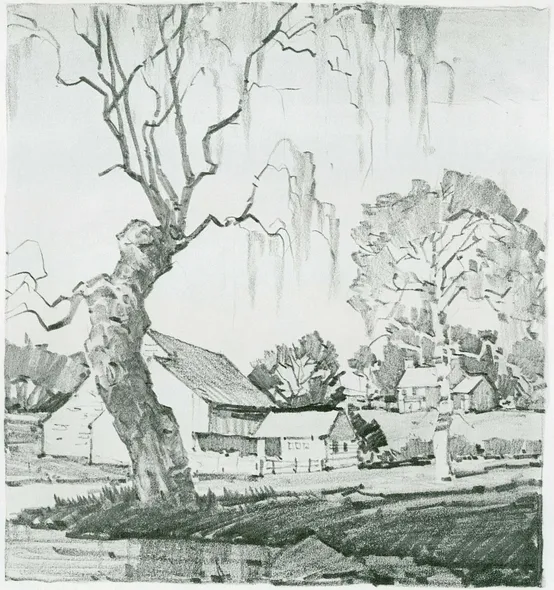
CHARLESTON, S. C.
Size of original: 22″ by 25″. Painted on 300-pound D’Arches, medium-rough surface.
Palette: Cobalt Blue, French Ultramarine Blue, Raw Sienna, Burnt Umber, Alizarin Crimson, Hooker’s Green Number 2, Cadmium Yellow.
Order of painting: 1. The Live Oak in the right foreground, beginning with the general shapes of the shadowed foliage and using a square-end brush. The main branches, limbs and trunk were struck in next, using dark values for the shadowed areas and medium to light values in the sunlit portions. 2. Modeling of foliage and Spanish moss was finished, using dry-brush strokes in vertical sweeps for the moss. 3. The cast foreground shadows up to the road’s edge. 4. The middle and background trees, the sunlit areas of grass and the shrubs in front of the house. 5. The roof and shadow areas of the house. 6. The road and the continuation of the cast shadows across it. 7. The sky. 8. The final details in the sunlit areas.
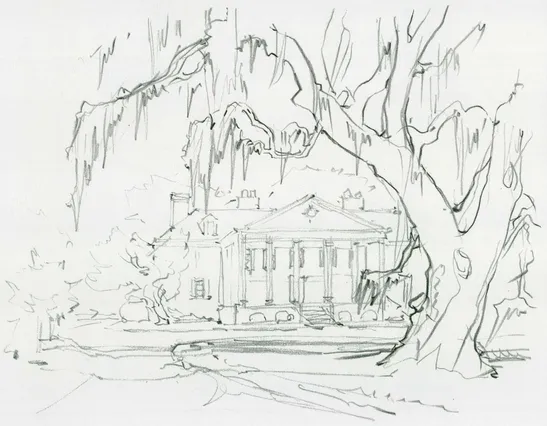
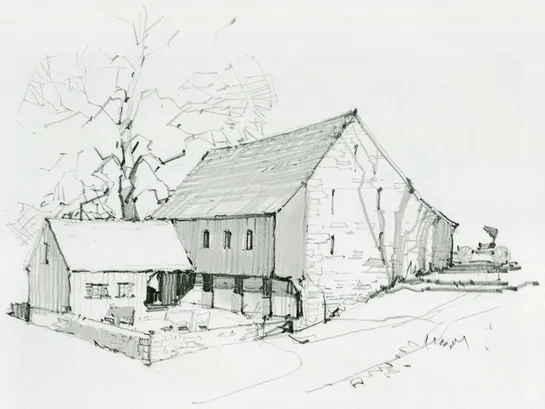
Above and facing page: Studies in composition and value for Rural Pennsylvania, page 106.
RURAL PENNSYLVANIA
Size of original: 22” by 25”. Painted on 300-pound D’Arches, medium-rough surface.
Palette: Cobalt Blue, French Ultramarine...
Table of contents
- DOVER BOOKS ON ART INSTRUCTION
- Title Page
- Copyright Page
- Table of Contents
- EDITOR’S NOTE
- INTRODUCTION
- THE COLOR PIGMENTS
- PAPER FOR WATERCOLORS
- BRUSHES AND OTHER EQUIPMENT
- WASHES AND STROKES
- THE USE OF ACCESSORIES
- TIPS ON PAINTING BUILDINGS
- PAINTING SKIES AND CLOUDS
- SPECIAL METHODS WITH TREES
- MOUNTAINS, HILLS, AND ROCKS
- REFLECTIONS ON WATER
- WHAT TWO PIGMENTS CAN DO
- NOW LET’S TRY THREE PIGMENTS
- WITH FOUR COLORS WE ARE RICH
- THE WINTER LANDSCAPE
- VILLAGE VISTAS
- HARBOR WATERFRONTS
- ALONG THE BEACH
- MORE PRACTICE
- DOVER COLORING BOOKS OF ART AND DESIGN
Trusted by 375,005 students
Access to over 1.5 million titles for a fair monthly price.
Study more efficiently using our study tools.
Frequently asked questions
Yes, you can cancel anytime from the Subscription tab in your account settings on the Perlego website. Your subscription will stay active until the end of your current billing period. Learn how to cancel your subscription
No, books cannot be downloaded as external files, such as PDFs, for use outside of Perlego. However, you can download books within the Perlego app for offline reading on mobile or tablet. Learn how to download books offline
Perlego offers two plans: Essential and Complete
- Essential is ideal for learners and professionals who enjoy exploring a wide range of subjects. Access the Essential Library with 800,000+ trusted titles and best-sellers across business, personal growth, and the humanities. Includes unlimited reading time and Standard Read Aloud voice.
- Complete: Perfect for advanced learners and researchers needing full, unrestricted access. Unlock 1.5M+ books across hundreds of subjects, including academic and specialized titles. The Complete Plan also includes advanced features like Premium Read Aloud and Research Assistant.
We are an online textbook subscription service, where you can get access to an entire online library for less than the price of a single book per month. With over 1.5 million books across 990+ topics, we’ve got you covered! Learn about our mission
Look out for the read-aloud symbol on your next book to see if you can listen to it. The read-aloud tool reads text aloud for you, highlighting the text as it is being read. You can pause it, speed it up and slow it down. Learn more about Read Aloud
Yes! You can use the Perlego app on both iOS and Android devices to read anytime, anywhere — even offline. Perfect for commutes or when you’re on the go.
Please note we cannot support devices running on iOS 13 and Android 7 or earlier. Learn more about using the app
Please note we cannot support devices running on iOS 13 and Android 7 or earlier. Learn more about using the app
Yes, you can access Ways with Watercolor by Ted Kautzky in PDF and/or ePUB format, as well as other popular books in Art & Art Techniques. We have over 1.5 million books available in our catalogue for you to explore.