"A joy to read, as well as a constant reference library. Thoroughly inspiring." — Workbench
The republication of this highly valuable text by Edouard Lanteri, a renowned teacher, sculptor, and intimate friend of Rodin (Rodin called him "my dear master, my dear friend"), makes it possible for serious students to gain the requisite skills needed for figurative sculpture and to bridge the gap between artistic concept and figurative realization.
Modelling and Sculpting Animals, together with its companion piece Modelling and Sculpting the Human Figure, is the classic treatise on the techniques of figurative sculpture. Representing at least three thousand years of studio lore, this readily understandable, authoritative guide is a goldmine of technical information, easily comprising a four-year sculpture curriculum unavailable elsewhere.
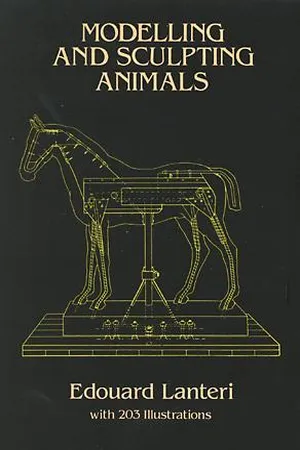
In this reasonably priced volume, devoted almost entirely to the modelling of animals, Lanteri offers thorough step-by-step instruction for the figurative sculptor. Beginning with a description of the historical symbolism of animals in different cultures, the author then proceeds to give meticulous anatomy for the horse, lion, and bull. Rules of motion, measurements of construction, erecting the framework, tools, materials, and other pertinent aspects of animal sculpture are covered in detail. The final section presents a comprehensive exposition of the methods of casting in plaster, including how to mix the plaster, applying successive layers and irons, opening the mold, soaping and oiling, chipping off the mold, and special precautions. A profusion of illustrations — over 200 photographs, drawings, and diagrams — clearly demonstrate every principle and method the author describes. 64 full-page photographic plates, 139 drawings and diagrams.
- 352 pages
- English
- ePUB (mobile friendly)
- Available on iOS & Android
eBook - ePub
Modelling and Sculpting Animals
About this book
Information
Topic
ArtSubtopic
Art GeneralCHAPTER I
INTRODUCTORY REMARKS
SYMBOLISM is the striking and general interest embodied in the representation of animals in the early epochs of sculpture. Their forms were for the artist the means by which certain ideas received material expression: the lion, for example, was symbolical of courage; the cat, of mysterious prudence and treachery; the hawk, of avidity; the cow was the sacred image of beneficent fecundity ; the serpent, the owl, were the emblems of watchfulness; the soaring bird signified the upward flight of the soul.
Each country had its favourite animals, according to the symbolism attaching to them, or to the uses they could be put to. The Hindus, who had come to live with the elephant on terms of familiarity, were fond of representing it in their architecture, carrying the architrave of their temples, and typifying the power of inert and massive resistance. The Assyrians studied the lion, which they had every occasion to observe in the royal menageries.
On the friezes of their temples the Egyptians represented all kinds of animals: the cat, the monkey, the vulture, etc. When they made isolated figures of animals, they chose in preference the lion, the bull, and the ram, but in the treatment of these subjects they did not strictly adhere to the copy of natural forms. Inspired by their priests, who delighted to surround the highest truths with mystery, and whose language was always figurative, this people’s mind conceived monstrous beings, odd medleys of forms, strangers one to the other, but fraught with an obscure and dreadful meaning. Species of the utmost difference were associated in these chimerical images; the ram assumed the claws and the tail of the lion; the latter, in turn, assumed the head of a man or a woman, and became that figure which was to stand later as the emblem of every enigma–the Sphinx. In Egyptian sculpture, animals being only symbols, one must not be astonished that the imitation of nature, by the Egyptians, should have been limited to its bearing upon the idea, and have been seen from the larger point of view, that is to say, by insisting only on the characteristic points, on the more expressive and decided features.
When the sculptor is making one of these colosses, lion, bull, or elephant, as a part of some monumental scheme, his aim is not to perpetrate the exact portrait of any one individual of the species, but to present to the eye from afar a strong and fine idea; it is thus that the Egyptians understood it, and after them the Greeks of the first period.
It is necessary to distinguish between wild animals, whose forms are less familiar to us and those animals, the ordinary companions of man, such as the horse and the dog, which, better known to us, claim to be represented in such a way that it shall be possible to name even the particular variety to which they belong. The more the animal is mixed up with the everyday life of man, the more carefully must the sculptor present those features of its life which we are accustomed to notice, but such features can only be found in nature, so that an intimate study of their details becomes a necessity.
Without being an authority on the matter or a profound connoisseur of horsemanship, it is easy to understand that Grecian art, in the time of Pericles, had attained to the highest perfection in the sculptural representation of horses. To endow the ideal with life, to give to sublime beauty a simple and natural appearance, such was the problem, which the school of Phidias successfully dealt with. One comes across certain observations which appear almost trivial, but which are there to tone down the sublime, to prevent that it should be too tense and superhuman. Thus in the midst of the marvellous cavalry of the frieze of the Parthenon we find a horse lowering and stretching its neck to drive away a fly that is irritating it. Here we have one of those ingenious details which are meant to perplex us and to make us believe that Grecian art is nothing more than nature in all its simplicity, while in reality it is the very essence of nature.
CHAPTER II
THE HORSE
BELONGING to the genus mammalia, the horse is the type of the solidungulate 1 family, and is distinguished essentially by the existence of a single digit encased in a single undivided hoof for each foot. The metacarpal or metatarsal bone of this digit is very long and forms what is known as the “ cannon–bone,” and is accompanied on the sides by two smaller bones known as the “ splint–bones,” which represent the rudiments of the second and fourth metacarpals or metatarsals. Each jaw has six incisors, which in young horses have a pit in the apex. There are on either side, in the upper and lower jaws, six molars, the square heads of which are well marked, this characteristic pattern being produced by the curved folded plate of the enamel of the teeth. The males have, moreover, two small canines in the upper jaw and sometimes in the lower, but these are mostly absent in the females. Between these canines and the first molars is an empty space, in which is placed the bit, by which man curbs the animal to his will and guides it.
In horses the organs of sense are generally highly developed. Their eyes are large and near the surface of the head. Their sense of hearing is very delicate, the concha of the ear being especially mobile: at the least unaccustomed sound, or when some unfamiliar object appears they stop, prick up their ears, and listen with the greatest attention. Their sense of smell is also very acute and they make frequent use of it, especially when they seek to recognise some object which excites their suspicion. Their nostrils, like their ears, are also very mobile. Their tongue is soft and their upper lip fairly flexible ; they appear to use the latter at times to feel foreign bodies, and use it to pick up their food. The entire surface of their skin is extremely sensitive and it quivers at the least touch. Their coats are composed of soft and flexible hairs and the crest and tails furnished with long hard hairs. Their eyes have several lashes and on their lips are rough hairs, but not disposed in any regular form. On each of four legs is an oval wart, situated on the inside, and these are known as the “ chestnuts.”
By their forms, their proportions, and their movements, these animals convey the idea of force linked with agility. Their bodies are thick without heaviness; the croup is rounded, the shoulders set back on a wide chest, the thighs are muscular, the legs high and slim, the ham–strings are strong and supple, and the head is well supported by the thick neck.
The designation of thoroughbreds given to the higher species of the equine races in England means nothing less, says Vaulabelle, “than the direct descendance without mixing of oriental stallions and mares, brought into that Kingdom.” However this may be, it is certain that the English race of thoroughbreds have Arab blood as the dominant principle of their constitution.
The half–bred horse is the product of a thoroughbred horse or mare, crossed with a stallion or mare of a common species. The quarter–bred horse is a foal issued from a stallion or mare of a common species, crossed with a half–bred horse or mare.
In England thoroughbreds are only used for racing or for reproduction. Hunters are generally half–bred.
The equine races are generally divided into three categories: saddle horses, light draught horses, and heavy draught horses. Horses are again divided according to their places of origin, rather than to any particular characteristics which they possess.
The following is a short enumeration of principal breeds arranged topographically:
The English breeds: The thoroughbred, the hunter, the hackney, the dray–horse (shire and Clydesdale), the Suffolk, the coach–horse (Yorkshire), the nag, the polo–pony, and the Welsh, Scotch, and Shetland ponies.
The French breeds: The “ Boulonnaise,” the “ Bretonne,” the “ Percheron,” the “ Normand,” the “ Limousine,” the “ Landaise,” and the Corsican.
Other breeds are the Arab, the Persian, the Turkish, the Tartar, the Circassian, the Hungarian, all of which have oriental blood. The Algerian breeds, the Numidian and the Kabyl; the Spanish or Andalusian breeds, and the breeds particular to the northern countries–Mecklenburg, Hanover, Denmark, Holland, Belgium (Flanders).
The bit and the spur are the two means which have been devised to oblige the horse to obey our will; the bit to ensure precision, the spur, promptitude in the movements.
The mouth did not appear to have been destined by nature to receive any other impression than those of taste and appetite; however, it is of such sensibility in the horse, that it is by the mouth, rather than by the eye or the ear, that one seeks to convey to it the signs of the will. The least movement or the slightest pressure of the bit suffices to warn and guide the animal, and this organ of sensation has no other fault than that which is found in its very perfection; its excessive sensibility requires great care, for if it is misused, the mouth of the horse becomes spoilt by being rendered insensible to the impression of the bit.
The senses of sight and hearing would not be subject to the same deterioration and could not be blunted in the same way; but apparently it has been found inconvenient to use these organs in the management of horses, and it is also true that signs transmitted through the sense of touch have much more effect on animals in general than those transmitted to them through the eye or the ear. Again, the situation of the horse as regards its rider or driver, renders the eyes almost useless in this respect, since it is only by turning its head that it could see the signs made to it. Though the ear is an organ of sensation by which the horse is often animated and guided, it is only appealed to in the case of the rougher horses, since in the riding school, where the training of horses attains its greatest perfection, the voice is rarely used to horses, and where indeed it must even not be made apparent that they are guided. And so it should be, for, when well broken–in, the least pressure of the thighs of the rider, the slightest movement of the bit, suffice to guide them; even the spur is useless, except when it is sought to urge them to some violent exertion; and when through ignorance, it happens that the rider uses the spur and draws tight the bridle, the horse being urged on by the one action and restrained by the other, can only rear, making a bound without leaving its place.
When properly placed, the bridle gives an advantageous and dignified bearing to the head of the horse, and the least sign, or the slightest movement of the rider, suffices to make the horse take its different paces. The most natural is the trot, but the walk and even the gallop are more comfortable for the rider, and these are thus the two paces to which one seeks to give the greatest perfection.
When the horse raises the foreleg in walking, the movement must be done with decision and ease and the knee must be flexed enough; the raised leg must appear held for a moment, and when it descends the foot must fall firm and bear evenly on the ground without the head of the animal receiving any impression from the movement. For when the leg descends suddenly, and the head is lowered at the same time, it is generally to relieve the other leg, which is not strong enough to support the weight of the body. This is a serious defect, as is also that of carrying the foot outwards or inwards, for it will descend in the same direction. One must also notice that when the hoof bears more on its hind part it is a sign of weakness, and when on the fore–rim it is a fatiguing and forced position which the animal cannot long sustain.
The walk, if the slowest of all the paces, should still be brisk; the stride must be neither too long nor too short, and the bearing of the horse must be easy. This easiness depends a good deal on the freedom of the shoulders, and is recognised by the way in which the animal carries its head; if it holds its head firm and high, it is ordinarily strong and light; but if the movement of the shoulders has not the required freedom, the leg will not be raised enough and the animal is apt to stumble or to give with the foot against the inequalities of the ground. When the shoulders are still further drawn together and the movement of the legs appears as though it were independent of the shoulders, the horse is easily tired, falls, and is incapable of any good service.
The horse should bear on its haunches; that is, raise the shoulders and lower the haunches in walking. It must also hold up its leg and raise it high enough; but if it is held up too long and descends too slowly, the movement loses all the advantage of ease and becomes hard.
It is not enough that the movements of the horse should be easy; it is also necessary that they should be equal and uniform in the fore and hind parts; for if the crup balances while the shoulders are held up, the movement is transmitted to the rider by jerks and becomes uneasy for him. The same thing happens when the horse carries the hind leg too far forward and places the foot beyond the point just left by the fore–foot. It is those horses whose bodies are short which are the more subject to these defects; those whose legs cross or reach each other are not surefooted and generally speaking those with long bodies are the more easy mounts, because on these the rider is placed at an equal distance from the two centres of movement, the shoulders and the haunches, and thus feels less the impressions and jerks.
Quadrupeds generally walk by carrying forward one foreleg and one hind–leg at a time: when the right fore–leg starts, the left hind–leg follows suit, the movement being synchronous; this step taken the left fore–leg starts conjointly with right hind–leg, and so on. As the body bears on four points forming a quadrilateral, the easiest method of movement is to change at the same time two of these points placed diagonally, so that the centres of gravity of the animal’s body should be only slightly shifted and remain always very nearly in the direction of the two bearing points.
In the three natural paces of the horse, the walk, the trot, and the gallop, this rule of motion is observed, but with slight variations.
In the walk there are four steps in the movement; if the right fore–leg starts first the left hind–leg follows a moment later, the left fore–leg next starts, to be followed a moment later by the right hind–leg. In this way the right fore–foot is the first to be placed on the ground, the left hind–foot the second, the left fore–foot the third, and the right hind–foot the last. The movement is thus in four steps.
In trotting there are only two steps in the movement: if the right fore–leg starts, the left hind–leg starts at the same time without there being any interval between the movement of one and that of the other ; next the left fore–leg and the right hind–leg move together. So that in the trot there are but two steps: the right fore–foot and the left hind–foot are placed on the ground together, and next the left fore–foot and the right hind–foot are also placed on the ground at the same time.
In the gallop there are ordinarily three steps; but as in this form of motion, which is a kind of jump, the fore parts of the horse do not move right away of themselves, but are propelled by the force of the haunches and hind parts, if of the two fore–legs the right one must advance more than the left, it is necessary beforehand that the left hind–foot be placed on the ground to serve as a bearing point in this springing movement. Thus it is the left hind–foot which makes the first step of the movement, and which is first placed on the ground; next the right hind–foot rises conjointly with the left fore–foot and they fall to the ground at the same time; then, finally, the right fore–foot, which has risen immediately after the left fore–foot and right hind–one, is placed on the ground the last, which makes the third step. Thus in the gallop there are three steps and two intervals, and in the first of these intervals when the movement is rapid, there is a moment when the four legs are all raised from the ground and when you see the four shoes of the horse at once.
In the walk the legs of the animal are only slightly raised, and the feet glide along the surface of the ground; in the trot the legs are raised higher and the feet well detached from the ground; in the gallop, the legs are raised still higher and the feet appear to spring from off the ground. The walk, to be perfect, must be brisk, light, easy, and sure. The trot must be firm, brisk, and equally sustained; the hind–quarters must well propel the fore–parts. In this pace the horse should carry its head high, and the loins should be straight; for if the haunches rise and fall alternately at each step of the trot, if the croup balances, and if the horse rocks, it is weak and trots badly; if it throws its fore–legs outwards, this is also a fault; the fore–legs should be in the same line as the hind ones.
The spring of the hamstrings plays as much part in the movements of the gallop as that of the loins; for while the effort of the loins elevates and pushes forwards the fore–parts, the bend of the hamstrings acts as a spring, which deadens the shock and softens the shaking. The more binding and supple the hamstrings, the easier is the gallop; it is also the more brisk and rapid that the hamstrings are the stronger and the more sustained, that the horse bears the more on its haunches, and that the shoulders are the more supported by the strength of the loins. However, horses that in the gallop raise their fore–legs the highest are not those that are the best; they do not go as swiftly as the others, and are more easily fatigued, and the cause of this is generally to be found in that the shoulders are not free enough.
The walk, the trot, and the gallop are the more ordinary of the natural paces; but there are certain horses which have another pace, which is called the amble, and which is different from the three we have considered. In the amble the body of the animal is constantly carried on the two legs of the same side. Thus, while the two feet of the left side are on the ground, the two feet of the right side are elevated, and the instant these touch the ground is the instant at which the others are raised.
The amble is an exceptional pace. The giraffe, the bear, and the camel are perhaps the only species to which the amble is natural. One can train horses to the amble in submitting them, when young, to a prolonged system of fetters. In the amble, the body being supported in turn on either side, the centre of gravity must, at each step, bear successively on the line which joins the two feet of either side. The necessary effort to keep the centre of gravity inside this line makes the amble fatiguing to the shoulders of the horse; but this pace is easy and agreeable to ladies.
CHAPTER III
THE FIRST STAGES IN THE MAKING OF A SMALL MODEL OF A HORSE
IF it is proposed to make a figure of a horse life–size or larger, it is necessary first of all to make a model, at least of a quarter the size of the proposed figure...
Table of contents
- DOVER BOOKS ON ART INSTRUCTION
- Title Page
- Copyright Page
- Dedication
- Table of Contents
- CHAPTER I - INTRODUCTORY REMARKS
- CHAPTER II - THE HORSE
- CHAPTER III - THE FIRST STAGES IN THE MAKING OF A SMALL MODEL OF A HORSE
- CHAPTER IV - COMPARATIVE MEASUREMENTS
- CHAPTER V - FURTHER STAGES OF THE WORK
- CHAPTER VI - SOME SPECIAL POINTS
- CHAPTER VII - GENERAL PRINCIPLES
- CHAPTER VIII. - THE CONSTRUCTION OF THE TWO CHASSIS.
- CHAPTER IX - FIXING THE TWO CHASSIS
- CHAPTER X - CONSTRUCTION OF THE LARGE ARMATURE
- CHAPTER XI - COVERING THE ARMATURE WITH CLAY
- CHAPTER XII - THE POINTING
- CHAPTER XIII - POINTING A RELIEF
- CHAPTER XIV - ON THE SCULPTURAL PRESENTMENT OF ANIMALS IN GENERAL
- CHAPTER XV - THE LION
- CHAPTER XVI - ARMATURE FOR A LION; MOVEMENT AND CONSTRUCTION
- CHAPTER XVII - THE BULL
- CHAPTER XVIII - ARMATURE FOR THE BULL–CONSTRUCTION–MEASUREMENTS.
- CASTING IN PLASTER
- A FINAL WORD
Trusted by 375,005 students
Access to over 1.5 million titles for a fair monthly price.
Study more efficiently using our study tools.
Frequently asked questions
Yes, you can cancel anytime from the Subscription tab in your account settings on the Perlego website. Your subscription will stay active until the end of your current billing period. Learn how to cancel your subscription
No, books cannot be downloaded as external files, such as PDFs, for use outside of Perlego. However, you can download books within the Perlego app for offline reading on mobile or tablet. Learn how to download books offline
Perlego offers two plans: Essential and Complete
- Essential is ideal for learners and professionals who enjoy exploring a wide range of subjects. Access the Essential Library with 800,000+ trusted titles and best-sellers across business, personal growth, and the humanities. Includes unlimited reading time and Standard Read Aloud voice.
- Complete: Perfect for advanced learners and researchers needing full, unrestricted access. Unlock 1.5M+ books across hundreds of subjects, including academic and specialized titles. The Complete Plan also includes advanced features like Premium Read Aloud and Research Assistant.
We are an online textbook subscription service, where you can get access to an entire online library for less than the price of a single book per month. With over 1.5 million books across 990+ topics, we’ve got you covered! Learn about our mission
Look out for the read-aloud symbol on your next book to see if you can listen to it. The read-aloud tool reads text aloud for you, highlighting the text as it is being read. You can pause it, speed it up and slow it down. Learn more about Read Aloud
Yes! You can use the Perlego app on both iOS and Android devices to read anytime, anywhere — even offline. Perfect for commutes or when you’re on the go.
Please note we cannot support devices running on iOS 13 and Android 7 or earlier. Learn more about using the app
Please note we cannot support devices running on iOS 13 and Android 7 or earlier. Learn more about using the app
Yes, you can access Modelling and Sculpting Animals by Edouard Lanteri in PDF and/or ePUB format, as well as other popular books in Art & Art General. We have over 1.5 million books available in our catalogue for you to explore.