![]()
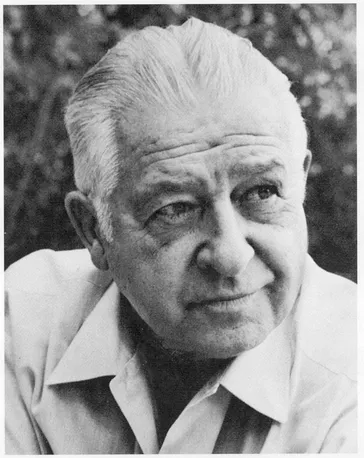
John Vassos, 1973. Photo by Douglas Fedor.
INTRODUCTION TO THE DOVER EDITION
DAVID A. BERONÄ
Prior to the Internet, whenever I entered a used bookstore, I would first locate the area where illustrated books were shelved. With my interest in wordless books, it was an exciting moment–though admittedly a rare occasion–when I found a work by Frans Masereel or Lynd Ward in those dusty and dimly lit stores. On some visits, however, I did discover illustrated books by these two artists, as well as many unfamiliar illustrators. The shelves of illustrated books were always packed tight with editions from various publishers, reflecting the renaissance in book illustration from the early twentieth century. This rebirth was primarily a direct result of the efforts of William Morris, the founder of the Kelmscott Press, who, as part of the Arts and Crafts Movement in England in the late nineteenth century, helped revive craftsmanship in bookmaking. Many publishers followed Morris’s lead, with special attention given to the illustrated book, including George Macy, who started the Limited Editions Club, and, later, the Heritage Press, whose mission was to “furnish to lovers of beautiful books unexcelled editions of their favorite works; to place beautifully printed books in the hands of book lovers at commendably low prices; and to foster in America a high regard for perfection in bookmaking.”
One book of interest that was a standard title illustrated by a variety of artists was The Ballad of Reading Gaol by Oscar Wilde. It was during my search for different editions of this lengthy poem that I discovered one illustrated by John Vassos, whose Art Deco illustrations filled me with a sense of wonder. I soon uncovered copies of all nine books that he illustrated from 1927 through 1935, including two other works by Oscar Wilde; three books written by John Vassos’s wife, Ruth Vassos; Thomas Gray’s Elegy Written in a Country Church-Yard; Samuel Taylor Coleridge’s Kubla Khan; and Phobia, which Vassos wrote as well as illustrated. When I found a copy of Phobia, I knew I was holding in my hands a bibliophile’s treasure.
John Vassos was born in Greece in 1898 but spent his youth in Constantinople (now Istanbul, Turkey), where his father was the editor of a newspaper. John, who showed an early interest in art, drew political cartoons for a rival newspaper, including one that was especially offensive to Turkish readers. To escape their wrath, Vassos, at the age of sixteen, left the country on a merchant ship. He spent five years at sea during World War I, once being rescued after a torpedo sunk his ship. He immigrated to Boston in 1919, where he initially worked for the Boston Opera Company as an assistant to Joseph Urban, famous for his production designs for the Ziegfeld Follies.
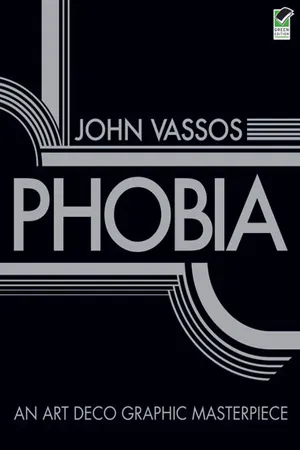
Vassos opened his own art studio, New York Display Company, in New York in 1924, winning accounts with thriving department stores such as Macy’s and Saks Fifth Avenue with his eye-catching advertisements and his distinctive hard-line medium of black-and-white gouache. It was during this time, prior to World War II, that Vassos illustrated the nine fine press books he is noted for today. After 1935, he moved from advertising to industrial design and was successful in designing early television models manufactured by RCA (Radio Corporation of America), where he worked for forty years. A founding member of the American Designers Institute (ADI) and the Industrial Designers Institute (IDI), Vassos played a major role in the 1965 merger of IDI with the American Society of Industrial Designers (ASID) and the Industrial Design Education Association (IDEA) to form the Industrial Designers Society of America (IDSA). Before his death in 1985, he oversaw the preparation of a survey of his books, published by Dover Publications in 1976, which offered examples from all nine volumes, long out of print, and included an informative foreword by P. K. Thomajan. In addition to the remarkable illustrations, the original book’s design had the distinctive Vassos style: strong bold lettering and a clear Art Deco style on the cover, with a simple embossed author and title encapsulated by mechanical designs in silver leaf. The interior text was presented in an unembellished bold font that set the stage visually for the illustrations on each facing page.
Vassos’s talent in industrial design was a perfect match for the prevalent Art Deco art movement, which was strongly influenced by the Cubism and Constructivism that flourished during the Great Depression. Art Deco works of art exhibited a mechanical style and were noted for their adoption of early geometrical designs used in Egyptian and Persian art. Vassos integrated his creative design of commercial products into his illustrations and book design, creating an unusual marriage of exceptional art work and mechanized simplicity.
Phobia not only reflects Vassos’s extraordinary hard-line technique, but also provides an historical document of psychology from an early-twentieth-century layman’s perspective. Vassos was well acquainted with Harry Stack Sullivan, regarded as the “Freud of America”; in fact, Vassos dedicated Phobia to him (“To H. S. S.”). In the original preface to his book, Vassos stated: “This is not a treatise on psychopathology. I have written the text merely as an aid to the understanding of the drawings and as a suggestion of some of the underlying factors by whose agency a phobia may be produced.” He continued with his reasons for his visual interpretations by noting that “a phobia is essentially graphic. The victim creates in his mind a realistic picture of what he fears, a mental image of a physical thing.”
Vassos introduces each phobia in bold text before the reader turns the page for the visual interpretation. What I found fascinating was his focus on the “powerlessness” of the victims and the underlying sexual repression that seemed pivotal in many of these maladies. Although the reasons behind these fears may seem dated, such as those strongly associated with sexual guilt, his ...