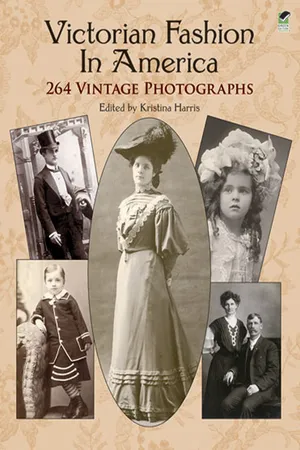
Compelling pictorial archive of 264 vintage photographs, selected from rare tintypes and other authentic materials (1850s–1910), depict little girls in their mothers' hats and clothes, sisters wearing identical plaid dresses and button boots, a young man in an everyday suit and bowler hat, a boy dressed in Little Lord Fauntleroy style, and scores of others.
- 96 pages
- English
- ePUB (mobile friendly)
- Available on iOS & Android
eBook - ePub
About this book
Information
Topic
DesignSubtopic
Fashion DesignIntroduction
Photographs are time machines—giving us a fascinating glimpse into everyday life in the past. They are important documents in the study of fashion, second only to existing garments. (In many ways, photos are superior to existing garments, because they show us exactly how garments were worn.)
Though fashion drawings may display tightly corseted waists, flat bellies, and enormous bustles, photographs show the reality of fashion, which may reveal that tight corsets were not the norm, that women’s bellies bulged, that bustles or hoops were worn smaller than fashion plates would have us believe, and that gloves or hats were not always mandatory. Photos also tell us what a woman’s posture was like in a hoopskirt, what was considered a “manly” or “ladylike” pose, how hats were tilted, and many other details that couldn’t be accurately discovered in any other way.
Too, photos expose the gulf between what the wealthy wore and what the poor wore. This is especially poignant when it’s considered that, just as they do today, people always tried to look their best when sitting for a portrait. This tendency was perhaps even stronger in the nineteenth century, when family photos were frequently displayed in parlors for guests.
Photographs are also collectible and important historical documents in their own right. At nearly every antique store or show, boxes can be found stuffed with sepia images of the past. Some people collect only “rare” images (of children with toys, for example), but a great many people buy old photos simply because they like the look of these people whose relatives seem to have forgotten them. (A running joke among dealers is to label boxes of old photos “Instant Relatives.”)
Dating the Images
There are two ways of determining a date for an image: examining the type of photograph and examining the fashions illustrated in the photo. Both methods were used in this book; for maximum accuracy, both should always be used.
I began collecting photographs because of the fashions depicted in them; therefore I often begin my journey into dating an image by studying the clothing shown. For photograph collectors, adding fashions to their repertoire can greatly help them pinpoint the dates of images. This method of dating, if used by itself, does, however, have its limitations.
Though fashion historians know when a style first appeared or first became popular (not necessarily the same), we can’t say for certain when a given person might have begun wearing it. Was it a month after it was first touted by the major fashion magazines, or more than a year later? When did the style come to an end? Did everyone suddenly stop wearing the style all at once, or (as is more likely) did its popularity wane gradually?
For the most part, since following fashion was far more socially important in the nineteenth and early twentieth centuries, it can be assumed that a person in a portrait photo was at least trying to keep up with the latest styles. (As author Priscilla Harris Dalrymple asks, “Why else would a lady strike a full-length profile pose in a dress with a bustle?”) Still, there were always individuals who clung to out-of-date fashions.
Another problem with this dating method is the way historians determine the...
Table of contents
- DOVER BOOKS ON FASHION
- Title Page
- Copyright Page
- Table of Contents
- Introduction
Trusted by 375,005 students
Access to over 1.5 million titles for a fair monthly price.
Study more efficiently using our study tools.
Frequently asked questions
Yes, you can cancel anytime from the Subscription tab in your account settings on the Perlego website. Your subscription will stay active until the end of your current billing period. Learn how to cancel your subscription
No, books cannot be downloaded as external files, such as PDFs, for use outside of Perlego. However, you can download books within the Perlego app for offline reading on mobile or tablet. Learn how to download books offline
Perlego offers two plans: Essential and Complete
- Essential is ideal for learners and professionals who enjoy exploring a wide range of subjects. Access the Essential Library with 800,000+ trusted titles and best-sellers across business, personal growth, and the humanities. Includes unlimited reading time and Standard Read Aloud voice.
- Complete: Perfect for advanced learners and researchers needing full, unrestricted access. Unlock 1.5M+ books across hundreds of subjects, including academic and specialized titles. The Complete Plan also includes advanced features like Premium Read Aloud and Research Assistant.
We are an online textbook subscription service, where you can get access to an entire online library for less than the price of a single book per month. With over 1.5 million books across 990+ topics, we’ve got you covered! Learn about our mission
Look out for the read-aloud symbol on your next book to see if you can listen to it. The read-aloud tool reads text aloud for you, highlighting the text as it is being read. You can pause it, speed it up and slow it down. Learn more about Read Aloud
Yes! You can use the Perlego app on both iOS and Android devices to read anytime, anywhere — even offline. Perfect for commutes or when you’re on the go.
Please note we cannot support devices running on iOS 13 and Android 7 or earlier. Learn more about using the app
Please note we cannot support devices running on iOS 13 and Android 7 or earlier. Learn more about using the app
Yes, you can access Victorian Fashion in America by Kristina Harris in PDF and/or ePUB format, as well as other popular books in Design & Fashion Design. We have over 1.5 million books available in our catalogue for you to explore.