![]()
SECTION II.
PREPARATORY OBSERVATIONS.
THE Lessons in the first Section, with but few exceptions, treated of the superficies of objects, and these were always executed in outline. The Lessons in this Number will represent objects as solids, with their light and shade. The most correct outline always requires shade to convey to the mind a complete idea of the solidity of the object it represents; but the first great essential is always to obtain a correct outline, and to this your attention will be particularly called throughout “ The Lessons.”
In this Number, also, you will find the practical value of your earliest Lessons by witnessing their application.
I cannot too much urge your attention to drawing from memory almost every Lesson. This practice is attended by many advantages, too important to be overlooked. It at once shows you what you have actually gained from the study of each Lesson; and shows your master whether you have really learned each Lesson, or merely copied it mechanically. His examination, in addition, enables him to judge whether you should repeat the Lesson, or may be permitted to proceed.
Drawing from memory educates your mind to a correct preconception of the change in the forms, and in the combination of objects, according to the point of view from which you see them; and beyond all other kinds of practice it best cultivates in you the power to draw from nature.
It is a great object, also, that you should execute these Lessons neatly, making all the perpendicular and horizontal lines perfectly perpendicular and horizontal, and exactly parallel.
To accomplish this, you should at first use a straight and a triangular ruler, and afterwards, when you perfectly understand the mode and order of executing each Lesson, you should draw it by hand only, and lastly from memory.
In this Number, also, is given to you a more complete application of the last paragraph of Lesson 13, which will be an additional proof of its great importance.
As the shadow in all cases contributes powerfully to satisfy the eye, it is more than probable you may hurry over the outline in order to put in the shade, which you find so pleasing and effective. If so, you will indeed “give up the substance for the shadow.” You must, however, remember that no shade can be effective on an incorrect outline, except to exhibit its defects more glaringly.
Drawing, and not shading, is the difficult acquirement. It is the form of a shadow, not the depth of its colour, which is of importance.
LESSON 24.
THE general remarks which you have at present to bear in mind regarding shade are,—
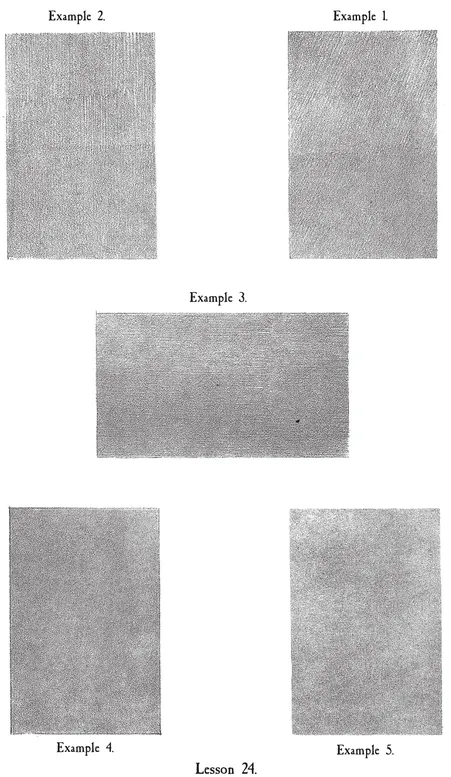
That it is produced by a repetition of lines either perpendicular, horizontal, or oblique; as shown in the Examples 1, 2, 3. These lines incline according to the inclination of the object whose shaded side is to be represented, subject to such modifications as varying circumstances may demand.
In all cases, shade, as seen in nature, whatever its depth, is of an even colour throughout; if it be found darker in one part than another, the increase in its depth is gradual from the lighter part—never sudden.
To produce this requisite evenness, the lines must be all of the same strength, and equally separate from each other, and the pencil must be held firmly in the hand. The distance of its point from the end of the fingers must be regulated by the depth of shade required, and should be greater or less, according as a lighter or darker shade is wanted, and should be produced from pencils having a broad point, and such as are made expressly with thick and broad lead.
Example 1 is done by perpendicular lines, which are plainly seen on the upper part, but they are not allowed to touch each other at their extremities.
Lean as equally as possible on each line, and separate them equally from each other; the whole mass of shade being thus done, though with great care, will not be perfectly even, the white and lighter spaces between the lines must afterwards be filled up by other perpendicular lines, and with a harder pencil. The shade may thus be made as even as you see it in the lower part of the example.
Example 2 is produced by a mass of sloping lines, as shown on the upper part, the light spaces being afterwards filled up, also by oblique lines, with a pencil having a finer point, until the whole of the shade becomes, like the lower part of this example, perfectly even. It is this perfect evenness which is the essential requisite.
Example 3 is produced by horizontal lines, the ends of which should not touch, or barely; but here they have been allowed to overlap, in order to show you that if by chance you should make such a mistake, the excess of colour thus produced you may nearly or quite remove by just touching the parts which are too dark with the point of a small piece of bread which has been rolled between the fingers into this form
. By thus removing any parts too dark, and by filling in such as are too light, the shade may be made even.
As a general rule, such methods of shading as are here represented in Examples 1, 2, and 3, are employed on near objects, because, at the same time that the shade is made even, the lines assist to indicate the surface and the proximity of the object. But shade, such as may with more propriety be applied to distant objects, or in cases when it is desirable not to show any character, must then be done in the following manner, as seen in Example 4.
Take a soft pencil, and rub it on a piece of coarse paper, and charge a leather stump with the lead so obtained, with which produce the shade as here shown, by passing the stump backwards and forwards perpendicularly; then with a fine point to a harder pencil, fill up the light spaces as before. The stump must of course be charged with the lead in quantity according to the depth of shade required. When the shade is completed by filling up the light parts, it is always darker. It must, therefore, in the first instance, be laid in paler than is required, so as to allow for the additional depth obtained in making it even. The last—
Example 5, is done by the stump only when lightly charged with lead, and may be so managed as to procure evenness at once.
In attempting the various shades, besides attending to the instructions here given, you must bear in mind what is said in the first Lesson relative to the position of your arm.
LESSON 25.
HITHERTO your study has been confined to the drawing of superfices, that is, of forms which have no breadth or thickness, and therefore have no shade.
You are now entering on the study of solids, and, consequently, will require the addition of shade to express solidity. Having passed through the various examples contained in your last Lesson, you should therefore be prepared to add the shade, properly, to all your future Lessons, whatever may be the direction of the lines by which they are produced. Remember they are always regulated by the nature of the surface under shade, whether it be perpendicular, horizontal, oblique, or curved.
Several of the following Lessons you will find illustrated by wood-cuts. In these, the shades are represented by narrower and more obvious lines, than could be easily produced from the chalk or pencil; but it is not necessary that you should imitat...