![]()
ENID
![]()
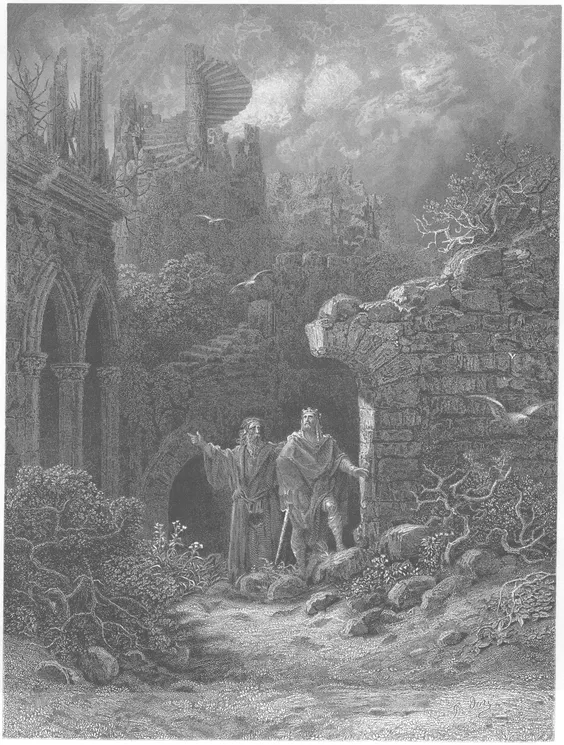
PLATE I
ENID HAS BEEN married to Prince Geraint—one of Arthur’s knights of the Round Table—for a year, and at court, Enid is one of Queen Guinevere’s favorites. Afraid that his wife might be influenced by Guinevere’s adulterous behavior, Geraint takes her away from Camelot. Once they return to his own earldom, which has become lawless in his absence, Geraint becomes so obsessed with watching over Enid that he forgets all other duties, and is ridiculed by his own subjects. Enid feels she should say something to him, but cannot. One morning, as she watches Geraint sleeping, she begins to upbraid herself for not speaking frankly to her husband. He wakes, only to hear her last words: “O me, I fear that I am no true wife.” Assuming his wife has been unfaithful, he determines to “ride forth into the wilderness” accompanied by Enid, who is to put on “her worst and meanest dress” as a sign of her offense. As she prepares to leave, ignorant of what she has done wrong, Enid recalls her first meeting with Geraint.
A year earlier, while Geraint is attending the Queen at a royal hunt, they see a strange knight, accompanied by a dwarf and a lady, ride by. Curious, the Queen asks Geraint to find out his name. When the knight refuses to answer, thereby insulting Geraint and the Queen, Geraint follows him to avenge the insult. Geraint’s search leads him to the ruined castle of Yniol, Enid’s father, who invites Geraint to partake of his hospitality. As Yniol escorts Geraint through the courtyard,
He look’d and saw that all was ruinous.
Here stood a shattcr’d archway plumed with fern;
And here had fall’n a great part of a tower,
Whole, like a crag that tumbles from the cliff,
And high above a piece of turret stair,
Worn by the feet that now were silent, wound
Bare to the sun, and monstrous ivy-stems
Claspt the gray walls with hairy-fibred arms,
And suck’d the joining of the stones, and look’d
A knot, beneath, of snakes, aloft, a grove. (315–325)
![]()
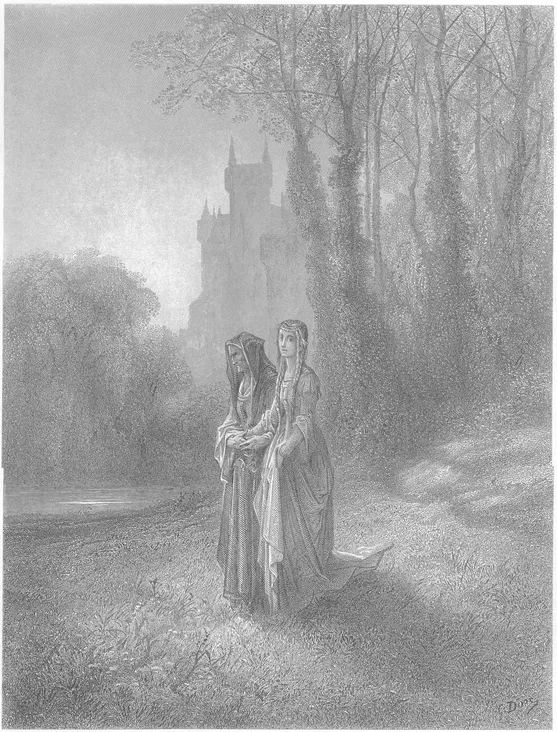
PLATE II
GERAINT IS SERVED that evening by Enid, who must assume the role of servant because her family is so poor. First attracted by her beauty, Geraint is further charmed at “seeing her so sweet and serviceable,” and before the evening is through he falls in love with her. Meanwhile Yniol tells Geraint that the knight he seeks is his own nephew, known as the “sparrow-hawk.” This knight, once Enid’s suitor, had been rejected by Yniol; infuriated, he brought Yniol’s family to ruin and usurped Yniol’s earldom. Geraint, on hearing the story, offers to challenge the sparrow-hawk at the tournament to be held the following day. Although he appreciates Geraint’s offer, Yniol explains that no man can tilt, “Except the lady he loves best be there.” Geraint then reveals that he loves Enid and, with Yniol’s permission, he will fight the sparrow-hawk and claim victory in her name. Yniol agrees and sends his wife to tell Enid, who doesn’t respond with words, but is clearly honored by Geraint’s favor:
Nor did she lift an eye nor speak a word,
Rapt in the fear and in the wonder of it;
So moving without answer to her rest
She found no rest, and ever fail’d to draw
The quiet night into her blood, but lay
Contemplating her own unworthiness;
And when the pale and bloodless east began
To quicken to the sun, arose, and raised
Her mother too, and hand in hand they moved
Down to the meadow where the jousts were held,
And waited there for Yniol and Geraint.
And thither came the twain, and when Geraint
Beheld her first in field, awaiting him,
He felt, were she the prize of bodily force,
Himself beyond the rest could move
The chair of Idris. (528-543)
![]()
PLATE III
SOON THE TOURNAMENT grounds arc filled with knights and ladies, and the field is prepared: “Two forks are fix’t into the meadow ground, / And over these is laid a silver wand, / And over that is placed the sparrow-hawk, / The prize of beauty for the fairest there.” For the past two years, Yniol’s nephew has won the prize, and so won the name “sparrow-hawk.” As he claims the prize—not expecting any challengers—Geraint boldly comes forward. The two men are evenly matched, and the battle is fierce; just when both are nearly exhausted, Yniol cries to Geraint, “Remember that great insult done the Queen.” Inspired, Geraint conquers the sparrow-hawk and once again asks his name.
[T]he fallen man
Made answer, groaning, “Edyrn, son of Nudd!
Ashamed am I that I should tell it thee.
My pride is broken: men have seen my fall.”
“Then, Edyrn, son of Nudd,” replied Geraint,
“These two things shalt thou do, or else thou diest.
First, thou thyself, thy lady, and thy dwarf,
Shalt ride to Arthur’s court, and being there,
Crave pardon for that insult done the Queen,
And shalt abide her judgment on it; next,
Thou shalt give back their earldom to thy kin.
These two things shalt thou do, or thou shalt die.”
And Edyrn answer’d, “These things will I do,
For I have never yet been overthrown,
And thou hast overthrown me, and my pride
Is broken down, for Enid sees my fall!”
And rising up, he rode to Arthur’s court,
And there the Queen forgave him easily. (575-592)
![]()
PLATE IV
ENID AND GERAINT travel to Camelot after the tournament, where they are married “with all ceremony” Now, a year later, the two prepare for another journey. Geraint orders Enid to ride ahead of him—not by his side—and charges her, whatever happens, not to speak to him. As they travel, past “bandit-haunted holds, / Gray swamps and pools, waste places of the hern, / And wildernesses, perilous paths,” Enid notices three knights, “caitiffs all,” lying in wait for them. Despite Geraint’s command, Enid turns back to warn her husband. Angry that she has disobeyed, Geraint prepares to prove to her that his “vigour is not lost.” He conquers the villains, and claims as his prize their armor and horses, which he orders Enid to herd before her. They move on, and once more Enid spies three horsemen waiting to ambush them. She turns back again to warn Geraint:
“There lurk three villains yonder i...