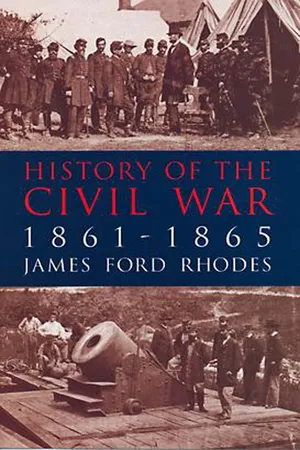
Awarded the Pulitzer Prize in 1917, James Ford Rhodes's History of the Civil War, 1861–1865 stands among the essential works in American history. Remarkable for its scholarly research, objectivity and engrossing narrative style, this volume is widely regarded as one of the most outstanding studies — and the first unbiased history — of the Civil War.
The book presents a neutral approach to the bloody struggle, neither distorting nor coloring the facts. Rhodes worked methodically, collecting the evidence, considering the opinions of others, and then precisely and lucidly presenting his own conclusions. Distilling material from official military records, diaries, reminiscences, letters, memoirs, newspapers, manuscripts, books, and interviews, the author produced an essential, carefully weighed, and complete account. The critics agreed: "a clear outline of the Civil War . . . it is well worthy of the welcome it has already received." — American Historical Review. " . . . the author's notable faculty of summarizing without leaving out the spirit, the life, and the color of events . . . infuses his narrative with unusual power to re-create the time of which he writes." — The New York Times.
While the narrative is neutral, choosing neither villains nor heroes, the ideological direction of Rhodes's work is surprisingly current. In accord with such present-day interpreters of the Civil War period as James McPherson and Ken Burns, Rhodes saw the Civil War as essentially a fight for freedom, and focused upon Abraham Lincoln as the deciding factor in the granting of freedom and the winning of the war.
This Dover edition contains a cogent new introduction by John Herbert Roper, Richardson Professor of American History, Emory and Henry College, Emory, Virginia.
- 528 pages
- English
- ePUB (mobile friendly)
- Available on iOS & Android
eBook - ePub
History of the Civil War, 1861-1865
About this book
Information
HISTORY OF THE CIVIL WAR
CHAPTER I
THE great factor in the destruction of slavery was the election of Abraham Lincoln as President in 18601 by the Republican party, who had declared against the extension of slavery into the territories. The territories were those divisions of the national domain2 which lacked as yet the necessary qualifications for statehood through insufficient population or certain other impediments they were under the control of Congress and the President. The Republicans were opposed to any interference with slavery in the States where it already existed, but they demanded freedom for the vast unorganized territory west of the Missouri river. How the election of Lincoln was brought about I have already related at length in my History of the United States from the Compromise of 1850 to the Final Restoration of Home Rule at the South in 1877 3 and more briefly in the first of my Oxford Lectures.4 It was a sectional triumph, inasmuch as Lincoln did not receive a single vote in ten out of the eleven States that afterwards seceded and made up the Confederate States. Charleston, South Carolina, an ultra pro-slavery city and eager for secession, rejoiced equally with the Northern cities over the election of Lincoln, but the Charleston crowds were cheering for a Southern confederacy.5 Herein were they supported by the people of South Carolina generally, who saw in the election of Lincoln an attack on their cherished institution of slavery and cared no longer for political union with a people who held them to be living in the daily practice of evil. They regarded their slaves as property and believed that they had the same constitutional right to carry that property into the common territory as the Northern settlers had to take with them their property in horses and mules. Lincoln as President would deny them that privilege; in other words he would refuse them equality. In his speeches he had fastened a stigma upon slavery; believing it wrong, he must oppose it wherever he had the power, and he certainly would limit its extension. Could a free people, they asked, have a more undoubted grievance? Were they not fired by the spirit of 1776 and ought they not to strike before any distinct act of aggression? Revolution was a word on every tongue. The crisis was like one described by Thucydides when “the meaning of words had no longer the same relation to things. . . . Reckless daring was held to be loyal courage; prudent delay was the excuse of a coward; moderation was the disguise of unmanly weakness. . . . Frantic energy was the true quality of a man.” 6 The people of South Carolina amid great enthusiasm demanded almost with one voice that their State secede from the Federal Union. The authorities promptly responded. A Convention duly called and chosen passed an Ordinance of secession which was termed a Declaration of Independence of the State of South Carolina.7 This act, in view of the South Carolinians and of the people of the other cotton States, was based on the State’s reserved right “under the compact entitled the Constitution.” Martial music, bonfires, pistol firing, fireworks, illuminations, cries of joy and exultation greeted the passage of the Ordinance, which seemed to the people of Charleston to mark the commencement of a revolution as glorious as that of 1776.8
Meanwhile the United States Senate, through an able and representative committee of thirteen, was at work on a compromise in the spirit of earlier days. In 1820, according to Jefferson, the knell of the Union had been rung; the slavery question, said he, “like a fire-bell in the night awakened and filled me with terror.” But then the Missouri Compromise had saved the Union.9 Again, in 1850 when the South and the North were in bitter opposition on the same issue of slavery and threats of dissolution of the Union were freely made by Southern men, the controversy was ended by Clay’s Compromise.10 And now in 1860 the people of the Northern and of the border slave States, ardent for the preservation of the Union, believed that Congress could somehow compose the dispute as it had done twice before. The Senate committee of thirteen at once took up the only expedient that could be expected to retain the six remaining cotton States in the Union.11 This was the Crittenden Compromise, called after its author, a senator from Kentucky; and the portion of it on which union or disunion turned was the article regarding territorial slavery. Crittenden proposed as a constitutional amendment that the old Missouri Compromise line of 36° 30’ should serve as the boundary between slavery and freedom in the Territories; north of it slavery should be prohibited, south of it protected. As phrased, the article was satisfactory to the Northern Democratic and border slave State senators, who together made up six of the committee. The two senators from the cotton States would have accepted it, had the understanding been clear that protection to slavery was to apply to all territory acquired in the future south of the Compromise line. The five Republican senators opposed the territorial article, and, as it had been agreed that any report to be binding must have the assent of a majority of these five, they defeated in committee this necessary provision of the Compromise. William H. Seward,12 one of the thirteen, the leader of the Republicans in Congress, and the prospective head of Lincoln’s Cabinet, would undoubtedly have assented to this article, could he have secured Lincoln’s support. But Lincoln, though ready to compromise every other matter in dispute, was inflexible on the territorial question: that is to say as regarded territory which might be acquired in the future. He could not fail to see that the Territories which were a part of the United States in 1860 were, in Webster’s words, dedicated to freedom by “an ordinance of nature” and “the will of God”; and he was willing to give the slaveholders an opportunity to make a political slave State out of New Mexico, which was south of the Missouri Compromise line.13 But he feared that, if a parallel of latitude should be recognized by solemn exactment as the boundary between slavery and freedom, “filibustering for all south of us and making slave States of it would follow in spite of us.” “A year will not pass,” he wrote further, “till we shall have to take Cuba as a condition upon which they [the cotton States] will stay in the Union.” Lincoln, therefore, using the powerful indirect influence of the President-elect, caused the Republican senators to defeat the Crittenden Compromise in the committee, who were thus forced to report that they could not agree upon a plan of adjustment. Then Crittenden proposed to submit his plan to a vote of the people. So strong was the desire to preserve the Union that, had this been done, the majority would probably have been overwhelming in favor of the Compromise; and, although only an informal vote, it would have been an instruction impossible for Congress to resist. Crittenden’s resolution looking to such an expression of public sentiment was prevented from coming to a vote in the Senate by the quiet opposition of Republican senators: the last chance of retaining the six cotton States in the Union was gone.14
Between January 9 and February 1, 1861, the conventions of Mississippi, Florida, Alabama, Georgia, Louisiana and Texas passed ordinances of secession. Early in February the Confederate States was formed. Delegates from six cotton States 15 assembled in Montgomery and, proceeding in an orderly manner, formed a government, the cornerstone of which rested “upon the great truth. . . that slavery is the negro’s natural and normal condition.” They elected Jefferson Davis16 President and adopted a Constitution modelled on that of the United States, but departing from that instrument in its express recognition of slavery and the right of secession.17
When Lincoln was inaugurated President on March 4, he confronted a difficult situation. Elected by a Union of thirty-three States, he had lost, before performing an official act, the allegiance of seven. Believing “that no State can in any way lawfully get out of the Union without the consent of the others and that it is the duty of the President. . . to run the machine as it is,” 18 he had to determine on a line of policy toward the States that had constituted themselves the Southern Confederacy. But any such policy was certain to be complicated by the desirability of retaining in the Union the border slave States of Maryland, Virginia, Kentucky and Missouri, as well as North Carolina, Tennessee and Arkansas, whose affiliations were close with the four border States. All seven were drawn towards the North by their affection for the Union and towards the South by the community of interest in the social system of slavery. One of Lincoln’s problems then was to make the love for the Union outweigh the sympathy with the slaveholding States that had seceded.
It is difficult to see how he could have bettered the policy to which he gave the keynote in his inaugural address. “I hold,” he said, “that the union of these States is perpetual. . . . Physically speaking we cannot separate. . . . The power confided to me will be used to hold, occupy and possess the property and places belonging to the Government.” This last declaration, though inevitable for a President in his position, outweighed all his words of conciliation and rendered of no avail his closing pathetic appeal to his “dissatisfied fellow countrymen” not to bring civil war on the country.19
During the progress of the secession, the forts, arsenals, custom-houses and other property of the Federal government within the limits of the cotton States were taken possession of by these States and, in due time, all this property was turned over to the Southern Confederacy, so that on March 4, all that Lincoln controlled was four military posts, of which Fort Sumter, commanding Charleston, was much the most important.20 Since the very beginning of the secession movement, the eyes of the North had been upon South Carolina. For many years she had been restive under the bonds of the Union; her chief city, Charleston, had witnessed the disruption of the Democratic national convention,21 and the consequent split in the party which made certain the Republican success of 1860, that in turn had led to the secession of the State and the formation of the Southern Confederacy. Fort Sumter had fixed the attention of the Northern mind by an occurrence in December, 1860. Major Anderson with a small garrison of United States troops had occupied Fort Moultrie; but, convinced that he could not defend that fort against any attack from Charleston, he had, secretly on the night after Christmas, withdrawn his force to Fort Sumter, a much stronger post. Next morning, when the movement was discovered, Charleston fumed with rage whilst the North, on hearing the news, was jubilant and made a hero of Anderson.22 Lincoln recognized the importance of holding Fort Sumter but he also purposed to use all means short of the compromise of his deepest convictions to retain the border slave States and North Carolina, Tennessee and Arkansas in the Union. The action of these three turned upon Virginia, whose convention was in session, ready to take any action which the posture of affairs seemed to demand. The fundamental difficulty now asserted itself. To hold Fort Sumter was to Lincoln a bounden duty but to the Virginians it savored of coercion; and coercion in this case meant forcing a State which had seceded, back into the Union. If an attempt was made to coerce a State, Virginia would join the Southern Confederacy. The Confederate. States now regarded the old Union as a foreign power whose possession of a fort within their limits, flying the American flag, was a daily insult. They attempted to secure Sumter by an indirect negotiation with the Washington government and were encouraged by the assurances of Seward, Lincoln’s Secretary of State and most trusted counsellor. Had the President known of Seward’s intimation, which was almost a promise, that Sumter would be evacuated, he would have been greatly perturbed and would have called a halt in the negotiations to the end that the Southern commissioners be undeceived. On April 1 he was further troubled by a paper, “Some Thoughts for the President’s Consideration,” which Seward had privately submitted to him as an outline of the fit policy to be pursued. This was briefly : the evacuation of Fort Sumter; the reënforcement of the other posts in the South; a demand at once for explanations from Spain and France and, if they were not satisfactory, a call of a special session of Congress to declare war against those two nations; also explanations to be sought from Great Britain and Russia. With that same rash disregard of his chief and blind reliance on his own notions of statecraft which he had shown in his negotiations with Justice Campbell, the intermediary between himself and the Southern commissioners, who had been sent to Washington by Davis, he gave the President a strong hint that the execution of this policy should be devolved upon some member of the Cabinet and that member, himself. The proposed foreign policy was reckless and wholly unwarranted. Our relations with these four powers were entirely peaceful; to use Seward’s own words less than three months before, “there is not a nation on earth that is not an interested, admiring friend.” 23 Seward had got it into his head that, if our nation should provoke a foreign war, the cotton States would unite in amity with the North and like brothers fight the common foe under the old flag. Lincoln of course saw that the foreign policy proposed was wild and foolish but ignored it in his considerate reply to “Some Thoughts for the President’s Consideration”; he kept the existence of the paper rigidly a secret; 24 he did not demand the Secretary’s resignation; he had for him no word of sarcasm or reproach.
The President submitted to another drain on his time and strength in the persistent scramble for office. “The grounds, halls, stairways, closets of the White House,” wrote Seward, are filled with office seekers; and Lincoln said, “I seem like one sitting in a palace assigning apartments to importunate applicants, while the structure is on fire and likely soon to perish in ashes.”25 When he ought to have been able to concentrate his mind on the proper attitude to the seceding States, he was hampered by the ceaseless demands for a lucrative recognition from his supporters and by the irrational proposals of the chief of his Cabinet.
The great problem now was Sumter. What should be done about it? On the day after his inauguration, the President was informed that Anderson believed a reënforcement of 20,000 men necessary for the defence of the post; 26 after being transported to the neighborhood by sea, they must fight their way through to the fort. For the South Carolinians had been steadily at work on the islands in Charleston harbor erecting batteries and strengthening the forts which bore on Sumter. Moreover, Anderson’s provisions would not last beyond the middle of April. General Scott, the head of the army, advised the evacuation of Sumter, a logical step in the course of action toward the South, which he and other men of influence had advocated and which he expressed in the pertinent words, “Wayward sisters depart in peace.” 27 At the Cabinet meeting of March 15 the President asked his advisers, If it be possible to provision Fort Sumter, is it wise to attempt it? Four
agreed with Seward, saying, No; only two gave an affirmative answer. Lincoln undoubtedly had moments of thinking that the Fort must be evacuated.28 With his eye upon Virginia, whose convention he hoped might adjourn without action, he may have promised one of her representatives that he would withdraw Anderson, provided the Virginia convention, always a menace of secession while it continued to sit, would adjourn sine die. The evidence is too conflicting to justify a positive assertion; but if such a proposal were made, it was never transmitted to and acted upon by the convention.29
In the final decision, the sentiment of the North had to be taken into account. To abandon Sumter would seem to indicate that a peaceful separation would follow; that the principle of the sovereignty of the States and secession had triumphed. Finally, with increasing support in his Cabinet, Lincoln came to a wise decision. Reënforcement from a military point of view was impracticable; to reach the fort the North might have to fire the first. shot. But, as a political measure, he decided to “send bread to Anderson,” 30 so that Sumter would not have to be evacuated from lack of food. In accordance with his previous promise,31 he sent word to the Governor of South Carolina of his intention. Beauregard, commander of the Confederate troops at Charleston, who in company with the Governor heard the formal notification, telegraphed it to the Confederate Secretary of War at Montgomery, receiving two days later [April 10] the order to demand the evacuation of Fort Sumter and, if this was refused, to proceed to reduce it.
The demand was ...
Table of contents
- DOVER BOOKS ON HISTORY, POLITICAL AND SOCIAL SCIENCE
- Title Page
- Copyright Page
- INTRODUCTION TO THE DOVER EDITION
- INTRODUCTION
- PREFACE
- Table of Contents
- ABBREVIATIONS OF TITLES OF AUTHORITIES
- CHAPTER I
- CHAPTER II
- CHAPTER III
- CHAPTER IV
- CHAPTER V
- CHAPTER VI
- CHAPTER VII
- CHAPTER VIII
- CHAPTER IX
- CHAPTER X
- CHAPTER XI
- CHAPTER XII
- CHAPTER XIII
- CHAPTER XIV
- NOTES
- NOTES
- INDEX
Trusted by 375,005 students
Access to over 1.5 million titles for a fair monthly price.
Study more efficiently using our study tools.
Frequently asked questions
Yes, you can cancel anytime from the Subscription tab in your account settings on the Perlego website. Your subscription will stay active until the end of your current billing period. Learn how to cancel your subscription
No, books cannot be downloaded as external files, such as PDFs, for use outside of Perlego. However, you can download books within the Perlego app for offline reading on mobile or tablet. Learn how to download books offline
Perlego offers two plans: Essential and Complete
- Essential is ideal for learners and professionals who enjoy exploring a wide range of subjects. Access the Essential Library with 800,000+ trusted titles and best-sellers across business, personal growth, and the humanities. Includes unlimited reading time and Standard Read Aloud voice.
- Complete: Perfect for advanced learners and researchers needing full, unrestricted access. Unlock 1.5M+ books across hundreds of subjects, including academic and specialized titles. The Complete Plan also includes advanced features like Premium Read Aloud and Research Assistant.
We are an online textbook subscription service, where you can get access to an entire online library for less than the price of a single book per month. With over 1.5 million books across 990+ topics, we’ve got you covered! Learn about our mission
Look out for the read-aloud symbol on your next book to see if you can listen to it. The read-aloud tool reads text aloud for you, highlighting the text as it is being read. You can pause it, speed it up and slow it down. Learn more about Read Aloud
Yes! You can use the Perlego app on both iOS and Android devices to read anytime, anywhere — even offline. Perfect for commutes or when you’re on the go.
Please note we cannot support devices running on iOS 13 and Android 7 or earlier. Learn more about using the app
Please note we cannot support devices running on iOS 13 and Android 7 or earlier. Learn more about using the app
Yes, you can access History of the Civil War, 1861-1865 by James Ford Rhodes in PDF and/or ePUB format, as well as other popular books in History & American Civil War History. We have over 1.5 million books available in our catalogue for you to explore.