"Vignola codified the rules of classical architecture for the Italian Renaissance . . . Ware codified Vignola for the American Renaissance." — John Barrington Bayley, from the Introductory Notes to The American Vignola
From 1890 to 1940, Americans designed and built classical architecture on an extraordinary scale. During this American Renaissance were built countless libraries, museums, universities, courthouses, capitol buildings and other structures, both public and private, rich with domes, pediments, colonnades, and other classical features. "We built with unparalleled grandeur," architect and scholar John Barrington Bayley observes, "and our architecture led the world."
More than any other document of the period, The American Vignola laid the groundwork for this grand resurgence in American architecture. Its author, William R. Ware, founded America's first school of architecture at M.I.T. in 1865, and sixteen years later, the School of Architecture at Columbia University. He became America's leading teacher of the art of designing classical architecture. The American Vignola is his textbook on that art.
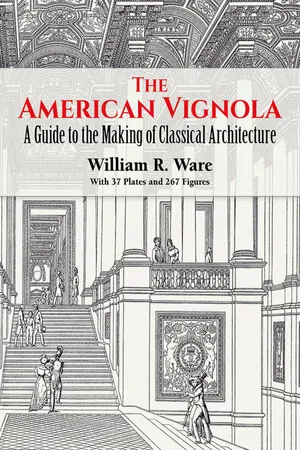
As the Renaissance architect Giacomo Barozzi da Vignola helped to recover the lost laws of classical architecture that made possible the architectural wonders of the Italian Renaissance, Ware helped lay the groundwork for the wonders of the American Renaissance. The American Vignola contains tables of the Tuscan, Ionic, Doric, Corinthian, and Composite Orders; measured drawings of the great monuments of the ancient, Renaissance, and baroque periods; and guides for drawing and establishing geometrical relations. Especially important are its detailed practical instructions for designing classical arches and vaults, roofs and domes, doors and windows, walls and ceilings, steps and staircases, and more. Over 300 illustrations illuminate the text, including 37 full-page plates and 267 smaller figures. Introductory notes by Mr. Bayley and architectural expert Henry Hope Reed set Mr. Ware's great achievement in perspective.
- 160 pages
- English
- ePUB (mobile friendly)
- Available on iOS & Android
eBook - ePub
About this book
Information
Topic
ArchitectureSubtopic
History of ArchitecturePART I
The Five Orders
PREFACE
IN January, 1859, I went from Mr. Edward Cabot’s office in Boston, where I had been for two or three years, to join the little company of half a dozen young men who were studying architecture in the Studio Building in Tenth Street, under the inspiration of Mr. Richard Hunt. Mr. Hunt had just returned from Paris and was eager to impart to younger men, though we were not much his juniors, what he had learned in the École des Beaux-Arts and in work upon the New Louvre. We had all, I believe, had more or less of office experience, but those were the days when the Gothic Revival was at its height, and Mr. Hunt found most of us unfamiliar with Classical details and quite unskilled in their use. I, at any rate, knew hardly a touch of them, and I remember well the day when, as I was carefully drawing out a Doric Capital according to the measurements given in my Vignola, Mr. Hunt took the pencil out of my hand and, setting aside the whole apparatus of Modules and Minutes, showed me how to divide the height of my Capital into thirds, and those into thirds, and those again into thirds, thus getting the sixths, ninths, eighteenths, twenty-sevenths, and fifty-fourths of a Diameter which the rules required, without employing any larger divisor than two or three.
It seemed as if this method, so handy with the Doric Capital, might be applied to other things, and I forthwith set myself to studying the details of all the Orders, and to devising for my own use simple rules for drawing them out. The present work presents the results of these endeavors. Experience in the class room has, meanwhile, amplified and extended them, and they have at many points been improved by the suggestions of my colleagues.
I am particularly indebted to Professor Hamlin and to Mr. W. T. Partridge for some ingenious applications of the 45-degree line to the Doric Entablature and to the Corinthian Capital, and for an analogous employment of the 60-degree line.
Finding that the plates in which, for the convenience of my own students, I have embodied these results are somewhat in demand by others, I now publish them in the present volume, adding such text and marginal illustrations as the subject matter seems to require. The Plates have been drawn out for me anew by Mr. Partridge, as have also most of the Illustrations. The rest have been taken from standard publications, especially from Bühlmann’s “Architecture of Classical Antiquity and the Renaissance,” which has furnished twenty-six of the Figures.
The forms and proportions here set forth are, in the main, those worked out by Giacomo Barozzi da Vignola and first published by him at Rome in the year 1563, as those which, in his judgment, best embodied the best practice of the ancient Romans. Other systems have been presented by Alberti, Palladio, Scamozzi, Serlio, Sir William Chambers, and others. But Vignola’s Orders have generally been accepted as the standard. His works have been frequently republished, and recourse must be had to them for minute information in regard to details. But the dimensions given in this book, and the methods of determining them here described, will suffice for the execution of all drawings and designs which are made to a small scale.
This volume is concerned only with Columns, Pilasters and Entablatures, Pediments, Pedestals, and Balustrades. The employment of these Elements in the Composition of Doors and Windows, Wall Surfaces, external and internal, Staircases, Towers, and Spires, Arches and Arcades, Vaults and Domes, and other architectural features, will, I hope, at a later day be made the subject of a separate treatise which will be the natural sequel to this one.
After the chief part of this volume was in press my attention was directed to a somewhat similar work by the celebrated James Gibbs, the architect of St. Martin’s-in-the-Fields and of St. Mary-le-Strand. He published in London, in 1732, a series of plates showing the Orders and their applications with a...
Table of contents
- THE CLASSICAL AMERICA SERIES IN ART AND ARCHITECTURE
- Title Page
- Copyright Page
- Table of Contents
- FOREWORD TO THE DOVER EDITION
- INTRODUCTORY NOTES - for the Classical America Edition
- PART I - The Five Orders
- PART I - The Plates
- PART II - Arches and Vaults Roofs and Domes Doors and Windows Walls and Ceilings Steps and Staircases
- PART II - The Plates
Trusted by 375,005 students
Access to over 1.5 million titles for a fair monthly price.
Study more efficiently using our study tools.
Frequently asked questions
Yes, you can cancel anytime from the Subscription tab in your account settings on the Perlego website. Your subscription will stay active until the end of your current billing period. Learn how to cancel your subscription
No, books cannot be downloaded as external files, such as PDFs, for use outside of Perlego. However, you can download books within the Perlego app for offline reading on mobile or tablet. Learn how to download books offline
Perlego offers two plans: Essential and Complete
- Essential is ideal for learners and professionals who enjoy exploring a wide range of subjects. Access the Essential Library with 800,000+ trusted titles and best-sellers across business, personal growth, and the humanities. Includes unlimited reading time and Standard Read Aloud voice.
- Complete: Perfect for advanced learners and researchers needing full, unrestricted access. Unlock 1.5M+ books across hundreds of subjects, including academic and specialized titles. The Complete Plan also includes advanced features like Premium Read Aloud and Research Assistant.
We are an online textbook subscription service, where you can get access to an entire online library for less than the price of a single book per month. With over 1.5 million books across 990+ topics, we’ve got you covered! Learn about our mission
Look out for the read-aloud symbol on your next book to see if you can listen to it. The read-aloud tool reads text aloud for you, highlighting the text as it is being read. You can pause it, speed it up and slow it down. Learn more about Read Aloud
Yes! You can use the Perlego app on both iOS and Android devices to read anytime, anywhere — even offline. Perfect for commutes or when you’re on the go.
Please note we cannot support devices running on iOS 13 and Android 7 or earlier. Learn more about using the app
Please note we cannot support devices running on iOS 13 and Android 7 or earlier. Learn more about using the app
Yes, you can access The American Vignola by William R. Ware in PDF and/or ePUB format, as well as other popular books in Architecture & History of Architecture. We have over 1.5 million books available in our catalogue for you to explore.