"It should be read by anyone even remotely interested in the long saga of the universe's profound and lasting influence on mankind’s development." — New Scientist
"A grand book." — Publishers Weekly
"Dr. Krupp teaches us once more to look up at the stars and marvel." — Ray Bradbury
The intriguing world of archaeoastronomy — the study of ancient peoples' observations of the skies and the impact of what they saw on their cultural evolution — is the focus of this eminently readable and authoritative survey. Author E. C. Krupp, an astronomer, is the director of the Griffith Observatory in Los Angeles, California. He is one of the world's greatest experts on archaeoastronomy, and the author of numerous books including Beyond the Blue Horizon (1992) and In Search of Ancient Astronomies (1978). His interpretations of sky-watching customs from around the world range from everyday pursuits such as measuring time and calculating planting seasons to philosophical issues concerning the role of humanity within the larger context of the universe.
Beginning with an explanation of how the sky works and how people have relied upon its guidance for centuries, Dr. Krupp explores ancient and prehistoric observatories, from sites in China and Babylonia to Scotland and Peru. He relates sky god mythology from many cultures, discusses astronomy's influence on funerary rites and other vigils and rituals, and profiles sacred places such as Stonehenge and the kivas of the American Southwest. An extraordinary interdisciplinary work of investigation and discovery, this book offers a compelling portrait of the ancient stargazers, their beliefs, and their customs. 208 illustrations. Bibliography. Index.
"This remarkable book, written by one of the greatest experts on archaeoastronomy is packed with valuable information." — Message to Eagle
- 416 pages
- English
- ePUB (mobile friendly)
- Available on iOS & Android
eBook - ePub
About this book
Information
Topic
Physical SciencesSubtopic
Astronomy & Astrophysics1
The Lights We See
The way people look at the universe has a lot to do with how they behave. And the sky is what used to tell us about the big picture—about what really makes the world the way it is.
In this age of urbanization and artificial light, it is difficult to appreciate the paramount importance of the sky to our ancestors. Digital watches and desk calendars are readily available; there is no need to watch the sky to tell the time of day or the year. And under the lights of our cities, we can scarcely see anything overhead—the night is diluted. Most of the stars are fainter than the background of scattered light. For city dwellers, the night sky is preserved only under the dome of the local planetarium. We have struggled—successfully—to shelter ourselves from the elements, and we have managed to shut out the sky. In the process, we also have removed ourselves from one of the fundamental components of our culture.
For most of the history of humankind, going back to stone age times, the sky has served as a tool. Just as the hands of the first people grasped the flints they crafted, so their brains grasped the sky. The regularity of the motions of celestial objects enabled them to orient themselves in time and space. And just as their culture was partly a product of the tools they made with their hands—axes and arrowheads, needles and spear-throwers-so it was also shaped by their perceptions of the sky. From the sky they gained—and we, their descendants, have inherited—a profound sense of cyclic time, of order and symmetry, and of the predictability of nature. In this awareness lie not only the foundations of science but of our view of the universe and our place in it.
The sky was a very practical tool: It helped people survive. We are so used to the concept of time—so oppressed by time—that we take it for granted. It seems as straightforward as the calendar on the wall. There, before us, is an array of days to come and days just past. Mentally, we place ourselves somewhere among the orderly sequence of numbered days. By doing so, we can plan the future and evaluate the past. This consciousness of time permits complicated undertakings. We can interrupt the pattern of our personal lives and engage in planned, joint enterprises. Organized, cooperative groups have an evolutionary advantage, and the essence of social cohesion—effective human interaction—demands the invention of a common system of reference. Timekeeping and the calendar depend on reliable, repetitive celestial cycles for meaning and measure.
Our sense of location—of the organization of the landscape—also has helped us survive, and it, too, depends upon the sky. Directions on land derive their meaning from celestial phenomena—from the steadiness of the pole star and from the regular changes in the point at which the sun rises along the horizon. In this we are not so different from our fellow creatures. Honeybees, we know from the work of Austrian Nobel prizewinner Karl von Frisch, use the position of the sun and its polarized ultraviolet light to find their way from hive to flower and from flower to hive. Pigeons depend on the sun and their own internal clocks to find their way back to roost (magnetic particles in the tissue of their brains, in tune with the earth’s magnetic field, are part of a backup navigation system). Were our habitat restricted to the ground, and were our eyes ant-high, the pattern of the trees above us might satisfy our need for references, as it seems to do for foraging ants who manage to find their way back to their nest through a maze of obstacles. But we wander the earth, and it is the sky that engages our brains.
For our ancestors, what went on in the sky was metaphor. It meant something. It was both the symbol of the principles that they felt ordered their lives and the force behind those principles. There was power in the sky. The tides resonated with the phases of the moon; the seasons fell into place in concert with the sun and stars; the world and its inhabitants followed the seasons. Modern, urbanized peoples have lost this sense of coherence between what goes on in the sky and in their lives, but some traditional peoples still have it. The Desana Indians of Colombia even describe the sky as a brain, its two hemispheres divided by the Milky Way. Their brains, they say, are in resonance with the sky. This integrates them into the world and gives them a sense of their role in the cosmos.
The perception of the Desana was common to many ancient peoples. They also sensed that the sky orders our psyches and our societies, and they expressed the bond between brain and sky in their works: in calendars and clocks; in star maps and almanacs; in gods and in myths; in ceremony, costume, and dance; in temples and in tombs. Sometimes they symbolized this bond on the ceiling, sometimes on the floor. They embedded it in the layout of their cities. They incorporated it on playing boards for games. They carved it on boundary stones that commemorated a royal grant of land to a loyal subject. They wove it into the protocol of kingship and social organization. Some used the sky to assess the state of the world. Others looked up into the darkness to prognosticate the future.
Our place in the universe can be known only by knowing the universe. Its structure, its creation, and its ultimate fate are deduced from the clues overhead. Ancient astronomers at genuine observatories kept vigils with the night and looked for meaning and understanding. Today their modern counterparts continue the same quest, and this old tradition of skywatching still gives us perspective, still tells us what and where and when in the cosmos we are. We perceived order in the sky and stitched it to earth. But this should not really surprise us. After all, the sky also is the mirror of our mind’s own eye.
Looking Through the Eyes of Our Ancestors
Most of us have lost touch with the sky, but we are reminded of our old heritage, now and then, when the colors of sunset recapture us and we stop and watch the last gleam of sun slip behind the dark silhouette of a distant horizon. Alarm clocks awake us now instead of the morning songs of the birds, but it is still possible to experience the sense of renewal our ancestors found in the dawn. All we have to do is rise before sunup and wait for the first warm beams of light to spill over the landscape. By traveling outside our cities we can see the same stars people have watched for at least tens of thousands of years. Few of us have jobs and life-styles that permit us to live with the sky, as our ancestors did, but even a glimpse lets us feel what they felt.
Thousands of stars powder the sky. Some that are especially bright draw our attention, and the even brighter planets seem to stand apart from the many other stars around them. The smoky trail of the Milky Way bridges the sky from one side to the other, like the white ghost of a vast rainbow. The night sky is rich, beautiful, and mysterious.
To really know the sky, however, you have to keep watching it. A glance won’t take it in, and it does change—from hour to hour, day to day, month to month, year to year, and in even longer cycles of appalling spans of time. If we take the trouble to notice them, the shorter cycles can be sensed just as our ancestors sensed them.
From one simple cycle, the earth’s daily rotation, time is metered and directions are set. The cycle begins in the morning when the sun rises. By this we mean it crosses the horizon, that boundary between the earth spread out around us and the sky stretched out above. The original meaning for horizon is “boundary” or “limit,” and our sense of territory, or bounded space, may owe something to the perception that the earth ends at the “edge” of the sky. As far as our eyes are concerned it does not matter if we know the earth to be round or if we think it flat. At any particular spot we are surrounded by the rim of the horizon.
Eventually the sun returns to the horizon—once it disappears the sky grows darker, and within an hour stars begin to shine overhead. By watching them closely, we see that most of them do the same thing the sun did. They rise, they pass over the world, and they set. Those that were near the position of the setting sun follow it below the horizon in the early evening. Others, just rising when the sun went down, may be up the entire night. All the stars still in the sky at dawn vanish in the twilight as the sun brings day back to the world.
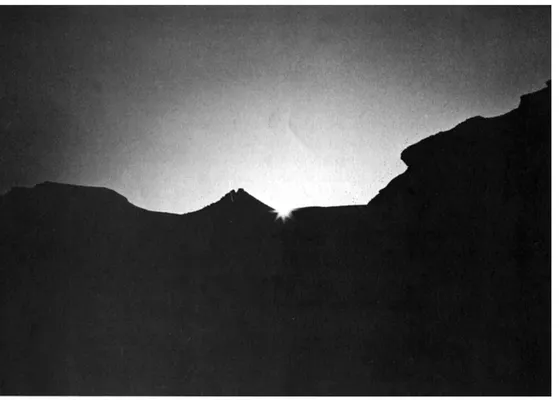
The sun’s first gleam upon an irregular desert horizon in California renews the sky’s daily life. (Robin Rector Krupp)
This reliable pattern of day and night is the sky’s first cycle in the passage of time. Day and night are apportioned by the journey of the sun and stars across the sky. It is a parade animated by the spinning earth. We stand on the earth but we don’t sense its motion. Instead we see it reflected in the sky. Our planet rotates from west to east, and to us, it looks like the pageant is rolling from east to west.
East is the realm of risings. Settings occur in the west. These directions acquire meaning because of the celestial events that define them, and these events have, in turn, symbolic meaning of their own. When we speak of east in a general sense—and not due east—we refer to the half of the horizon where celestial objects can appear. They are, in a sense, “born” there, and we associate birth, creation, and life with the east. East in Latin is orient, a word which derives from the verb “to rise.” West, on the other hand, is occident, and similarly related to the verb “to fall.” Ancient peoples equated settings of the sun and the other celestial objects to their “deaths,” and we still speak of “sunset years” as a metaphor for old age. For many cultures the west was the land of the dead, and in World War I a soldier killed in action was said to have “gone west.” The widely read novel The Lord of the Rings concludes as the two main characters, Frodo and Bilbo, in old age and at the end of an era, depart their homelands for “the West.”
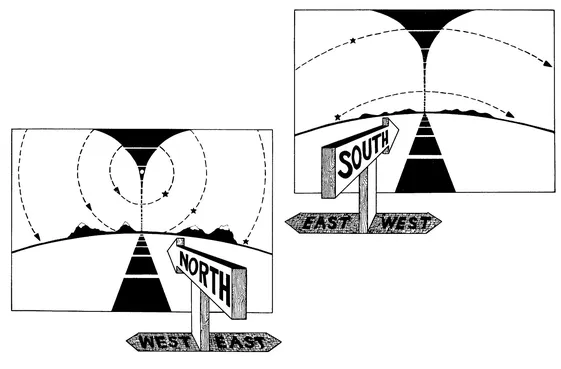
Some stars are placed so that they never descend beneath the horizon; throughout the day and night, they follow circular courses having a common center, a spot that never moves. In our era, in the northern hemisphere, an almost motionless star in Ursa Minor nearly occupies that spot. It is Polaris. The name refers to the north celestial pole, the center of the circular paths followed by the stars that never set. Just as the earth spins around its “pole,” the sky appears to turn around this unique spot, and the stars that complete circles around it are called circumpolar stars. If we face the north celestial pole, the stars turn counterclockwise around it, but below the earth’s equator, in the southern hemisphere, we see stars moving clockwise in rings around a similar spot, the south celestial pole. No bright object points it out, but the daily movement of the stars would make it noticed.
When we face due north in the northern hemisphere, we see the stars near the north celestial pole trace circular paths around it. The pole itself is stationary and therefore special, and it makes the direction we must face special, too. A dashed north-south line seems to step up to greet us, and the dashed arc of the meridian stretches up the sky from cardinal north, through the north celestial pole, and on across the zenith overhead. If we turn completely around, we face south and see the meridian arch down to meet the cardinal line on the ground at the south point. The paths of stars in this direction nearly cross the sky horizontally, in contrast with the circular trails of the stars in the north. (Robin Rector Krupp)
Pole, in the sense we have used it here, derives from the word for “stake,” and the concept behind the word is a pole that reaches to the canopy of the sky, supports it, and acts as the pivot of the sky’s daily rotation. It is a cosmic axis and is described in the mythologies of various peoples as a mountain, as an actual pole, as a tree, or as some other sky-piercing staff. In any event, the pole of the sky is a special place, a motionless reference in a moving sky.
By following an imaginary line from the steady beacon of Polaris straight down to the horizon, we locate the direction north. It is because Polaris defines this direction for us in the northern hemisphere that it is also called the North Star. And once we’ve found north, the other three cardinal directions, south, east, and west, are automatically defined. Between the cardinal compass points are the intercardinal directions, northeast, northwest, southeast, and southwest, in the center of each quarter arc of horizon.
Seeing Seasons in the Sun and Stars
Time slides through the seasons, and this too shows up in the sky. This cycle is a long one. It takes a year, the length of time in which the earth orbits the sun. Again, we don’t sense the motion directly but follow it by observing daily changes in the positions of the sun and the stars until, after a year’s time, they return to their original starting places.
During each circuit of the sun, the earth spins around about 365¼ times. There are, therefore, 365¼ days in a year, and shifts in the sun’s daily path measure out the annual cycle. The measurement is made this way: From any place we care to stand, we can notice the direction in which sunrise occurs. If we are in the northern hemisphere, once every year, in winter, the sun comes up far to the southeast, as far south of east as we will ever see it from our chosen sunwatching station. Although the sunrise seems to reappear in the same spot on several successive mornings, it gradually edges north until—half a year later, in summer—it occurs far to the northeast, at its northern limit. For several days, the point of sunrise lingers there, but it eventually reverses its movements again and returns toward the south, parceling out the second half of the year until the sunrise is back at its southern limit and winter returns. This annual seasonal cycle, which is mirrored by the moving point of sunset along the western half of the horizon, then begins once more. Thus, by the passage of the sun, time is regulated in an orderly sequence of days and years.
When the sunrise occurs at its southern extreme, in the southeast quarter of the horizon, we say it is the day of the winter solstice. Both the event and the date bear this name, and solstice literally means “sun stand still,” an acknowledgment that sunrise (and sunset) dawdles for a while before reversing its course along the eastern horizon. Similarly, the northern limit is reached on the summer solstice. Although these limits of sunrise occur in the general direction of northeast and southeast, they do not necessarily coincide with those intercardinal directions. The exact positions of the limits depend upon latitude. The farther you travel from the earth’s equator, the farther north and south the solstices occur.
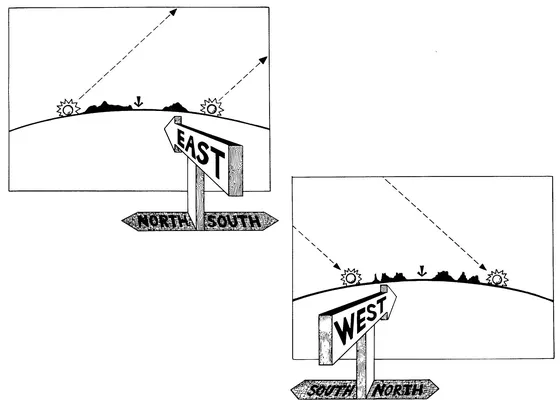
East is the direction of risings, and the two paths shown here belong to the sun at summer (left) and winter (right) solstice. At this location, the sun never appears to rise farther to the north (left) or farther to the south (right) than the places here where it first appears above the horizon. The sun rises midway between these two extremes, due east, at the equinoxes. This annual pattern of sunrise is mirrored in the west by the sunsets. Again, the extremes of the sun’s annual motion are indicated by the two descending paths of winter (left and south) and summer (right and north) solstice. Equinox sunsets take place due west. (Robin Rector Krupp)
Midway between its northern and southern extremes, the sun rises due east and sets due west. This occurs twice a year, once when the sunrise is headed north and again six months later when the sun returns south. Both events are called the equinox—in spring the vernal equinox and in fall the ...
Table of contents
- Title Page
- Copyright Page
- Dedication
- Foreword - to the 1994 edition
- Table of Contents
- Acknowledgments
- 1 - The Lights We See
- 2 - The Skies We Watch
- 3 - The Gods We Worship
- 4 - The Tales We Tell
- 5 - The Dead We Bury
- 6 - The Vigils We Keep
- 7 - The Days We Tally
- 8 - The Rituals We Perform
- 9 - The Space We Enclose
- 10 - The Temples We Align
- 11 - The Cities We Plan
- 12 - The Symbols We Draw
- 13 - The Universes We Design
- Bibliography
- Index
Trusted by 375,005 students
Access to over 1.5 million titles for a fair monthly price.
Study more efficiently using our study tools.
Frequently asked questions
Yes, you can cancel anytime from the Subscription tab in your account settings on the Perlego website. Your subscription will stay active until the end of your current billing period. Learn how to cancel your subscription
No, books cannot be downloaded as external files, such as PDFs, for use outside of Perlego. However, you can download books within the Perlego app for offline reading on mobile or tablet. Learn how to download books offline
Perlego offers two plans: Essential and Complete
- Essential is ideal for learners and professionals who enjoy exploring a wide range of subjects. Access the Essential Library with 800,000+ trusted titles and best-sellers across business, personal growth, and the humanities. Includes unlimited reading time and Standard Read Aloud voice.
- Complete: Perfect for advanced learners and researchers needing full, unrestricted access. Unlock 1.5M+ books across hundreds of subjects, including academic and specialized titles. The Complete Plan also includes advanced features like Premium Read Aloud and Research Assistant.
We are an online textbook subscription service, where you can get access to an entire online library for less than the price of a single book per month. With over 1.5 million books across 990+ topics, we’ve got you covered! Learn about our mission
Look out for the read-aloud symbol on your next book to see if you can listen to it. The read-aloud tool reads text aloud for you, highlighting the text as it is being read. You can pause it, speed it up and slow it down. Learn more about Read Aloud
Yes! You can use the Perlego app on both iOS and Android devices to read anytime, anywhere — even offline. Perfect for commutes or when you’re on the go.
Please note we cannot support devices running on iOS 13 and Android 7 or earlier. Learn more about using the app
Please note we cannot support devices running on iOS 13 and Android 7 or earlier. Learn more about using the app
Yes, you can access Echoes of the Ancient Skies by E. C. Krupp in PDF and/or ePUB format, as well as other popular books in Physical Sciences & Astronomy & Astrophysics. We have over 1.5 million books available in our catalogue for you to explore.