The superbly illustrated and detailed handbook that popularized the use of classic Greek architectural style in America in the early and middle 1800s. 271 illustrations.
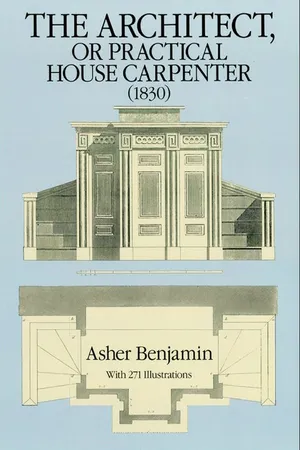
- 192 pages
- English
- ePUB (mobile friendly)
- Available on iOS & Android
eBook - ePub
The Architect, or Practical House Carpenter (1830)
About this book
Information
Topic
ArchitectureSubtopic
History of ArchitectureGLOSSARY OF ARCHITECTURAL TERMS.
A.
Aaron’s Rod; an ornamental figure representing a rod with a serpent entwined about it, and called by some, though improperly, the Caduceus of Mercury.
Abacus; the upper member of a capital of a column, serving as a kind of crown-piece in the Grecian Doric, and a collection of members or mouldings in the other orders.
Abutment ; a pier, upon which the extremity of an arch rests.
Accessories; in architectural composition, those parts, or ornaments, either designed or accidental, which are not apparently essential to the use and character of a building.
Acropolis; from the Greek; the highest part of a city, the citadel or fortress.
Acroteria ; small pedestals placed on the apex and two sides of a pediment. They sometimes support statues.
Ægricanes ; sculptures representing the heads and skulls of rams; commonly used as a decoration of ancient altars, friezes, &c.
Ætoma ; a pediment, or the tympanum of a pediment.
Aile, or Aisle; a walk in a church on the sides of the nave; the wings of a choir.
Alcove ; a recess, or part of a chamber, separated by an estrade, or partition of columns, and other corresponding ornaments.
Amphiprostyle ; an order of temples among the Greeks, having columns in the back, as well as the front.
Alto-relievo, or High-relief; that kind or portion of sculpture, which projects so much from the surface to which it is attached as to appear nearly insulated. It is therefore used in comparison with Mezzo-relievo, or Mean-relief, and in opposition to Basso-relievo, or Low-relief.
Amphitheatre; a spacious edifice, of a circular or oval form, in which the combats and shows of antiquity were exhibited.
Ancones ; the carved key-stone of arches.
Angle-rafter ; in carpentry, otherwise Hip-rafter ; see Hip.
Angular capital; the modern Ionic, or Scammozian capital, which is formed alike on all the four faces, so as to return at the angles of the building.
Annulet ; a small square moulding, commonly used to connect the others.
Antœ ; small projections, in Grecian architecture, from the wall, to receive the entablatures from the columns of a portico, and having bases and capitals different from the columns.
Apophyge ; the curve connecting the upper fillet of the base, or under one of the capital, with the cylindrical part of the shaft.
Arœostyle ; a manner of intercolumniation, in which all the columns are distant from each other about four diameters.
Arcade; an aperture in a wall, with an arched head. It also signifies a range of apertures with arched heads.
Arch; a part of a building supported at its extremities only, and concave towards the earth or horizon.
Architectonic ; something endowed with the power and skill of building, or calculated to assist the architect.
Architrave; the undermost principal division of an entablature.
Astragal; a small moulding, semicircular in profile.
B.
Back; generally that side of an object which is opposite to the face, or breast: but the back of a handrail is the upper side of it; that of a rafter is the upper side of it, in the sloping plane of one side of a roof.
Back-shutters, or Back-flaps; additional breadths hinged to the front-shutters, for completely closing the aperture, when the window is to be shut.
Balcony (from the French balcon) ; an open gallery, projecting from the front of a building, and commonly constructed of iron or wood.
Baluster; a small kind of column or pillar, belonging to a balustrade.
Balustrade; a range of balusters, supporting a cornice, and used as a parapet or screen, for concealing a roof, or other object.
Band; a square member in a profile.
Base; the lower division of a column. In the Greek Doric there is no base.
Battlement; see Parapet.
Bay-window ; a window projecting from the front, in two or more planes, and not forming the segment of a circle.
Bed-mouldings ; the mouldings below the corona in a cornice.
Belfry, anciently the campanile; the part of a steeple in which the bells are hung.
Belvidere ; a turret, look-out, or observatory, commanding a fine prospect, and generally very ornamental.
Boultin; a name for the echinus.
Bow-window ; a window forming the segment of a circle.
Broach (in Gothic architecture) ; a spire, or polygonal pyramid, whether of stone or timber.
Bracket (in Gothic architecture) ; a projection to sustain a statue, or other ornament, and sometimes supporting the ribs of a roof.
Buttress (in Gothic architecture) ; a projection on the exterior of a wall, to strengthen the piers and resist the pressure of the arches within.
C.
Cabling; cylindrical pieces let into the lower part of the flutes of columns.
Caduceus; an emblem or attribute of Mercury; a rod entwined by two-winged serpents.
Caisson; a name for sunk panels of geometrical forms.
Campana; the body of the Corinthian capital.
Campanœ, or Campanula, or Guttœ; the drops of the Doric architrave.
Canopy (in Gothic architecture) ; the ornamental dripstone of an arch. It is usually of the ogee form.
Canted (in Gothic architecture); any part of a building having its angles cut off, is said to be canted.
Capital; the upper division of a column, or pillar.
Cartouch; the square blocks under the eaves of a house.
Cant-moulding; a bevelled surface, neither perpendicular to the horizon, nor to the vertical surface to which it may be attached.
Cap (in joinery); the uppermost of an assemblage of parts, as the capital of a column, the cornice of a door, &c.
Caryatidœ, or Caryatides; so called from the Caryatides, a people of Caria; an order of columns or pilasters, under the figures of women dressed in long robes, after the manner of the Carian people, and serving to support an entablature. This order is called the Caryati...
Table of contents
- DOVER BOOKS ON ARCHITECTURE
- Title Page
- Copyright Page
- PREFACE.
- Table of Contents
- PRACTICAL GEOMETRY.
- MOULDINGS.
- TUSCAN ORDER.
- GRECIAN DORIC ORDER.
- ROMAN DORIC ORDER.
- DORIC ORDER, EXAMPLE No. 3.
- RAKING MOULDINGS.
- BASE MOULDINGS.
- GRECIAN IONIC ORDER.
- GRECIAN IONIC CAPITAL.
- ROMAN IONIC ORDER.
- IONIC ORDER, EXAMPLE No. 3.
- GRECIAN ENTABLATURES.
- VOLUTES.
- CORINTHIAN ORDER.
- CORINTHIAN CAPITAL.
- COMPOSITE ORDER.
- PEDESTALS.
- ARCADES.
- FLUTES AND FILLETS.
- BALUSTRADES.
- ANTÆ.
- PILASTERS.
- COLONNADE.
- ORDERS UPON ORDERS.
- PEDIMENTS.
- ATTICS.
- NICHES.
- VASES.
- FRONTISPIECE.
- IONIC PORTICO.
- WINDOWS.
- DORMER WINDOW
- FRONT FENCES.
- EAVE CORNICES.
- STUCCO CORNICES.
- FINISHING. WINDOWS.
- INSIDE DOORS.
- SUR-BASE MOULDINGS.
- BASE MOULDINGS.
- ARCHITRAVES.
- CHIMNEY PIECES.
- GUILOCHE AND FRETS.
- CARPENTRY.
- HANDRAILING.
- STAIRS.
- CHURCHES.
- THE GRECIAN AND ROMAN ORDERS.
- GLOSSARY OF ARCHITECTURAL TERMS.
Trusted by 375,005 students
Access to over 1.5 million titles for a fair monthly price.
Study more efficiently using our study tools.
Frequently asked questions
Yes, you can cancel anytime from the Subscription tab in your account settings on the Perlego website. Your subscription will stay active until the end of your current billing period. Learn how to cancel your subscription
No, books cannot be downloaded as external files, such as PDFs, for use outside of Perlego. However, you can download books within the Perlego app for offline reading on mobile or tablet. Learn how to download books offline
Perlego offers two plans: Essential and Complete
- Essential is ideal for learners and professionals who enjoy exploring a wide range of subjects. Access the Essential Library with 800,000+ trusted titles and best-sellers across business, personal growth, and the humanities. Includes unlimited reading time and Standard Read Aloud voice.
- Complete: Perfect for advanced learners and researchers needing full, unrestricted access. Unlock 1.5M+ books across hundreds of subjects, including academic and specialized titles. The Complete Plan also includes advanced features like Premium Read Aloud and Research Assistant.
We are an online textbook subscription service, where you can get access to an entire online library for less than the price of a single book per month. With over 1.5 million books across 990+ topics, we’ve got you covered! Learn about our mission
Look out for the read-aloud symbol on your next book to see if you can listen to it. The read-aloud tool reads text aloud for you, highlighting the text as it is being read. You can pause it, speed it up and slow it down. Learn more about Read Aloud
Yes! You can use the Perlego app on both iOS and Android devices to read anytime, anywhere — even offline. Perfect for commutes or when you’re on the go.
Please note we cannot support devices running on iOS 13 and Android 7 or earlier. Learn more about using the app
Please note we cannot support devices running on iOS 13 and Android 7 or earlier. Learn more about using the app
Yes, you can access The Architect, or Practical House Carpenter (1830) by Asher Benjamin in PDF and/or ePUB format, as well as other popular books in Architecture & History of Architecture. We have over 1.5 million books available in our catalogue for you to explore.