![]()
1: Oil Painting Equipment
ALTHOUGH I HAVE PAINTED a great many watercolors in my life, I still consider oils a much easier and more flexible medium in which to work. The instructions in this book will be based on painting in oil, and I will try to give you all the information at my disposal to help you handle this medium in a professional manner.
Some artists and many students think that they have to paint in watercolors for years before they acquire sufficient skill to work in oils. This assumption has always seemed absurd to me, for there is no medium as easy to work in as oil. You can make changes and repaint the picture with the greatest of ease if you are using oil, while in watercolor you are in trouble if a single wash goes wrong.
Painting in oil isn’t like drawing with a pencil. Your brush strokes should be broad and strong, so accustom yourself to working on a fairly large scale from the start.
For the benefit of those who have had no previous experience with oil painting, I will list the necessary equipment for out-of-door painting.
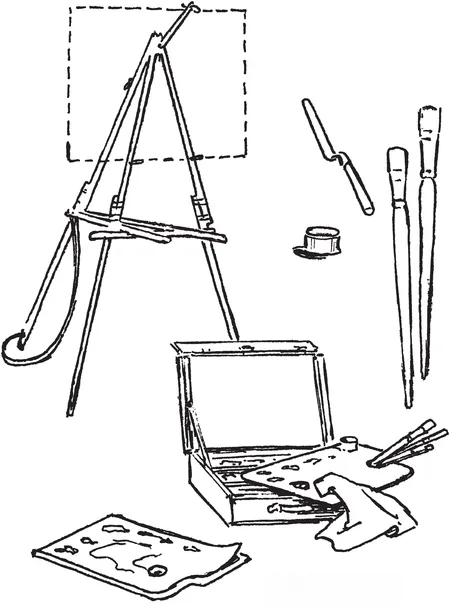
You will need a sketchbox to carry your brushes and paints. A wooden box 12 x 16 inches is a good size, although you can use a 16 x 20 inch box if you prefer a more generous one. Sketchboxes are usually made of wood, though some people prefer those of aluminum because of their light weight. A smaller sketchbox is easier to carry, but I think one does better with a fairly generous size.
A palette comes with the sketchbox, though some artists like to use a paper palette with disposable sheets. If you use a wooden palette it is a good idea to rub a little linseed oil on it, when new, in order to give it a smoother and less porous surface on which to mix your paint.
Don’t buy a fitted box. It contains a lot of useless colors and is much too expensive.
You will want a good, solid sketching easel of either wood or aluminum. My favorite is the Anderson easel, now being manufactured by Edith Anderson Miller in Cincinnati, Ohio. It has a shelflike arrangement below the canvas on which to rest the sketchbox and palette. This easel folds up compactly and has a shoulder strap for carrying. It is a great help when you are wandering around the docks with a sketchbox in one hand and a couple of canvases in the other. Some of the aluminum easels have a similar arrangement. If the easel hasn’t a place for a palette, you can nail three stretcher sticks together to fit down over the easel and give you a platform for it.
I never paint while holding the palette in my left hand. It is uncomfortable and, moreover, you need your left hand to hold extra brushes or a paint rag.
I recommend at least six brushes, ranging from a quarter of an inch to an inch in width, and prefer bristle brushes to sable, because you are liable to get your work too polished with sable brushes. These brushes should be flat with a square end, either the type called brights with short bristles or those with slightly longer bristles called flats.
It is a good idea to have two brushes of approximately the same size, one for light color and the other for dark — for your smaller ones, Nos. 2 and 3; for the next size, 4 and 5; and for the larger sizes, 7 and 8. For very fine lines you could buy a No. 1 brush, but you will be able to get a fairly fine line by using the side of your larger brushes and will rarely need a small brush. It is better always to use as large a brush as possible in order to cover your canvas rapidly and to keep your picture broad and simple.
You will need a single oil cup about two inches in diameter and a palette knife of the trowel type, with the knife surface a little below the handle. This type of knife is easier to use than the straight type, and you get less paint on your hands (Fig. 1).
The list of colors in the Ballinger Palette is a simple one. It consists of ultramarine blue and cerulean blue, zinc white, cadmium yellow pale, cadmium orange, cadmium red light, cadmium red medium or dark and alizarin crimson. There are no earth colors, greens or black.
These are the colors you will employ most of the time. In addition, you can buy phthalo blue and viridian, though you will seldom use them.
Medium is the liquid you mix with your paint when you apply it to your canvas. I use a combination of linseed oil and turpentine, half and half. The oil should be a purified linseed oil obtainable from any art materials store; any clear gum turpentine sold by paint stores is adequate. You will also need retouching varnish. This is a light, quick-drying varnish to bring a gloss to the parts of the picture that look dull and lifeless. It can be sprayed on by a fixative blower or applied with a clean, soft brush if the painting is dry. You will need only the retouch varnish when the picture dries out and you want to continue painting on it.
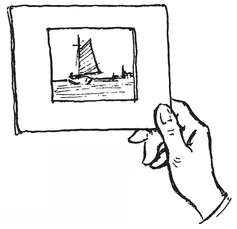
One other useful piece of equipment is a view finder (Fig. 2). This is simply a piece of cardboard with a rectangular opening in it and a wide enough border around the opening to blank out all but the scene that you are viewing. When you are sketching outdoors there is so much to see that it is often difficult to decide what to include in your picture and what to leave out. The view finder will help you isolate your projected composition.
The last item to consider is what to paint on. Canvas mounted on a cardboard panel is good because it is easy to transport. For larger sizes — 20 x 24 inches or over — I would suggest a stretched canvas. Panels the size of your sketchbox are handy because you can carry them in the lid of your box, which has slots for that purpose. Some of my friends use Masonite panels cut to a desired size. They are practically indestructible, but I don’t like the surface — one side is too smooth and the other too rough.
At this point I would like to list a few terms that artists use in describing pictures, which otherwise may be confusing to the beginner. Artists are constantly talking about warm and cool colors in their pictures. This means exactly what it says. The warm colors are red, yellow, orange, yellowish green, reddish purple and the browns or grays in which the warm colors predominate. The cool colors are the blues, bluish greens, blue-purples and all the bluish grays.
By value we mean the degree of light and dark of any particular part of a picture or color. It also means the degree of light or dark of one color compared to another. Tone means about the same as value. Half tones are the values in a picture that are neither light nor shade — the values that are between the light and dark masses.
Key means the color value of the picture. A high-keyed painting would be one with light, bright colors, while a low-keyed picture would have dark, sombre colors.
![]()
2: Simplified Approach to Composition
THE FIRST THING TO CONSIDER in any picture is composition, that is, the dark and light pattern or design of the picture. Color alone won’t make a good picture unless you also have a pleasing balance of the masses. I always try to think of every scene that I paint as a big, simple arrangement in two tones of light and dark (Fig. 3). This is the framework for the whole picture. I try to see every portion of the picture either as part of the light or of the dark pattern. I always “tie” my darks together by having one dark spot blend into or overlap an adjoining one to make a large, irregular shape of dark rather than a number of isolated spots (Fig. 4A & Fig. 4B). Tie up the light spots in the same manner. The dark pattern, of course, makes the light one.
By thinking of the picture as a two-tone pattern of light and dark, you start with a simple poster-like arrangement (Fig. 5). There is so much detail in nature that it is a great help to start a picture in simple masses and then, as you work along, modify some of the darks and lights, adding detail where necessary (Fig. 6).
There are a few standard forms of composition that are often used in the structural design of most pictures, but before we discuss them I would like to explain what is meant by balance in a picture.
Pictures are composed on the principle of the steelyard balance. If this term is confusing, think of the old idea of the seesaw: an adult has to sit well in toward the center to be balanced by a child out on one end of the seesa...