This book arose out of the authors' desire to present Lebesgue integration and Fourier series on an undergraduate level, since most undergraduate texts do not cover this material or do so in a cursory way. The result is a clear, concise, well-organized introduction to such topics as the Riemann integral, measurable sets, properties of measurable sets, measurable functions, the Lebesgue integral, convergence and the Lebesgue integral, pointwise convergence of Fourier series and other subjects. The authors not only cover these topics in a useful and thorough way, they have taken pains to motivate the student by keeping the goals of the theory always in sight, justifying each step of the development in terms of those goals. In addition, whenever possible, new concepts are related to concepts already in the student's repertoire. Finally, to enable readers to test their grasp of the material, the text is supplemented by numerous examples and exercises. Mathematics students as well as students of engineering and science will find here a superb treatment, carefully thought out and well presented , that is ideal for a one semester course. The only prerequisite is a basic knowledge of advanced calculus, including the notions of compactness, continuity, uniform convergence and Riemann integration.
The problem of finding the area of a plane region bounded by vertical lines x = a and x = b, the horizontal line y = 0, and the graph of the non-negative function y = f(x), is a very old one (although, of course, it has not always been stated in this terminology). The Greeks had a method which they applied successfully to simple cases such as f(x) = x2. This “method of exhaustion” consisted essentially in approximating the area by figures whose areas were known already—such as rectangles and triangles. Then an appropriate limit was taken to obtain the result.
In the seventeenth century, Newton and Leibnitz independently found an easy method for solving the problem. The area is given by F(b)–F(a), where F is an antiderivative of f. This is the familiar Fundamental Theorem of Calculus; it reduced the problem of finding areas to that of finding antiderivatives.
Eventually mathematicians began to worry about functions not having antiderivatives. When that happened, they were forced to return again to the basic problem of area. At the same time, it became clear that a more precise formulation of the problem was necessary. Exactly what is area, anyway? Or, more generally, how can
be defined rigorously for as wide a class of functions as possible?
In the middle of the nineteenth century, Cauchy and Riemann put the theory of integration on a firm footing. They described—at least theoretically—how to carry out the program of the Greeks for any function f. The result is the definition of what is now called the Riemann integral of f. This is the integral studied in standard calculus courses.
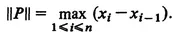
1.1 Definition: A partition P of a closed interval [a,b] is a finite sequence (x0,x1, . . . xn) such that a = x0 < x1 < . . . < xn = b. The norm (or width, or mesh) of P, denoted ||P||, is defìned by
That is, ||P|| is the length of the longest of the subintervals [x0,x1], [x2,x3], . . . , [xn−1, xn].
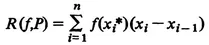
1.2 Definition: Let P = (x0, . . . ,xn) be a partition of [a,b], and let f be defined on [a,b]. For each i = 1, . . . ,n, let xi* be an arbitrary point in the interval [xi−1,xi]. Then any sum of the form
is called a Riemann sum of f relative to P.
Notice that R(f,P) is not completely d...
Table of contents
Title Page
Copyright Page
Table of Contents
Preface
CHAPTER 1 - The Riemann Integral
CHAPTER 2 - Measurable Sets
CHAPTER3 - Properties of Measurable Sets
CHAPTER 4 - Measurable Functions
CHAPTER 5 - The Lebesgue Integral
CHAPTER6 - Convergence and The Lebesgue Integral
CHAPTER7 - Function Spaces and L2
CHAPTER 8 - The L2 Theory of Fourier Series
CHAPTER 9 - Pointwise Convergence of Fourier Series
Appendix
Bibliography
INDEX
A CATALOG OF SELECTED DOVER BOOKS IN SCIENCE AND MATHEMATICS
CATALOG OF DOVER BOOKS
Trusted by 375,005 students
Access to over 1.5 million titles for a fair monthly price.
Study more efficiently using our study tools.
Frequently asked questions
Yes, you can cancel anytime from the Subscription tab in your account settings on the Perlego website. Your subscription will stay active until the end of your current billing period. Learn how to cancel your subscription
No, books cannot be downloaded as external files, such as PDFs, for use outside of Perlego. However, you can download books within the Perlego app for offline reading on mobile or tablet. Learn how to download books offline
Perlego offers two plans: Essential and Complete
Essential is ideal for learners and professionals who enjoy exploring a wide range of subjects. Access the Essential Library with 800,000+ trusted titles and best-sellers across business, personal growth, and the humanities. Includes unlimited reading time and Standard Read Aloud voice.
Complete: Perfect for advanced learners and researchers needing full, unrestricted access. Unlock 1.5M+ books across hundreds of subjects, including academic and specialized titles. The Complete Plan also includes advanced features like Premium Read Aloud and Research Assistant.
Both plans are available with monthly, semester, or annual billing cycles.
We are an online textbook subscription service, where you can get access to an entire online library for less than the price of a single book per month. With over 1.5 million books across 990+ topics, we’ve got you covered! Learn about our mission
Look out for the read-aloud symbol on your next book to see if you can listen to it. The read-aloud tool reads text aloud for you, highlighting the text as it is being read. You can pause it, speed it up and slow it down. Learn more about Read Aloud
Yes! You can use the Perlego app on both iOS and Android devices to read anytime, anywhere — even offline. Perfect for commutes or when you’re on the go. Please note we cannot support devices running on iOS 13 and Android 7 or earlier. Learn more about using the app
Yes, you can access An Introduction to Lebesgue Integration and Fourier Series by Howard J. Wilcox,David L. Myers, David L. Myers in PDF and/or ePUB format, as well as other popular books in Mathematics & Mathematical Analysis. We have over 1.5 million books available in our catalogue for you to explore.