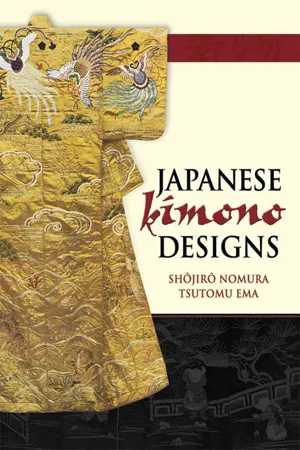
Japanese Kimono Designs
eBook - ePub

Japanese Kimono Designs

  1. 64 pages
  2. English
  3. ePUB (mobile friendly)
  4. Available on iOS & Android
eBook - ePub

Japanese Kimono Designs

About this book

Japan's ancient and esteemed tradition of textile arts has long been reflected in the delicate beauty of the kimono and its appealing designs. This unique design treasury, consisting of lavish full-color pictures of a vibrant array of kimonos, is reproduced directly from two rare and costly original portfolios.
Devotees of fashion, art, and Asian culture will appreciate this beautiful book and its tribute to the elegance and refinement of Japanese art, as expressed in the colorful grace of kimono designs.
Frequently asked questions

Yes, you can cancel anytime from the Subscription tab in your account settings on the Perlego website. Your subscription will stay active until the end of your current billing period. Learn how to cancel your subscription.
No, books cannot be downloaded as external files, such as PDFs, for use outside of Perlego. However, you can download books within the Perlego app for offline reading on mobile or tablet. Learn more here.
Perlego offers two plans: Essential and Complete
  • Essential is ideal for learners and professionals who enjoy exploring a wide range of subjects. Access the Essential Library with 800,000+ trusted titles and best-sellers across business, personal growth, and the humanities. Includes unlimited reading time and Standard Read Aloud voice.
  • Complete: Perfect for advanced learners and researchers needing full, unrestricted access. Unlock 1.4M+ books across hundreds of subjects, including academic and specialized titles. The Complete Plan also includes advanced features like Premium Read Aloud and Research Assistant.
Both plans are available with monthly, semester, or annual billing cycles.
We are an online textbook subscription service, where you can get access to an entire online library for less than the price of a single book per month. With over 1 million books across 1000+ topics, we’ve got you covered! Learn more here.
Look out for the read-aloud symbol on your next book to see if you can listen to it. The read-aloud tool reads text aloud for you, highlighting the text as it is being read. You can pause it, speed it up and slow it down. Learn more here.
Yes! You can use the Perlego app on both iOS or Android devices to read anytime, anywhere — even offline. Perfect for commutes or when you’re on the go.
Please note we cannot support devices running on iOS 13 and Android 7 or earlier. Learn more about using the app.
Yes, you can access Japanese Kimono Designs by Shôjirô Nomura,Tsutomu Ema, Tsutomu Ema in PDF and/or ePUB format, as well as other popular books in Design & Fashion Design. We have over one million books available in our catalogue for you to explore.

Information

eBook ISBN
9780486137421
Topic
Design
e9780486137421_i0002.webp

JAPANESE KIMONO DESIGNS

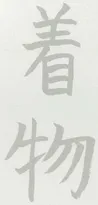
LITERALLY the Japanese word for “thing to wear,” the term “kimono” has come to refer specifically to the straight-cut robe that is the Asian garment most familiar to the people of the west. The kimono has a long ancestry that can be traced back to China. By the eighth century, Chinese-style robes were being worn by the Japanese court. In the tenth century, during the Heian period [794-1192], Japanese culture began to move away from Chinese traditions and to develop its own sensibility. The Heian period was one of elegance and refinement, and great emphasis was placed on dress. The basic garment for court women was square cut, but was much more voluminous than the modern kimono. As many as twelve different layers might be worn, each slightly larger in size than the last and a slightly different color. The innermost layer, the kosode (literally “small sleeve,” so named for its narrow arm openings), was the forerunner of the modern kimono. The Kamakura period [1192-1333] that followed was a period of turmoil and warfare, and the elegance of the Heian court gave way to simpler styles. By the late fourteenth century, the humble kosode took center stage as an outer garment, and by the mid-fifteenth century was worn by men and women of all classes.
Despite variations in size, material, decoration, and number of layers worn at a time, the kimono has remained a square-cut body with square-cut sleeves. In this, it differs dramatically from western dress, which tends to follow the lines of th...

Table of contents

  1. Title Page
  2. Copyright Page
  3. Table of Contents
  4. JAPANESE KIMONO DESIGNS