![]()
PART I
THE APPROACH TO MATHEMATICS
![]()
CHAPTER 1
THE DREAD OF MATHEMATICS
‘The greatest evil is fear.’
Epicurean Philosophy
THE main object of this book is to dispel the fear of mathematics. Many people regard mathematicians as a race apart, possessed of almost supernatural powers. While this is very flattering for successful mathematicians, it is very bad for those who, for one reason or another, are attempting to learn the subject.
Very many students feel that they will never be able to understand mathematics, but that they may learn enough to fool examiners into thinking they do. They are like a messenger who has to repeat a sentence in a language of which he is ignorant - full of anxiety to get the message delivered before memory fails, capable of making the most absurd mistakes in consequence.
It is clear that such study is a waste of time. Mathematical thinking is a tool. There is no point in acquiring it unless you mean to use it. It would be far better to spend time in physical exercise, which would at least promote health of body.
Further, it is extremely bad for human beings to acquire the habit of cowardice in any field. The ideal of mental health is to be ready to face any problem which life may bring - not to rush hastily, with averted eyes, past places where difficulties are found.
Why should such fear of mathematics be felt? Does it lie in the nature of the subject itself? Are great mathematicians essentially different from other people? Or does the fault lie mainly in the methods by which it is taught?
Quite certainly the cause does not lie in the nature of the subject itself. The most convincing proof of this is the fact that people in their everyday occupations — when they are making something — do, as a matter of fact, reason along lines which are essentially the same as those used in mathematics: but they are unconscious of this fact, and would be appalled if anyone suggested that they should take a course in mathematics. Illustrations of this will be given later.
The fear of mathematics is a tradition handed down from days when the majority of teachers knew little about human nature, and nothing at all about the nature of mathematics itself. What they did teach was an imitation.
Imitation Subjects
Nearly every subject has a shadow, or imitation. It would, I suppose, be quite possible to teach a deaf and dumb child to play the piano. When it played a wrong note, it would see the frown of its teacher, and try again. But it would obviously have no idea of what it was doing, or why anyone should devote hours to such an extraordinary exercise. It would have learnt an imitation of music. And it would fear the piano exactly as most students fear what is supposed to be mathematics.
What is true of music is also true of other subjects. One can learn imitation history - kings and dates, but not the slightest idea of the motives behind it all ; imitation literature — stacks of notes of Shakespeare’s phrases, and a complete destruction of the power to enjoy Shakespeare. Two students of law once provided a good illustration: one learnt by heart long lists of clauses; the other imagined himself to be a farmer, with wife and children, and he related everything to this farm. If he had to draw up a will, he would say, ‘I must not forget to provide for Minnie’s education, and something will have to be arranged about that mortgage.’ One moved in a world of half-meaningless words; the other lived in the world of real things.
The danger of parrot-learning is illustrated by the famous howler, ‘The abdomen contains the stomach and the bowels, which are A, E, I, O and U.’ What image was in the mind of the child who wrote this? Large metal letters in the intestines? Or no image at all? Probably it had heard so many incomprehensible statements from the teacher, that the bowels being A, E, I, O and U seemed no more mysterious than other things heard in school.
A large proportion of examination papers contain mathematical errors which are at least as absurd as this howler, and the reason is the same — words which convey no picture, the lack of realistic thinking.
Parrot-learning always involves this danger. The deaf child at the piano, whatever discord it may produce, remains unaware of it. Real education makes howlers impossible, but this is the least of its advantages. Much more important is the saving of unnecessary strain, the achievement of security and confidence in mind. It is far easier to learn the real subject properly, than to learn the imitation badly. And the real subject is interesting. So long as a subject seems dull, you can be sure that you are approaching it from the wrong angle. All discoveries, all great achievements, have been made by men who delighted in their work. And these men were normal, they were no freaks or high-brows. Edison felt compelled to make scientific experiments in just the same way that other boys feel compelled to mess about with motor bicycles or to make wireless sets. It is easy to see this in the case of great scientists, great engineers, great explorers. But it is equally true of all other subjects.
To master anything — from football to relativity — requires effort. But it does not require unpleasant effort, drudgery. The main task of any teacher is to make a subject interesting. If a child left school at ten, knowing nothing of detailed information, but knowing the pleasure that comes from agreeable music, from reading, from making things, from finding things out, it would be better off than a man who left university at twenty-two, full of facts but without any desire to inquire further into such dry domains. Right at the beginning of any course there should be painted a vivid picture of the benefits that can be expected from mastering the subject, and at every step there should be some appeal to curiosity or to interest which will make that step worth while.
Bad teaching is almost entirely responsible for the dislike which is shown in such words as ‘high-brow’. Children want to know things, they want to do things. Teachers do not have to put life into them: the life is there, waiting for an outlet. All that is needed is to preserve and to direct its flow.
Too often, unfortunately, teaching seems to proceed on the philosophy that adults have to do dull jobs, and that children should get used to dull work as quickly as possible. The result is an entirely justified hatred and contempt for all kinds of learning and intellectual life.
Many members of the teaching profession are already in revolt against the tradition of dull education. Some excellent teaching has been heard over the wireless. The same ideas, the same methods are being developed independently in all parts of the country. No claim for originality is therefore made in respect of this book. It is no more than an individual expression of a feeling shared by thousands.
In the following chapters I shall try to show what mathematics is about, how mathematicians think, when mathematics can be of some use. In such a short space it is impossible to go into details. If you want to master any special department of mathematics, you will certainly need text-books. But most text-books contain vast masses of information, the object of which is not always obvious. It would be useless to burden your memory with all this purposeless information. It would be like having a hammer so heavy that you could not lift it. Mathematics is like a chest of tools: before studying the tools in detail, a good workman should know the object of each, when it is used, how it is used, what it is used for.
![]()
CHAPTER 2
GEOMETRY — THE SCIENCE OF FURNITURE AND WALLS
‘So the Doctor buckled to his task again with renewed energy; to Euclid, Latin, grammar and fractions. Sam’s good memory enabled him to make light of the grammar, and the fractions too were no great difficulty, but the Euclid was an awful trial. He could not make out what it was all about. He got on very well until he came nearly to the end of the first book and then getting among the parallelogram ‘props’ as we used to call them (may their fathers’ graves be defiled!) he stuck dead. For a whole evening did he pore patiently over one of them till AB, setting to CD, crossed hands, pousetted and whirled round ‘in Sahara waltz’ through his throbbing head. Bed-time, but no rest ! Who could sleep with that long-bodied ill-tempered looking parallelogram AH standing on the bedclothes, and crying out in tones loud enough to waken the house, that it never had been, nor ever would be equal to the fat jolly square CK?’
Henry Kingsley, Geoffrey Hamlyn.
IN the previous chapter it was mentioned that people, in their everyday life, used the same methods of reasoning as mathematicians, but that they did not realize this.
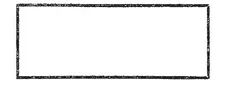
For instance, many people who would be paralysed if you said to them, ‘Kindly explain to me the geometrical construction for a rectangle’ would have no difficulty at all if you said, ‘Please tell me a good way to make a table.’ A ‘rectangle’ means the shape below —
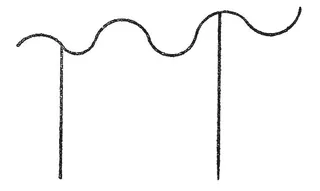
and no one could make much of a table unless he understood well what this shape was. Suppose for instance you had a table like this
All the plates and tea-pots and milk-jugs would slide down into the hollows, or fall over, and altogether it would be very inconvenient. People who make tables are unanimous that the tops ought to be
straight, not curved. Even if the top is straight, it may not be level; the table may look like this
And when the top is right, the legs may still look queer, such as
or
In such cases the weight of the table-top would tend to break the joints. To avoid this, legs are usually made upright, and the table stands on the floor like this
Anyone who understands what a table should look like understands what a rectangle is. You will find a lot about rectangles in books on geometry, because this shape is so important in practical life — though the older geometry books give no hint of this reason why we study rectangles.
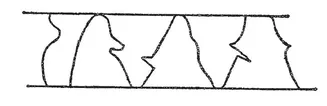
Another craft which uses rectangles is bricklaying. An ordinary brick has a rectangle on top, below, at the ends and sides. Why? It is easy to guess. The bricks have to be laid level, if they are not to slide. (Even in making walls from rough stone, such as the Yorkshire dry walls, one tries to build with level layers.) So that the bricks must fit in between two level lines. But it would still be possible to have fancy shapes for the ends —
But this looks more like a jig-saw puzzle than a wall: the poor bricklayer would spend half his life looking for a brick that would fit. We want an the bricks to have the same shape. This can be done in several ways -
or
These would make ragged ends to the wall, and if two walls met there would be open spaces to fill. By having the ordinary shape of brick, all these complications are avoided.
No one will have any difficulty in following such an argument. Why, then, do people dislike geometry? Partly because it is a mystery to them : they do not realize (and are not told) how close it lies to everyday life. Secondly, because mathematics is supposed to be perfect. There is nothing in the geometry book about shapes being ‘nearly triangles’ or ‘almost rectangles,’ while it is quite common for a door or table to be just a little out of true. This perfection puts people off. You can have several tries at making a table, and each attempt may be an improvement on the last. You learn as you go along. By insisting on ‘mathematical exactness’, it is easy to close this great road of advance, Trial and Error. If you remember how close geometry is to carpentry, you will not fall into this mistake. If you have a problem which puzzles you, the first thing to do is to try a few experiments: when you have found a method that seems to work, you may be able to find a logical, ‘exact’, ‘perfect’ justification for your method: you may be able to prove that it is right. But this perfection comes at the end: experiment comes at the beginning.
The first mathematicians, then, were practical men, carpenters and builders. This fact has left its mark on the very words used in the subject. What is a ‘straight line’? If you look up ‘straight’ in the dictionary, you will find that it comes from the Old English word for ‘stretclaed’, while ‘line’ is the same word as ‘linen’, or ’‘linen thread.’ A straight line, then, is a stretched linen thread — as anyone who is digging potatoes or laying bricks knows.
Euclid puts it rather differently. He says a straight line is the shortest distance between two points. But how do you find the shortest distance? If you take a tape-measure from one point to the other, and then pull one end as hard as you can, so that as little as possible of the tape-measure is left between the two points, you will have found the shortest path from one to the other. And the tape-measure will be ‘stretched’ in exactly the same way as the builder’s or gardener’s ‘line’.
If you are told to define something, ask yourself, How would I make such a thing in practice?’
For instance, you might be asked to define a ‘right angle’. A ‘right angle’ (in case the expression is new to you) means the figure formed when two lines meet as in a capital L, thus:
You will find a right angle at every corner of this sheet of paper. On the other hand,
and
are not right angles.
How would you make a right angle? Suppose you want to tear a sheet of note-paper into two neat halves: what do you do? You fold it over, and tear along the crease, which you know stands at the ‘right’ angle to the edge. If you fold it very carelessly, you do not get the ‘right’ angle, but something like
too much paper is left on one side, too little on the other. We now see the special feature of a right angle — both sides of the crease
look the same. If we had blots of ink on one side of the crease, we should get ‘reflections’ of these on the other when we unfolded the paper. The crease acts like a mirror. And the reflection of the edge of the paper — if we have the right angle — lies along the edge on the other side of the crease.
You can try this with a ruler or walking-stick. There is ...