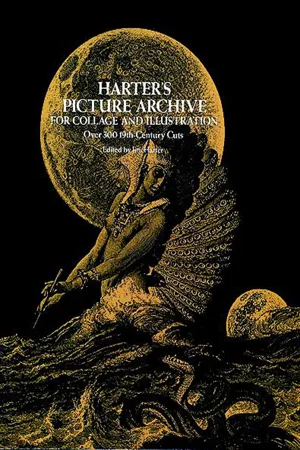
Men in strange flying machines … Mysterious veiled women … Exotic animals, birds, insects, plants … Eerie faces … Wonderful technological devices … Unusual landscapes, cityscapes, moonscapes … Children, couples, Victorian buildings, and interiors … Over 300 authentic and strikingly visual nineteenth-century engravings selected from rare periodicals, books, and catalogs, dating mostly from 1870 to 1900, and valuable for collagists, commercial and graphic artists, designers, illustrators, and others.
These rare pictures, both real and imagined, of relics, rituals, people, animals, and geometric shapes and designs provide much-needed material for collage and illustrations — material of the highest quality that is difficult if not impossible to find elsewhere. There are 25 full-page scenes of historic, natural, and city vistas that are ideally suited as background for collages and other projects. All of the pictures are sharply defined and clearly printed on one side of each page to allow for optimal use of their lines and textures and to eliminate the possibility of "show-through."
The illustrations were chosen by the well-known collagist Jim Harter, whose work has appeared in TheNew York Times, New York magazine, and other publications. Mr. Harter's artistry is evident in his selection of images that — besides being useful as decorative or illustrative elements — have a strong visual impact and symbolic potential. Line engravings offer unique textural qualities, and as Mr. Harter writes, they "have a dream-like quality that other material cannot duplicate." Mr. Harter’s introduction gives a brief history of collage as well as instructions on techniques and materials and an overview of his own perspective on the art. To illustrate the various ways these nineteenth-century cuts can be used, six collages composed entirely of images from this book are included.
- 192 pages
- English
- ePUB (mobile friendly)
- Available on iOS & Android
eBook - ePub
Harter's Picture Archive for Collage and Illustration
About this book
Information
Topic
ArteSubtopic
Arte generaleINTRODUCTION
Collage is the art of gathering images from a variety of sources and pasting them down into a single creative work. It combines a craft-like simplicity of materials and execution with a dynamic potential for visual impact and symbolic expression. A highly accessible contemporary art form, it is popular among professional artists and talented amateurs alike.
The birth of collage as a serious medium took place during the early 1900’s in France. Around this time, the two Cubist painters Pablo Picasso and Georges Braque started to incorporate newsprint, cigarette wrappers, wallpaper and other decorative materials into their paintings to achieve textural variations. Later on, Dadaists like Kurt Schwitters and Marcel Duchamp began to create pictures entirely out of such materials, which they cut out and glued upon a background of canvas or wood. The traditional name of painting seeming inappropriate for this new art, the term collage—from the French verb coller, “to glue”—came into use.
Soon after these initial experiments in collage, the early Surrealists, notably Max Ernst, began to use for their collages contemporary photographic images and wood engravings they found in periodicals, books and newspapers. Drawing upon such intellectual energies of the day as Freud’s theories and Jung’s concept of the collective unconscious, and reflecting the rapidly growing threat of domination of man by the machine, the strongly symbolic visual language of collage was transferred into a vital medium for serious social and personal statement. Ernst, and in more recent years other artists, including Wilfried Sätty and Anita Siegel, using conventional pictures in unconventional arrangements, created fantastic tableaux that commented upon the absurdity and tensions of modern society.
By the early 1900’s, as photographic (halftone) reproduction became feasible in commercial printing, the use of line engravings was discontinued. Thus, today many other materials are being used in the construction of collages. As lively and flexible as these new materials are, the use of line engraving...
Table of contents
- DOVER PICTORIAL ARCHIVE SERIES
- Title Page
- Copyright Page
- Table of Contents
- INTRODUCTION
Trusted by 375,005 students
Access to over 1.5 million titles for a fair monthly price.
Study more efficiently using our study tools.
Frequently asked questions
Yes, you can cancel anytime from the Subscription tab in your account settings on the Perlego website. Your subscription will stay active until the end of your current billing period. Learn how to cancel your subscription
No, books cannot be downloaded as external files, such as PDFs, for use outside of Perlego. However, you can download books within the Perlego app for offline reading on mobile or tablet. Learn how to download books offline
Perlego offers two plans: Essential and Complete
- Essential is ideal for learners and professionals who enjoy exploring a wide range of subjects. Access the Essential Library with 800,000+ trusted titles and best-sellers across business, personal growth, and the humanities. Includes unlimited reading time and Standard Read Aloud voice.
- Complete: Perfect for advanced learners and researchers needing full, unrestricted access. Unlock 1.5M+ books across hundreds of subjects, including academic and specialized titles. The Complete Plan also includes advanced features like Premium Read Aloud and Research Assistant.
We are an online textbook subscription service, where you can get access to an entire online library for less than the price of a single book per month. With over 1.5 million books across 990+ topics, we’ve got you covered! Learn about our mission
Look out for the read-aloud symbol on your next book to see if you can listen to it. The read-aloud tool reads text aloud for you, highlighting the text as it is being read. You can pause it, speed it up and slow it down. Learn more about Read Aloud
Yes! You can use the Perlego app on both iOS and Android devices to read anytime, anywhere — even offline. Perfect for commutes or when you’re on the go.
Please note we cannot support devices running on iOS 13 and Android 7 or earlier. Learn more about using the app
Please note we cannot support devices running on iOS 13 and Android 7 or earlier. Learn more about using the app
Yes, you can access Harter's Picture Archive for Collage and Illustration by Jim Harter in PDF and/or ePUB format, as well as other popular books in Arte & Arte generale. We have over 1.5 million books available in our catalogue for you to explore.