![]()
CHAPTER I
BABYHOOD
Some things are of that nature as to make
One’s fancy chuckle, while his heart doth ache.
— The Author’s Way of Sending Forth His Second
Part of the Pilgrim. John Bunyan, 1684.
THERE is something inexpressibly sad in the thought of the children who crossed the ocean with the Pilgrims and the fathers of Jamestown, New Amsterdam, and Boston, and the infancy of those born in the first years of colonial life in this strange new world. It was hard for grown folk to live; conditions and surroundings offered even to strong men constant and many obstacles to the continuance of existence; how difficult was it then to rear children!
In the southern colonies the planters found a climate and enforced modes of life widely varying from home life in England; it took several generations to accustom infants to thrive under those conditions. The first years of life at Plymouth are the records of a bitter struggle, not for comfort but for existence. Scarcely less sad are the pages of Governor Winthrop’s journal, which tell of the settlers of Massachusetts Bay. On the journey across seas not a child “had shown fear or dismayed-ness.” Those brave children were welcomed to the shore with good cheer, says the old chronicler, Joshua Scottow; “with external flavor and sweet odor; fragrant was the land, such was the plenty of sweet fern, laurel, and other fragrant simples; such was the scent of our aromatic and balsam-bearing pines, spruces and larch trees, with our tall cedars.” They landed on a beautiful day in June, “with a smell on the shore like the smell of a garden,” and these happy children had gathered sweet wild strawberries and single wild roses. It is easy to picture the merry faces and cheerful laughter.
Scant, alas! were the succeeding days of either sweetness or light. The summer wore on in weary work, in which the children had to join; in constant fears, which the children multiplied and magnified; and winter came, and death. “There is not a house where there is not one dead,” wrote Dudley. One little earth-weary traveller, a child whose “family and kindred had dyed so many,” was, like the prophets in the Bible, given exalted vision through sorrow, and had “extraordinary evidence concerning the things of another world.” Fierce east winds searched the settlers through and through, and frosts and snows chilled them. The dreary ocean, the gloomy forests, were their bounds. Scant was their fare, and mean their roof-trees; yet amid all the want and cold little children were born and welcomed, with that ideality of affection which seems as immortal as the souls of the loved ones.
Hunger and privation did not last long in the Massachusetts colony, for it was a rich community —for its day — and soon the various settlements grew in numbers and commerce and wealth, and an exultant note runs through their records. Prosperous peoples will not be morose; thanksgiving proclamations reflect the rosy hues of successful years. Child life was in harmony with its surroundings; it was more cheerful, but there was still fearful menace to the life and health of an infant. From the moment when the baby opened his eyes on the bleak world around him, he had a Spartan struggle for life; half the Puritan children had scarce drawn breath in this vale of tears ere they had to endure an ordeal which might well have given rise to the expression “the survival of the fittest.” I say half the babies, presuming that half were born in warm weather, half in cold. All had to be baptized within a few days of birth, and baptized in the meeting-house; fortunate, indeed, was the child of mid-summer. We can imagine the January babe carried through the narrow streets or lanes to the freezing meeting-house, which had grown damper and deadlier with every wintry blast; there to be christened, when sometimes the ice had to be broken in the christening bowl. On January 22, 1694, Judge Samuel Sewall, of Boston, records in his diary: —
“A very extraordinary Storm by reason of the falling and driving of Snow. Few women could get to Meeting. A Child named Alexander was baptized in the afternoon.”
The Judge tells of his own children — four days old — shrinking from the icy water, but crying not. It was a cold and disheartening reception these children had into the Puritan church; many lingered but a short time therein. The mortality among infants was appallingly great; they died singly, and in little groups, and in vast companies. Putrid fevers, epidemic influenzas, malignant sore throats, “bladders in the windpipe,” raging small pox, carried off hundreds of the children who survived baptism. The laws of sanitation were absolutely disregarded — because unknown; drainage there was none — nor deemed necessary; disinfection was feebly desired — but the scanty sprinkling of vinegar was the only expression of that desire; isolation of contagious diseases was proclaimed but the measures were as futile when the disease was known to be contagious as they were lacking in the diseases which our fathers did not know were communicable. It is appalling to think what must have been the unbounded production and nurture of disease germs; and we can paraphrase with truth the words of Sir Thomas Browne, and say of our grandfathers and their children, “Considering the thousand roads that lead to death, I do thank my God they could die but once.”
It is heartrending to read the entries in many an old family Bible — the records of suffering, distress, and blasted hopes. Until this century these sad stories may be found. There lies open before me an old leather-bound Bible with the record of my great-grandfather’s family. He had sixteen children. When the first child was a year and a half old the second child was born. The baby was but four days old when the older child died. Five times did that mother’s heart bear a similar cruel loss when she had a baby in her arms; therefore when she had been nine years married she had one living child, and five little graves bore record of her sorrow.
In the seventeenth century the science of medicine had not wholly cut asunder from astrology and necromancy; and the trusting Christian still believed in some occult influences, chiefly planetary, which governed not only his crops but his health and life. Hence the entries of births in the Bible usually gave the hour and minute, as well as the day, month, and year. Thus could be accurately calculated what favoring or mischief-bearing planets were in ascendency at the time of the child’s birth; what influences he would have to encounter in life.
The belief that meteorological and astrological conditions affected medicines was strong in all minds. The best physicians gravely noted the condition of the moon when gathering herbs and simples and concocting medicines; and certain drugs were held to be powerless at certain times of the year, owing to planetary influences. “Sympathetical” medicines were confidingly trusted, and tried to a surprising extent upon children; apparently these were as beneficial as our modern method of healing by the insinuation of improved health.
We cannot wonder that children died when we know the nostrums with which they were dosed. There were quack medicines which held sway for a century—among them, a valuable property, Daffy’s Elixir. These patented — or rather secret — medicines had a formidable rival in snail-water, which was used as a tonic and also a lotion. Many of the ingredients and extracts used in domestic medicines were incredibly revolting.
Venice treacle was a nasty and popular compound, traditionally invented by Nero’s physician; it was made of vipers, white wine, opium, “spices from both the Indies,” licorice, red roses, tops of germander and St.-John’s-wort, and some twenty other herbs, juice of rough sloes, mixed with honey “triple the weight of all the dry spices.” The recipe is published in dispensatories till within this century. The vipers had to be put, “twelve of ’em,” into white wine alone. Mithridate, the ancient cure-all of King Mithridates, was another dose for children. There were forty-five ingredients in this, each prepared and introduced with care. Rubila, made chiefly of antimony and nitre, was beloved of the Winthrops, and frequently dispensed by them — and with benefit.
Children were grievously afflicted with rickets, though curiously enough it was a new disease, not old enough to have received adequate observation in England, wrote Sir Thomas Browne in the latter part of the seventeenth century. Snails furnished many doses for the rickets.
Exact instruction of treatment for the rickets is given in a manuscript letter written to Rev. Joseph Perry of Windsor, Connecticut, in 1769: —
“REV’D SIR:
“In ye Rickets the best Corrective I have ever found is a Syrup made of Black Cherrys. Thus. Take of Cherrys (dry’d ones are as good as any) & put them into a vessel with water. Set ye vessel near ye fire and let ye water be Scalding hot. Then take ye Cherrys into a thin Cloth and squeeze them into ye Vessell, & sweeten ye Liquor with Melosses. Give 2 Spoonfuls of this 2 or 3 times in a day. If you Dip your Child, Do it in this manner: viz: naked, in ye morning, head foremost in Cold Water, don’t dress it Immediately, but let it be made warm in ye Cradle & sweat at least half an Hour moderately. Do this 3 mornings going & if one or both feet are Cold while other Parts sweat (which is sometimes ye Case) Let a little blood be taken out of ye feet ye 2nd Morning and yt will cause them to sweat afterwards. Before ye dips of ye Child give it some Snakeroot and Safern Steep’d in Rum & Water, give this Immediately before Diping and after you have dipt ye Child 3 Mornings Give it several times a Day ye following Syrup made of Comfry, Hartshorn, Red Roses, Hog-brake roots, knot-grass, petty-moral roots, sweeten ye Syrup with Melosses. Physicians are generally fearful about diping when ye Fever is hard, but oftentimes all attemps to lower it without diping are vain. Experience has taught me that these fears are groundless, yt many have about diping in Rickety Fevers; I have found in a multitude of Instances of diping is most effectual means to break a Rickety Fever. These Directions are agreable to what I have practiced for many years.”
Among other English notions thrust upon American children was one thus advertised in ante-Revolutionary newspapers: —
“THE FAMOUS ANODYNE NECKLACE
“price 20 shillings
“For children’s teeth, recommended in England by Dr. Chamberlen, with a remedy to open and ease the foregums of teething children and bring their teeth safely out. Children on the very brink of the Grave and thought past recovery with their teeth, fits, fevers, convulsions, hooping and other violent coughs, gripes, looseness, and all proceeding from their teeth who cannot tell what they suffer nor make known their pains any other way but by crying and moans, have almost miraculously recovered after having worn the famous Anodyne Necklace but one night’s time. A mother then would never forgive herself whose child should die for want of so very easy a remedy for its teeth. And what is particularly remarkable of this necklace is, that of those vast numbers who have had this necklace for their children, none have made any complaints but express how glad they have been that their children have worn it whereas if they had not had it, they believed their children would have been in the grave, all means having been used in vain until they had the necklace.”
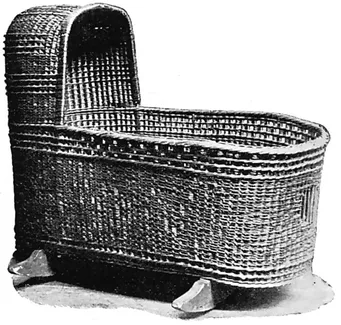
Mayflower Cradle, owned by the Pilgrim William White
These anodyne necklaces were akin to the medicated belts of our own day, and were worn as children still wear amber beads to avert the croup. Various native berries had restorative and preventive properties when strung as a necklace. Uglier decorations were those recommended by Josselyn to New England parents, strings of fawn’s teeth or wolf’s fangs, a sure promoter of easy teething. He also advised scratching the child’s gums with an osprey bone. Children died, however, in spite of these varied charms and doses, in vast numbers while teething.
There were some feeble expressions of revolt against the horrible doses of the day. In 1647 we hear of the publication of “a Most Desperate Booke written against taking of Phissick,” but it was promptly ordered to be burnt; and the doses were continued until well into this century. The shadow of their power lingers yet in country homes.
Many alluring baits were written back to England by the first emigrants to tempt others to follow to the new world. Among other considerations Gabriel Thomas made this statement: —
“The Christian children born here are generally well-favored and beautiful to behold. I never knew any to come into the world with the least blemish on any part of the body; being in the general observed to be better-natured, milder, and more tenderhearted than those born in England.”
John Hammond lavished equal praise on the children in Virginia. It was also asserted that the average number of children in a family was larger, which is always true in a pioneer settlement in a new country. The promise of the Lord is ever fulfilled that he will “make the families of his servants in the wilderness like a flock.”
A cheerful home life was insured by these large families when they lived. Sir William Phips was one of twenty-six children, all with the same mother. Green, the Boston printer, had thirty children. Another printer, Benjamin Franklin, was one of a family of seventeen. William Rawson had twenty children by one wife. Rev. Cotton Mather tells us: —
“One woman had not less than twenty-two children, and another had no less than twenty-three children by one husband, whereof nineteen lived to man’s estate, and a third was mother to seven and twenty children.”
He himself had fifteen children, though but two survived him. Other ministers had larger families. Rev. John Sherman, of Watertown, Massachusetts, had twenty-six children by two wives. Rev. Samuel Willard, the first minister of Groton, Massachusetts, had twenty children, and was himself one of seventeen children. It is to the honor of these poorly paid ministers that they brought up these large families well. Rev. Abijah Weld, of Attleboro, Massachusetts, had an annual salary of about two hundred and twenty dollars. He had a small farm and a decent house; he lived in generous hospitality, entertaining many visitors and contributing to the wants of the poor. He had fifteen children and reared a grandchild. In his fifty-five years of service as a minister he was never detained from his duties nor failed to perform them.
Rev. Moses Fiske had sixteen children; he sent three sons to college and married off all his daughters; his salary was never over ninety pounds, and usually but sixty pounds a year, paid chiefly in corn and wood. One verse of a memorial poem to Mrs. Sarah Thayer reads: —
“And one thing more remarkable
Which here I shall record;
She’d fourteen children with her
At t...