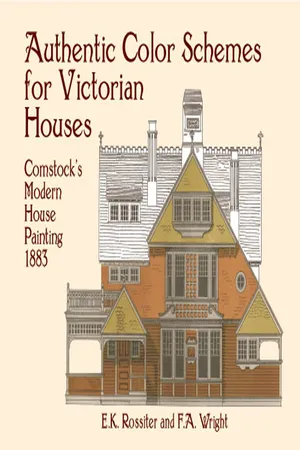
When the authors, a pair of respected architects, first published this beautiful book in the late Victorian era, they meant it as a wakeup call to the forward-looking homeowners of the time — inviting them to eschew "the old puritanical hatred of color, which found its natural outcome in white houses with green blinds" and join in the revolutionary trend toward "advanced notions, in which the more positive colors find a chance of expression." The book helped homeowners to attain this goal through its presentation of full-color illustrations of attractive, up-to-date color schemes for houses, with special attention given to the refined lines of Queen Anne-style homes.
The heart of the book is the section of 20 exquisite color plates — each reproducing a flawlessly executed architectural drawing that shows the color possibilities for a specific house, and each accompanied by an extensive written description of the colors to be used for exterior walls and trim. An informative introductory section gives a clear explanation of how to mix primary and secondary colors to achieve such popular, mellow tones of the period as olive, russet, citrine, buff, plum, and sage. This authentic source of inspiration and suggestions will be prized by restorationists, architects, home-builders, and lovers of Victoriana.
eBook - ePub
Authentic Color Schemes for Victorian Houses
Comstock's Modern House Painting, 1883
- 64 pages
- English
- ePUB (mobile friendly)
- Available on iOS & Android
eBook - ePub
Authentic Color Schemes for Victorian Houses
Comstock's Modern House Painting, 1883
About this book
Information
Topic
ArchitectureSubtopic
Architecture GeneralCHAPTER I.
INTRODUCTORY.
IN all departures from generally accepted standards, and in all innovations that embody anything of a startling nature, the radicals are the prime movers, and usually come to the front as the men of action, who inaugurate, and set in motion, the machinery designed to carry out the new idea. This, naturally, often results in extreme measures at first; but, afterwards there comes the inevitable conservative reaction which tends to moderation and temperance. That. which the reform embodies of good is carefully garnered up, while that which is fanatical and meretricious is gradually sifted out and rejected. The final working out of the new ideas may be said to result in neither the one extreme of radical innovation, nor in the other of conservative inaction; but in the golden mean between the two, which is tolerance within reasonable and well defined limits.
Some such process as this is at the present time being worked out in architecture. The present architectural renaissance of the so-called Queen Anne, Free Classic, and English Domestic styles, represents an important movement in the right direction, which has all the characteristics of a true reform. The renaissance of the architectural styles prevalent over a century ago is marked by efforts of a new and original nature, resulting in elaborate complexity, and wild vagaries, not strictly warranted by ancient authority. The movement is now fairly inaugurated, with all its inconsistencies, absurdities, oddities, and extreme fanatical tendencies, brought prominently to the foreground, in full accordance with the general law we have noted. The reaction has not yet set in, but already have been heard the mutterings which presage its coming, in the protests entered here and there against some of the more especially indefensible examples, and in the growing tendency to reject features which will not adapt themselves to modern exigencies and practical requirements. Some of the good features of the new style—features that have stood the crucial test of adaptability and utility—have also been recognized by this time, and have been unhesitatingly adopted as among the architectural ideas that will live. There has grown up with the present style, as indeed an integral part of it, an ever inrceas-ing demand for and love of color. The broken surfaces and picturesque outlines of the modern Queen Anne country house offer many advantages for almost endless artistic color treatment, not possessed by former types, and it is very gratifying to find that this is seen and appreciated. This is in itself one of the most important of the good results of the revival. Color bears such an intimate relation to it that, at the risk of having it considered somewhat out of place, we cannot refrain from broadly analyzing the new style.
This is the more necessary because of the very widespread ignorance as to what is, and what is not, real Queen Anne work. Any piece of modern work in which some old and quaint effect has been introduced, or in which some ancient detail has been copied, has been unblushingly christened Queen Anne. The name has been made to do duty for classifying any departure from ordinary and well accepted standards. Not infrequently we see two buildings whose characteristic features are diametrically opposed, classed as Queen Anne, when the truth is that neither of them partakes in any degree of what can strictly speaking be so designated. Modern Queen Anne, or Free Classic, is based upon English examples of domestic buildings erected during the reigns of William and Mary, Queen Anne, and the first two Georges, and also upon buildings of a later date of a nondescript character, which resulted from an exceedingly lively effort of an eclectic school of designers to break away from English Domestic Gothic. Drawing its features from so many sources, it is not easy to clearly define them. Generally speaking, however, they are such as result from the application of classical details to Gothic forms and mediæval principles of construction. The general form and arrangement of these buildings was after the Gothic manner: i.e. they were designed from the inside; the plan was the first consideration, and was made to meet the practical requirements of the times, while the exterior was left in a great measure to take care of and adapt itself to the plan. Breaking away from the bad precedents established by the Renaissance, especially the practice of subordinating the convenience of plan and interior effects to the requirements of a classical exterior, symmetry began to be considered as no longer the all essential characteristic of good architecture. Picturesqueness was aimed at and, while the claims of convenience and utility may have been often sacrificed to whims and quaint conceits, yet, in general the result was an advance beyond the elaborate baldness of the Palladian class of renaissance buildings which were at one time becoming very numerous. The new school of designers was, and is now, eclectic, claiming the right to use the special features and details of any and every style, which can be bent to harmonize with the requirements of their buildings. The tendency is to substitute for the heavy and clumsy Gothic detail, the more delicate, graceful, and refined features which characterize the renaissance of the Grecian and Roman styles. There are strictly speaking but two great styles of architecture, the underlying principles of which are based upon the construction. One is the classical style, based upon the lintel as its chief constructive feature, and the other the mediaeval Gothic in which the arch is used to span openings. Modern styles are chiefly the result of a compromise between these two great systems. They are transitions from one to the other in which characteristic features of both are blended.
The prototypes of the present style in England were generally executed in brick or stone, and for real Queen Anne these are the materials required. Our country houses are for the most part of wood, and in working out the problem of keeping to the essential features of the style while the material is different, many modifications of old, and new features have resulted. Colonial architecture affords many examples in wood which take the place of brick prototypes. The differences between colonial work and contemporaneous Queen Anne are such as arise chiefly from their being worked out in different materials. In the better class of Colonial houses these differences are more marked. In some of these examples the symmetrical planning is evident, and they partake of the classical idea more than of the Gothic. They are very valuable for the detail which they contain, and much of the best in modern work is drawn from this source.
Modern Queen Anne, using the term to cover in a general way all the present reigning styles, is founded upon these various examples in our own land and abroad, and thus partakes of the characteristics of many local styles. In its better phases, however, it is very different from its prototypes, being marked by greater freedom of treatment, and being broken up more in outline and form. The detail has also undergone considerable change. Greater refinement, richness, and delicacy of expression, has been attempted, than in the old examples, and the result is, perhaps, a more harmonious whole. A modern style must reflect modern tastes and modern ways of life, and it must fail where it attempts to copy the old without regard to adaptability or fitness. It is in this respect that the extreme of unreasonable fanaticism is reached.
Modern styles cover a wider range, and embrace a larger school of purely eclectic designers than ever before. They have not yet crystalized into any very definite forms. They are respectively called Queen Anne, English Domestic, Colonial, or Free Classic, as the different supposed characteristics of these various styles are thought to pro-dominate, but they all elude any definite architectural analysis. Things are in a state of transition, for the most part. Buildings that are recognizably definable in any distinct style are rare. It is, perhaps, well that it should be so. There is no good reason why we should not learn all that we can from the past, and recall from oblivion all that is good and adaptable to modern life. This is what is now taking place, and it cannot be denied that our houses are, in consequence, gradually assuming a more homelike and picturesque character much to be preferred to the manufactured style so monotonously prevalent at one period.
If for nothing else, let us be thankful for the opportunity offered for better color treatment. Exterior house decoration has been obliged to keep pace with the new ideas, and effects which do not admit of commonplaceness in coloration. The old puritanical hatred of color, which found its natural outcome in white houses with green blinds, has had to give way; at first, to a compromise, in which neutral and sickly drab tints played a pro...
Table of contents
- Title Page
- Copyright Page
- PREFACE TO THE SECOND EDITION.
- Table of Contents
- CHAPTER I. - INTRODUCTORY.
- CHAPTER II. - COLOR.
- CHAPTER III. - PREPARATION, USE AND APPLICATION OF COLORS.
- The Plates
- DOVER BOOKS ON ARCHITECTURE
Trusted by 375,005 students
Access to over 1.5 million titles for a fair monthly price.
Study more efficiently using our study tools.
Frequently asked questions
Yes, you can cancel anytime from the Subscription tab in your account settings on the Perlego website. Your subscription will stay active until the end of your current billing period. Learn how to cancel your subscription
No, books cannot be downloaded as external files, such as PDFs, for use outside of Perlego. However, you can download books within the Perlego app for offline reading on mobile or tablet. Learn how to download books offline
Perlego offers two plans: Essential and Complete
- Essential is ideal for learners and professionals who enjoy exploring a wide range of subjects. Access the Essential Library with 800,000+ trusted titles and best-sellers across business, personal growth, and the humanities. Includes unlimited reading time and Standard Read Aloud voice.
- Complete: Perfect for advanced learners and researchers needing full, unrestricted access. Unlock 1.5M+ books across hundreds of subjects, including academic and specialized titles. The Complete Plan also includes advanced features like Premium Read Aloud and Research Assistant.
We are an online textbook subscription service, where you can get access to an entire online library for less than the price of a single book per month. With over 1.5 million books across 990+ topics, we’ve got you covered! Learn about our mission
Look out for the read-aloud symbol on your next book to see if you can listen to it. The read-aloud tool reads text aloud for you, highlighting the text as it is being read. You can pause it, speed it up and slow it down. Learn more about Read Aloud
Yes! You can use the Perlego app on both iOS and Android devices to read anytime, anywhere — even offline. Perfect for commutes or when you’re on the go.
Please note we cannot support devices running on iOS 13 and Android 7 or earlier. Learn more about using the app
Please note we cannot support devices running on iOS 13 and Android 7 or earlier. Learn more about using the app
Yes, you can access Authentic Color Schemes for Victorian Houses by E. K. Rossiter,F. A. Wright, F. A. Wright in PDF and/or ePUB format, as well as other popular books in Architecture & Architecture General. We have over 1.5 million books available in our catalogue for you to explore.