![]()
List of Drawings
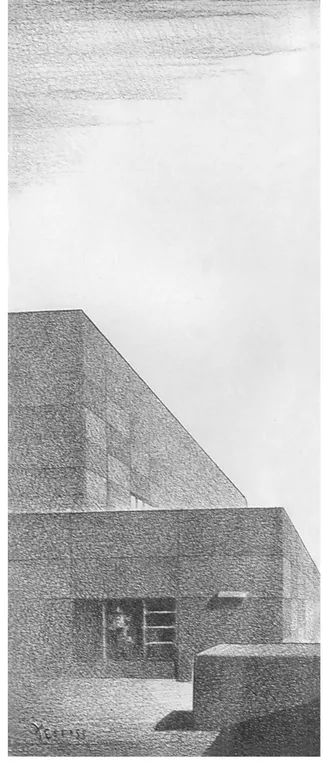
Cherokee Dam, Tennessee Frontispiece
- Viaduct on Washington Heights, New York City
- Franklin D. Roosevelt Drive, Portal at 56th Street, New York City
- Triborough Bridge Anchorage, New York City
- Norris Dam, Tennessee
- Turbine, Grand Coulee Dam, Washington
- Grand Coulee Dam
- Zapotec Structure, Mexico
- Shasta Dam, California
- National Airport, Washington, D.C.
- Grain Elevator, Kansas City, Missouri
- Ohio Steel Foundry, Lima
- Library and Museum, Cranbrook Academy of Art Bloomfield Hills, Michigan
- Preliminary Scheme, General Motors Technical Center, Detroit
- Johnson Wax Company Building, Racine, Wisconsin
- Interior, Johnson Wax Company Building
- Taliesin-in-Arizona, Scottsdale
- Rockefeller Center, New York City
- Detail, Eastern Air Lines Building, New York City
- “The Last Column”
- Steel Porch
- “Envelopes”
- Preliminary Study, Empire State Building, New York City
- Shelton Hotel, New York City
- “Wedding Cake ” vs. “Slabs”
- Lever House, New York City
- Proposed Alterations, Metropolitan Museum of Art, New York City
- Preliminary Study, New Cathedral of the Assumption of the Blessed Virgin Mary, Baltimore
- Proposed Development, Foley Square, New York City
- “Green River,” St. Louis
- A Sphere in Construction
- Perisphere and Trylon, Opening Night, New York World’s Fair
- Perisphere and Trylon, During Construction
- Proposed United Nations Headquarters, Flushing Meadows, Long Island
- Dome, Proposed General Assembly Building
- An Inscribed Wall
- X-City
- Entrance to Auditorium, X-City
- The Stage, X-City
- A Charette
- Preliminary Studies, United Nations Headquarters, New York City
- The “Floating” Building
- Preliminary Study, United Nations Headquarters, North Elevation
- Progressive Steps, United Nations Headquarters, 1947-49
- General View, United Nations Headquarters
- Inter-American Center, Biscayne Bay, Florida
- Bombproof Shelter
- Shelter Equipped for Occupancy
- Red Rocks Park, Colorado
- Hoover Dam, Arizona-Nevada Line
- Red Rocks Amphitheater
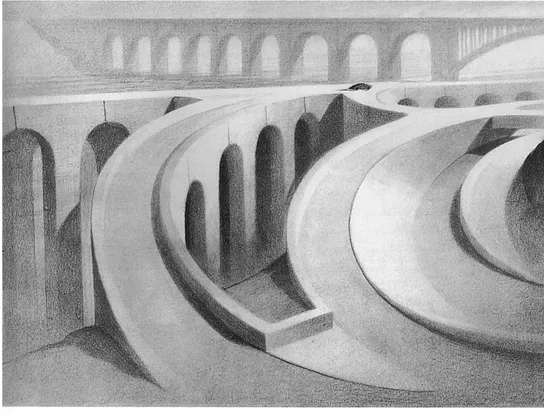
The purpose of this structure, the first to be drawn on the Brunner travels, would be obvious even without sketching in the automobile. That the traffic to be carried is heavy and high-speed is also obvious from the number, disposition, and curvature of the concrete lanes. They would not have been built in any age but our own. They were designed for purely utilitarian purposes. But if one looks at the structure itself and at the site, one notes a structural rhythm that repays study.
An artist despairs of ever conveying in two dimensions the effects produced by a three-dimensional structure. In this case, however, the effects are so simple that no trained draftsman could seriously distort the facts, and the following question can be put: does the picture opposite imply something of simple aesthetic interest—yes or no? If the reader votes “no” he may as well lay this book aside, for it will be concerned throughout with equally simple interests.
1 Viaduct on Washington Heights, New York City
Aymar Embury II, Consulting Architect
John Evans, Engineer
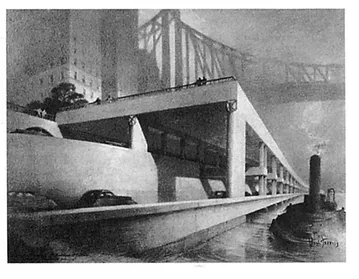
2 Franklin D. Roosevelt Drive, Portal at 56th Street New York City
Department of Borough Works, Manhattan
Harvey Stevenson, Consulting Architect
Lester C. Hammond, Engineer
The need for bringing a large volume of high-speed traffic into crowded cities has produced, of course, many striking designs; it would have been equally suitable to include, at this point, sketches made near the apex of Pittsburgh’s Triangle, or along Chicago’s handsome lake front, or on the “floating bridge” leading over Lake Washington to the unique city portal that pierces Mt. Baker, one of “the seven hills of Seattle.”
However, the “East River Drive” (as many New Yorkers persist in calling it) presents a series of interesting situations. This sketch, made when Stanley M. Isaacs was President of the Borough of Manhattan and Walter D. Binger was Commissioner of Borough Works, shows the two levels of automobile traffic and the third level that provides an elevated pedestrian esplanade overlooking the river. The architect’s hand is revealed in the way the bare structural facts have been simplified and enlivened.
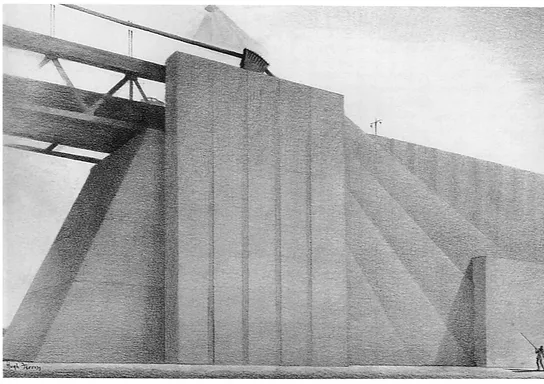
3 Triborough Bridge Anchorage, New York City
Triborough Bridge and Tunnel Authority
Aymar Embury II, Consulting Architect
O. H. Ammann, Chief Engineer; Allston Dana, Engineer of Design
Many people think of bridges as not being in the category of architecture. Actually, they well exemplify the architectural problem of combining structural utility and structural beauty. Queensboro and Whitestone, to mention two well-known bridges, are both altogether useful structures and sound engineering. It is of architectural interest that one is beautiful and the other is not. It is beauty, the extra dividend, that has made the Whitestone Bridge justly famous.
Would George Washington Bridge, spanning the Hudson, be handsomer, or “more architectural,” if the two towers had been encased in stone, as was at one time proposed? That proposal was studied in perspective drawings, some years ago, and it seemed obvious that the design is not only more logical but also more handsome without the masonry disguise.
Other great structures are Golden Gate Bridge and (also at San Francisco) Bay Bridge, with its tandem spans and handsome Yerba Buena tunnel; among the notable smaller bridges are the series along the Oregon Coast Highway (the most stunning drive in the country). William Gehron’s Veterans Memorial Bridge at Rochester, New York, is an outstanding example of the masonry-arch bridge.
But those spans are famous—everyone knows already how they look—and so those sketches have been put aside in favor of a subject less often noticed. By leaving out many details that would have been caught by the camera, I have emphasized the lines and planes which, at the site, give a sense of strong organization to this simple, utilitarian anchorage.
4 Norris Dam, Tennessee
Architects and Engineers of the Tennessee Valley Authority
I have seen no more massive evidence of this nation’s power in buildings than in the work of the United States Bureau of Reclamation and the Tennessee Valley Authority. My acquaintance with the latter began one October day in 1941 when Roland Wank, Chief Architect at that time, explained, during lunch at the Andrew Johnson Hotel in Knoxville, how the plans, from inception, passed regularly back and forth between the Authority’s architectural staff and its engineering staff. Later, I saw that coordination under way, and perceived its results in the actual structures—not only in the dams but also in the culverts, prefabricated units, recreation housing around newly made lakes, cooperative and public housing, and layouts for new communities and towns.
One learns, in the Tennessee Valley, names that are famous in the history of man-made structures (Walt Whitman would have enjoyed invoking them) : Pickwick, Wheeler, Chickamauga, Norris, Hiwassee, Cherokee. It is from the air that one gets the full story: the remodeling of a whole valley, an architecture for a region. The air age gives a new façade to architecture; so far as I know, artists have yet to portray it. But from an airplane one can at least see it; and what I saw, flying over the Tennessee Valley in 1951, was vast usefulness combined with deeply impressive forms.
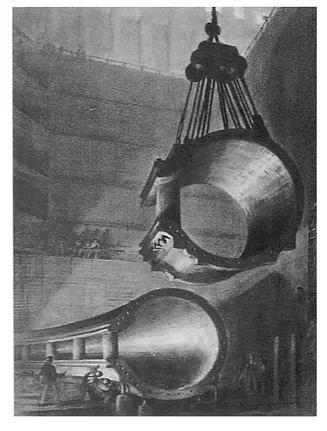
5 Turbine, Grand Coulee Dam, Washington
6 Grand Coulee Dam
United States Bureau of Reclamation
Gordon B. Kauffmann and Earl C. Morris, Consulting Architects
It was not from the air that my companion and I first saw this masterpiece of the Bureau of Reclamation. We had been driving not far from a trail once followed to Oregon by trappers and settlers and later by pioneering architects. Each mile had taken us farther from the familiar disputes of eastern-seaboard designers, such as the French-German aesthetic war of Beaux Arts vs. Bauhaus, and deeper into the regions of an indigenous architecture. Turning north from the Snake River into a landscape as wild as the moon’s and seemingly as uninhabited, we came suddenly upon the largest structure ever reared by man.
We inspected the dam and the clean-cut town that had grown alongside it; later we slept in one of the modern cabins next to the white, leviathan mass. Through the hot summer nights the cabins are cooled by ...