Egypt, Babylon, Greece up through 19th-century Europe; based on surviving pieces, art work, much more. Includes many clear, measured patterns for reproducing historic costumes. Full text. 595 illustrations. "...landmark in the field of Western European costume...exceptional value for its price." — American Artist.
- 464 pages
- English
- ePUB (mobile friendly)
- Available on iOS & Android
eBook - ePub
A History of Costume
About this book
Information
Topic
DesignSubtopic
Fashion DesignTHE MIDDLE AGES
ELEVENTH TO THIRTEENTH CENTURIES
THE costumes worn in the Middle Ages were based on the types that had been evolved about the middle of the first millennium from the intermingling of native fashions with those of later antiquity. In the first centuries after the migration of the nations (A.D. 600) there was little difference between the styles of dress current among the various nations of the West. Then ensued a period of separate development, each nation following its own tastes, and this lasted until the Crusades brought all the peoples of Europe into close touch with each other and reintroduced a greater measure of uniformity. This uniformity, however, was greatly enriched by the fruitful influences of ancient Oriental civilization, particularly in respect of material and ornamentation.
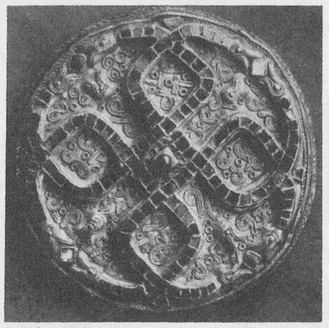
Fig. 139. CIRCULAR BROOCH FROM WITTISLINGEN
Seventh to eighth century A.D.
Seventh to eighth century A.D.
There is a very close connexion between the styles of the early Middle Ages and those of ecclesiastical dress. The latter has retained down to our own day survivals which enable us to form a clear conception of the costume of the Middle Ages (Fig. 191). Unfortunately, we possess very few original garments belonging to this long period. One of them is the white silk dalmatica that belonged to the Emperor Henry II (Fig. 168) which is among the treasures of Bamberg Cathedral. Samples of material and inwoven patterns are more numerous. It helps our imagination when we look at the miniatures in ancient manuscripts and the tombs that still exist. And in quite recent days the discoveries made at Herjolfsnes, the ancient Norse colony, have brought to light a number of garments that reveal the dress of the later Middle Ages. These are so perfect that they constitute a source of inestimable value for the history of European dress, even although these Norse settlers were limited in their choice of material by the remoteness of their situation. (See Figs. 187 and 100.)
Equally interesting is the golden dress of Margaret of Denmark, belonging to the second half of the fourteenth century, with the extraordinary length of the front of the skirt and the extreme shortness of the bodice, which was fastened at the back (Fig. 193). The beautiful material—cloth of gold shot through with a dark red-violet colour—helps us to imagine the rare splendour and beauty of the royal robes of that time.
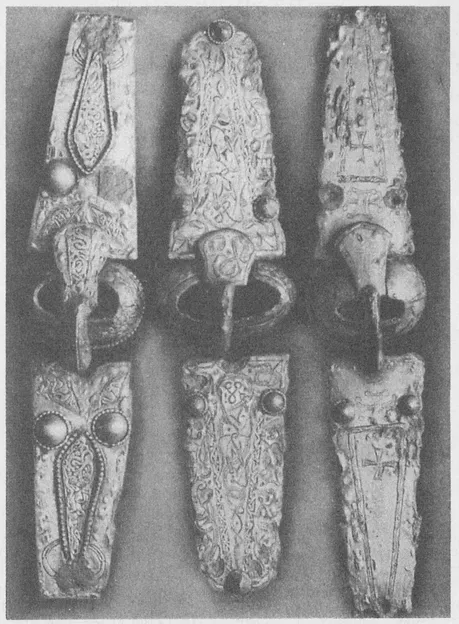
Fig. 140. SILVER BUCKLES FROM FÉTIGNY. SWITZERLAND
Seventh to eighth century A,D.
Seventh to eighth century A,D.
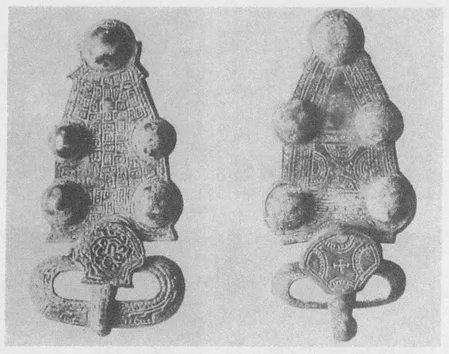
Fig. 141. BRONZE BUCKLES, ENGRAVED
Early period of the migration of nations.
Early period of the migration of nations.
To the period between fifty and seventy-five years later we must ascribe the coat of carmine red satin (Fig. 199) which is said to be part of the spoil from the battle of Granson in 1476, and is now in the Museum of Bern. It looks like an under-garment meant to be worn beneath the robe—an over-garment of heavy, rich material. It is said to have belonged to Charles the Bold of Burgundy, whose Court was one of the most brilliant of his time and powerfully affected the development of contemporary fashions.
To complete our conception of the dress of the Middle Ages we must add the jewellery. It was both beautiful and valuable, and fortunately numerous specimens still exist. Especially charming are the examples of the goldsmith’s art which belong to the zenith of the Middle Ages—the time of the Ottos and the Henrys (Figs. 165, 166, and 167). Their high perfection of technique is a constant delight. The breast-ornaments of the Empress Gisela, which belong to the year 1000, together with her earrings and clasps, bear eloquent testimony to the outstanding skill of the craftsmen and the cultivated taste of those who employed them. The jewels combine the strength of the Carolingian genius for design with the delicacy of Byzantine technique, and they are among the finest things of the kind in existence. The ancient Teutonic fondness for gold and precious stones, which had already been shown in the brooches and clasps of an earlier day, finds eloquent expression in these jewels.
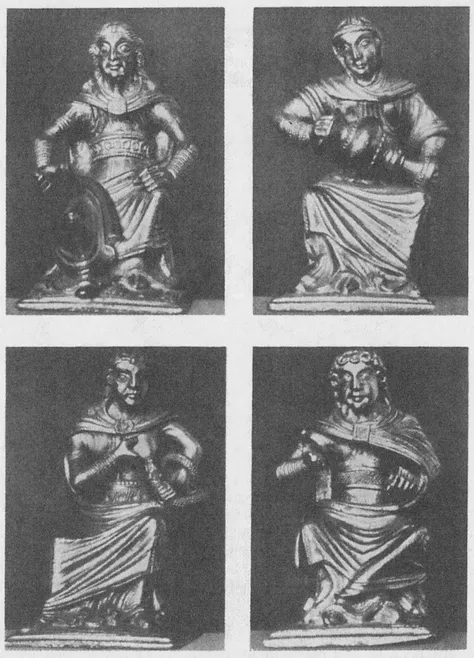
Figs. 142-145. THE FOUR ELEMENTS
Bronze statuettes from Lower Lorraine. End of the twelfth century.
Bronze statuettes from Lower Lorraine. End of the twelfth century.
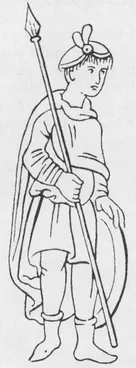
Fig. 146. MEN’S DRESS
ABOUT THE YEAR 1000
ABOUT THE YEAR 1000
GERMANY
At this period men were wearing a fairly wide tunic of varying length, girdled at the waist, and having sleeves that covered the whole arm down to the wrist. It was no longer unusual, although it was still far from being the universal practice, to wear beneath this tunic (which was generally made of wool, but frequently of silk) a linen shirt. This was worn next the skin. Over the tunic was worn a cloak, usually oblong in shape, which was thrown over the left shoulder and gathered on the right by means of a clasp (agraffe) (Fig. 146). Finally, men also wore leg-garments of varying length, and over these was drawn the footwear, mostly of eather and reaching up to the calf.
The cut of all these garments was still in all essentials the same as it had been for centuries (see Fig. 147)—that is to say, the coat consisted of two similar pieces, back and front, sewn together down the sides and on the shoulders. The sleeves were straight, with only one seam, and narrowed gradually from the shoulder to the wrist. The opening for the neck was fairly wide, sometimes rounded, sometimes square, and was cut in the front piece. The coat was usually made of bright-coloured material, and wide strips of braid or other stuff were sewn round the foot, the neck, and the wrists.
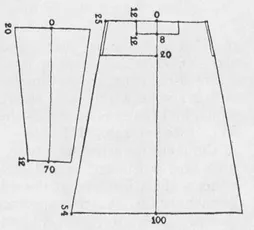
Fig. 147. SHAPE OF MEN’S SLEEVED
COAT OF ABOUT A.D. 1000
COAT OF ABOUT A.D. 1000
The shirt was shaped like the coat, but it was usually wider, and always much longer, often reaching as low as the ankles.
The cut of the cloak was rectangular, the length of the narrow sides being equal to the distance from the wearer’s neck to the middle of the lower leg, and about a third less than that of the long sides, which made the width of the cloak.
The leg-garments were long stockings, made of two pieces shaped like a leg and sewn together at the front and back. The lower part of the shirt was tucked into these ; they were attached to a girdle (worn under the coat) by means of tapes sewn on the outside of them, and were thus held in position. Beneath these stockings many men wore long, wide under-hose of linen, somewhat like two bags sewn together in the upper part. Footwear consisted either of ankle-high shoes or boots that came up to the middle of the calf.
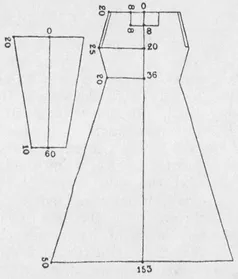
Fig. 148. CUT OF WOWEN’S COAT IN THE YEAR 1000
The usual female dress consisted of a long chemise of linen or hemp, with a low neck and short sleeves. Over it came the coat, or tunic, which had the same shape as the chemise, and reached from neck to feet. (See Fig. 148.) It had long, tight sleeves. These coats, like those of the men, were trimmed with wide strips of coloured braid at the neck and wrists and round the foot. Over the coat women wore either a cloak fastened at the middle of the breast with a clasp or a garment similar to that underneath, but shorter and with shorter sleeves. This over-garment was usually worn ungirt, but many women, if they were wearing only one garment, gathered it round them with a girdle.
The only difference between these coats, or tunics, for the two sexes was that those of the women were longer and not quite so full. Further, apart from slight variations, such as the low neck of the chemise and the short sleeves of the garment worn over it, all the items in the woman’s wardrobe were of the same shape.
On the whole, women’s garments were made in the primitive way. The front piece was joined to the back piece (which was narrower at the height of the breast) by seams on the shoulders and at the sides. The sleeves were straight, and had but one seam. The cut for the neck was invariably made in the front piece.
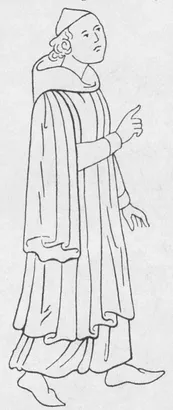
Fig. 149. GERMA...
Table of contents
- DOVER BOOKS ON FASHION
- Plate I
- Title Page
- Copyright Page
- PREFACE
- Table of Contents
- Table of Figures
- A HISTORY OF COSTUME - INTRODUCTION
- THE PEOPLES OF ANTIQUITY
- TEUTONIC PREHISTORIC PERIOD
- THE MIDDLE AGES
- THE SIXTEENTH CENTURY
- THE SEVENTEENTH CENTURY
- THE EIGHTEENTH CENTURY
- THE PERIOD 1790-1820
- THE PERIOD 1820–70
- BIBLIOGRAPHY
- INDEX
- A CATALOG OF SELECTED DOVER BOOKS - IN ALL FIELDS OF INTEREST
Trusted by 375,005 students
Access to over 1.5 million titles for a fair monthly price.
Study more efficiently using our study tools.
Frequently asked questions
Yes, you can cancel anytime from the Subscription tab in your account settings on the Perlego website. Your subscription will stay active until the end of your current billing period. Learn how to cancel your subscription
No, books cannot be downloaded as external files, such as PDFs, for use outside of Perlego. However, you can download books within the Perlego app for offline reading on mobile or tablet. Learn how to download books offline
Perlego offers two plans: Essential and Complete
- Essential is ideal for learners and professionals who enjoy exploring a wide range of subjects. Access the Essential Library with 800,000+ trusted titles and best-sellers across business, personal growth, and the humanities. Includes unlimited reading time and Standard Read Aloud voice.
- Complete: Perfect for advanced learners and researchers needing full, unrestricted access. Unlock 1.5M+ books across hundreds of subjects, including academic and specialized titles. The Complete Plan also includes advanced features like Premium Read Aloud and Research Assistant.
We are an online textbook subscription service, where you can get access to an entire online library for less than the price of a single book per month. With over 1.5 million books across 990+ topics, we’ve got you covered! Learn about our mission
Look out for the read-aloud symbol on your next book to see if you can listen to it. The read-aloud tool reads text aloud for you, highlighting the text as it is being read. You can pause it, speed it up and slow it down. Learn more about Read Aloud
Yes! You can use the Perlego app on both iOS and Android devices to read anytime, anywhere — even offline. Perfect for commutes or when you’re on the go.
Please note we cannot support devices running on iOS 13 and Android 7 or earlier. Learn more about using the app
Please note we cannot support devices running on iOS 13 and Android 7 or earlier. Learn more about using the app
Yes, you can access A History of Costume by Carl Köhler in PDF and/or ePUB format, as well as other popular books in Design & Fashion Design. We have over 1.5 million books available in our catalogue for you to explore.