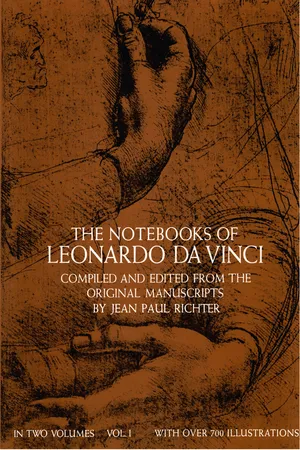
Scientist, painter, mechanical engineer, sculptor, thinker, city planner, storyteller, musician, architect — Leonardo da Vinci, builder of the first flying machine, was one of the great universal geniuses of Western civilization. His voluminous notebooks, the great storehouse of his theories and discoveries, are presented here in 1566 extracts that reveal the full range of Leonardo's versatile interest: all the important writings on painting, sculpture, architecture, anatomy, astronomy, geography, topography, and other fields are included, in both Italian and English, with 186 plates of manuscript pages and many other drawings reproduced in facsimile size.
The first volume, which contains all of Leonardo's writings on aspects of painting, includes discussions of such basic scientific areas as the structure of the eye and vision, perspective, the science of light and shade, the perspective of disappearance, theory of color, perspective of color, proportions and movements of the human figure, botany for painters, and the elements of landscape painting. A section on the practice of painting includes moral precepts for painters and writings on composition, materials, and the philosophy of art. The second volume contains writings on sculpture, architecture (plans for towns, streets, and canals, churches, palaces, castles, and villas, theoretical writings on arches, domes, fissures, etc.), zoology, physiology (including his amazingly accurate theories of blood circulation), medicine, astronomy, geography (including has famous writings and drawings on the movement of water), topography (observations in Italy, France, and other areas), naval warfare, swimming, theory of flying machines, mining, music, and other topics.
A selection of philosophical maxims, morals, polemics, fables, jests, studies in the lives and habits of animals, tales, and prophecies display Leonardo's abilities as a writer and scholar. The second volume also contains some letters, personal records, inventories, and accounts, and concludes with Leonardo's will. The drawings include sketches and studies for some of Leonardo's greatest works of art — The Last Supper, the lost Battle of Anghiari, The Virgin of the Rocks, and the destroyed Sforza monument.
- 396 pages
- English
- ePUB (mobile friendly)
- Available on iOS & Android
eBook - ePub
The Notebooks of Leonardo da Vinci, Vol. I
About this book
Information
Topic
ArtSubtopic
History of ArchitectureLIST OF ILLUSTRATIONS IN VOLUME I.
Pl. I. | Portrait of Leonardo, by himself, reproduced from the original drawing in red chalk in the Royal Library, Turin—see No. 1368, Note |
Pl. II. | Three Diagrams, illustrating the theories of Linear Perspective and of Light and Shade: No. 1 from the Ashburnham MS. I No. 1—see text No. 61. Nos. 2 and 3 from MS. C, Institut de France, Paris—see text No. 141 |
Pl. III. | Two Diagrams, illustrating the theory of Light and Shade; from the Ashburnham MS. I: No. 1—see text Nos. 148 and 275—; No. 2—see text No. 149 |
Pl. IV. | Five Diagrams, illustrating the theory of Light and Shade : No. 1 from MS. E, Institut de France, Paris—see text No. 162—; Nos. 2 and 3 from the Ashburnham MS. I—see text Nos. 169 and 173—; Nos. 4 and 5 from the Codex Atlanticus, Ambrosian Library, Milan—see text Nos. 179 and 187 |
Pl. V. | Diagram, illustrating the theory of Light and Shade and Sketches of Figures illustrating the Movements of the Human Figure; from the Royal Library, Windsor Castle—see text Nos. 183 and 597 |
Pl. VI. | Four Diagrams, illustrating the theory of Light and Shade: No. 1 from the Codex Atlanticus, Milan—see text No. 191—; Nos. 2 and 3 from MS. C, Institut de France, Paris—see text Nos. 215 and 216—; No. 4 from the Ashburnham MS. I—see text No. 224 |
Pl. VII. | Five Drawings, illustrating the theory of the Proportions of the Human Figure, from the Royal Library, Windsor Castle; No. 1—see text No. 310—; No. 2—see text Nos. 310 and 337—; No. 3—see text No. 313—; No. 4—see text Nos. 321 and 327—; No. 5—see No 595 |
Pl. VIII. | Two Drawings, illustrating the theory of the Proportions of the Human Figure; No. 1 from MS. A, Institut de France, Paris—see text No. 312—; No. 2 from the Royal Library, Windsor Castle—see text No. 332 |
Pl. IX. | Drawing, illustrating the theory of the Proportions of the Human Figure; from the Accademia at Venice—see text No. 315 |
Pl. X. | Drawing in silverpoint on bluish-toned paper, illustrating the theory of Proportions of the Human Figure; from the Royal Library, Windsor Castle—see text No. 316 |
Pl. XI. | Drawing, illustrating the theory of Proportions of the Human Figure; from the Royal Library, Windsor Castle—see text No. 318 |
Pl. XII. | Drawing, illustrating the theory of Proportions ia the Human Figure; from the Royal Library, Turin—see text No. 319 |
Pl. XIII. | Two Drawings illustrating the theory of the Proportions of the Human Figure; from the Royal Library Windsor Castle—see text No. 328 |
Pl. XIV. | Two drawings, illustrating the theory of Proportions of the Human Figure, from the Royal Library, Windsor Castle; No. 1—see text Nos. 326, 330—; No 2.—see text No. 334 |
Pl. XV. | Sketches, illustrating the theory of the Proportions of the Human Figure; from the Royal Library, Windsor Castle—see text Nos. 331 and 345 |
Pl. XVI. | Two Drawings, illustrating the theory of the Proportions of the Human Figure; from the Royal Library, Windsor Castle: No. 1, see text No. 335; No. 2, see text Nos. 339 and 342 |
Pl. XVII. | Two drawings, illustrating the theory of Proportions in the Human Figure; No. 1 from MS. A, Institut de France, Paris—see text No. 313 note—; No. 2 from the Royal Library, Windsor Castle,—see text Nos. 348 and 336 |
Pl. XVIII. | Drawing, illustrating the Proportions of the Human Figure, from the Accademia, Venice—see text No. 343 |
Pl. XIX. | Two Drawings, illustrating the theory of the Proportions of the Human Figure from the Royal Library, Windsor Castle; No. 1—see text No. 347—; No. 2—see text No. 351 |
Pl. XX. | Drawing, illustrating the theory of the Proportions of the Human Figure; from the Royal Library, Windsor Castle—see text No. 349 |
Pl. XXI. | Drawing in red chalk, illustrating the theory of the Movements of the Human Figure—see text No. 356—, and sketch in pen and ink of warriors fighting—see p. 340;—from the Royal Library, Windsor Castle |
Pl. XXII. | Fo... |
Table of contents
- Cover
- Title Page
- Copyright Page
- Dedication
- List of Subscribers
- Preface
- Contents
- List of Illustrations in Volume I
- I. Prolegomena and General Introduction to the Book on Painting
- II. Linear Perspective
- III. Six Books on Light and Shade
- IV. Perspective of Disappearance
- V. Theory of Colours
- VI. Perspective of Colour and Aerial Perspective
- VII. On The Proportions and on the Movements of the Human Figure
- VIII. Botany for Painters, and Elements of Landscape Painting
- IX. The Practice of Painting
- X. Studies and Sketches for Pictures and Decorations
- Reference Table to the Numerical Order of the Chapters
Trusted by 375,005 students
Access to over 1.5 million titles for a fair monthly price.
Study more efficiently using our study tools.
Frequently asked questions
Yes, you can cancel anytime from the Subscription tab in your account settings on the Perlego website. Your subscription will stay active until the end of your current billing period. Learn how to cancel your subscription
No, books cannot be downloaded as external files, such as PDFs, for use outside of Perlego. However, you can download books within the Perlego app for offline reading on mobile or tablet. Learn how to download books offline
Perlego offers two plans: Essential and Complete
- Essential is ideal for learners and professionals who enjoy exploring a wide range of subjects. Access the Essential Library with 800,000+ trusted titles and best-sellers across business, personal growth, and the humanities. Includes unlimited reading time and Standard Read Aloud voice.
- Complete: Perfect for advanced learners and researchers needing full, unrestricted access. Unlock 1.5M+ books across hundreds of subjects, including academic and specialized titles. The Complete Plan also includes advanced features like Premium Read Aloud and Research Assistant.
We are an online textbook subscription service, where you can get access to an entire online library for less than the price of a single book per month. With over 1.5 million books across 990+ topics, we’ve got you covered! Learn about our mission
Look out for the read-aloud symbol on your next book to see if you can listen to it. The read-aloud tool reads text aloud for you, highlighting the text as it is being read. You can pause it, speed it up and slow it down. Learn more about Read Aloud
Yes! You can use the Perlego app on both iOS and Android devices to read anytime, anywhere — even offline. Perfect for commutes or when you’re on the go.
Please note we cannot support devices running on iOS 13 and Android 7 or earlier. Learn more about using the app
Please note we cannot support devices running on iOS 13 and Android 7 or earlier. Learn more about using the app
Yes, you can access The Notebooks of Leonardo da Vinci, Vol. I by Leonardo da Vinci in PDF and/or ePUB format, as well as other popular books in Art & History of Architecture. We have over 1.5 million books available in our catalogue for you to explore.