". . . full of intellectual treats and tricks, of whimsy and deep scientific philosophy. It is highbrow entertainment at its best, a teasing challenge to all who aspire to think about the universe." — New York Herald Tribune
One of the world's foremost nuclear physicists (celebrated for his theory of radioactive decay, among other accomplishments), George Gamow possessed the unique ability of making the world of science accessible to the general reader.
He brings that ability to bear in this delightful expedition through the problems, pleasures, and puzzles of modern science. Among the topics scrutinized with the author's celebrated good humor and pedagogical prowess are the macrocosm and the microcosm, theory of numbers, relativity of space and time, entropy, genes, atomic structure, nuclear fission, and the origin of the solar system.
In the pages of this book readers grapple with such crucial matters as whether it is possible to bend space, why a rocket shrinks, the "end of the world problem," excursions into the fourth dimension, and a host of other tantalizing topics for the scientifically curious. Brimming with amusing anecdotes and provocative problems, One Two Three . . . Infinity also includes over 120 delightful pen-and-ink illustrations by the author, adding another dimension of good-natured charm to these wide-ranging explorations.
Whatever your level of scientific expertise, chances are you'll derive a great deal of pleasure, stimulation, and information from this unusual and imaginative book. It belongs in the library of anyone curious about the wonders of the scientific universe. "In One Two Three . . . Infinity, as in his other books, George Gamow succeeds where others fail because of his remarkable ability to combine technical accuracy, choice of material, dignity of expression, and readability." — Saturday Review of Literature
- 384 pages
- English
- ePUB (mobile friendly)
- Available on iOS & Android
eBook - ePub
About this book
Trusted by 375,005 students
Access to over 1.5 million titles for a fair monthly price.
Study more efficiently using our study tools.
Information
PART I
Playing with Numbers
CHAPTER 1
Big Numbers
1. HOW HIGH CAN YOU COUNT?
THERE is a story about two Hungarian aristocrats who decided to play a game in which the one who calls the largest number wins.
“Well,” said one of them, “you name your number first.”
After a few minutes of hard mental work the second aristocrat finally named the largest number he could think of.
“Three,” he said.
Now it was the turn of the first one to do the thinking, but after a quarter of an hour he finally gave up.
“You’ve won,” he agreed.
Of course these two Hungarian aristocrats do not represent a very high degree of intelligence2 and this story is probably just a malicious slander, but such a conversation might actually have taken place if the two men had been, not Hungarians, but Hottentots. We have it indeed on the authority of African explorers that many Hottentot tribes do not have in their vocabulary the names for numbers larger than three. Ask a native down there how many sons he has or how many enemies he has slain, and if the number is more than three he will answer “many.” Thus in the Hottentot country in the art of counting fierce warriors would be beaten by an American child of kindergarten age who could boast the ability to count up to ten!
Nowadays we are quite accustomed to the idea that we can write as big a number as we please—whether it is to represent war expenditures in cents, or stellar distances in inches—by simply setting down a sufficient number of zeros on the right side of some figure. You can put in zeros until your hand gets tired, and before you know it you will have a number larger than even the total number of atoms in the universe,3 which, incidentally, is 300,000,000,000,000,000,000,000,000,000,000,000,000,000,000,000,-000, 000,000,000,000,000,000,000,000.
Or you may write it in this shorter form: 3.1074.
Here the little number74 above and to the right of 10 indicates that there must be that many zeros written out, or, in other words, 3 must be multiplied by 10 seventy-four times.
But this “arithmetic-made-easy” system was not known in ancient times. In fact it was invented less than two thousand years ago by some unknown Indian mathematician. Before his great discovery—and it was a great discovery, although we usually do not realize it—numbers were written by using a special symbol for each of what we now call decimal units, and repeating this symbol as many times as there were units. For example the number 8732 was written by ancient Egyptians:

whereas a clerk in Caesar’s office would have represented it in this form:
MMMMMMMMDCCXXXII
The latter notations must be familiar to you, since Roman numerals are still used sometimes—to indicate the volumes or chapters of a book, or to give the date of a historical event on a pompous memorial tablet. Since, however, the needs of ancient accounting did not exceed the numbers of a few thousands, the symbols for higher decimal units were nonexistent, and an ancient Roman, no matter how well trained in arithmetic, would have been extremely embarrassed if he had been asked to write “one million.” The best he could have done to comply with the request, would have been to write one thousand M’s in succession, which would have taken many hours of hard work (Figure 1).
For the ancients, very large numbers such as those of the stars in the sky, the fish in the sea, or grains of sand on the beach were “incalculable,” just as for a Hottentot “five” is incalculable, and becomes simply “many”!
It took the great brain of Archimedes, a celebrated scientist of the third century B.C., to show that it is possible to write really big numbers. In his treatise The Psammites, or Sand Reckoner, Archimedes says:
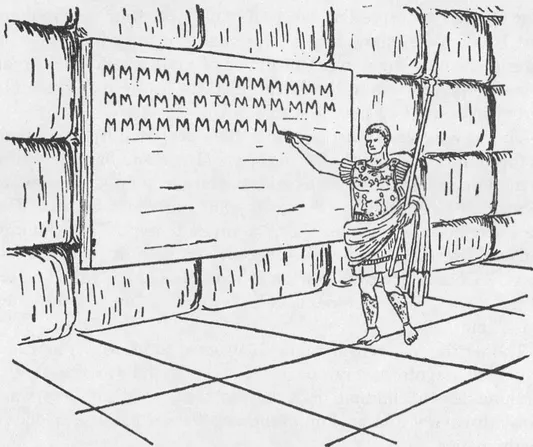
FIGURE 1
An ancient Roman, resembling Augustus Caesar, tries to write “one million” in Roman numerals. All available space on the wall-board hardly suffices to write “a hundred thousand.”
“There are some who think that the number of sand grains is infinite in multitude; and I mean by sand not only that which exists about Syracuse and the rest of Sicily, but all the grains of sand which may be found in all the regions of the Earth, whether inhabited or uninhabited. Again there are some who, without regarding the number as infinite, yet think that no number can be named which is great enough to exceed that which would designate the number of the Earth’s grains of sand. And it is clear that those who hold this view, if they imagined a mass made up of sand in other respects as large as the mass of the Earth, including in it all the seas and all the hollows of the Earth filled up to the height of the highest mountains, would be still more certain that no number could be expressed which would be larger than that needed to represent the grains of sand thus accumulated. But I will try to show that of the numbers named by me some exceed not only the number of grains of sand which would make a mass equal in size to the Earth filled up in the way described, but even equal to a mass the size of the Universe.”
The way to write very large numbers proposed by Archimedes in this famous work is similar to the way large numbers are written in modern science. He begins with the largest number that existed in ancient Greek arithmetic: a “myriad,” or ten thousand. Then he introduced a new number, “a myriad myriad” (a hundred million), which he called “an octade” or a “unit of the second class.” “Octade octades” (or ten million billions) is called a “unit of the third class,” “octade, octade, octades” a “unit of the fourth class,” etc.
The writing of large numbers may seem too trivial a matter to which to devote several pages of a book, but in the time of Archimedes the finding of a way to write big numbers was a great discovery and an important step forward in the science of mathematics.
To calculate the number representing the grains of sand necessary to fill up the entire universe, Archimedes had to know how big the universe was. In his time it was believed that the universe was enclosed by a crystal sphere to which the fixed stars were attached, and his famous contemporary Aristarchus of Samos, who was an astronomer, estimated the distance from the earth to the periphery of that celestial sphere as 10,000,000,000 stadia or about 1,000,000,000 miles.4
Comparing the size of that sphere with the size of a grain of sand, Archimedes completed a series of calculations that would give a highschool boy nightmares, and finally arrived at this conclusion:
“It is evident that the number of grains of sand that could be contained in a space as large as that bounded by the stellar sphere as estimated by Aristarchus, is not greater than one thousand myriads of units of the eighth class.”5
It may be noticed here that Archimedes’ estimate of the radius of the universe was rather less than that of modern scientists. The distance of one billion miles reaches only slightly beyond the planet Saturn of our solar system. As we shall see later the universe has now been explored with telescopes to the distance of 5,000,000,000,000,000,000,000 miles, so that the number of sand grains necessary to fill up all the visible universe would be over:
10100 (that is, 1 and 100 zeros)
This is of course much larger than the total number of atoms in the universe, 3·1074, as stated at the beginning of this chapter, but we must not forget that the universe is not packed with atoms; in fact there is on the average only about 1 atom per cubic meter of space.
But it isn’t at all necessary to do such drastic things as packing the entire universe with sand in order to get really large numbers. In fact they very often pop up in what may seem at first sight a very simple problem, in which you would never expect to find any number larger than a few thousands.
One victim of overwhelming numbers was King Shirham of India, who, according to an old legend, wanted to reward his grand vizier Sissa Ben Dahir for inventing and presenting to him the game of chess. The desires of the clever vizier seemed very modest. “Majesty,” he said kneeling in front of the king, “give me a grain of wheat to put on the first square of this chessboard, and two grains to put on the second square, and four grains to...
Table of contents
- Dover Science Books
- Title Page
- Dedication
- Copyright Page
- Preface
- Preface to the 1961 Edition
- Table of Contents
- Table of Figures
- PART I - Playing with Numbers
- PART II - Space, Time & Einstein
- PART III - Microcosmos
- PART IV - Macrocosmos
- Index
- A CATALOG OF SELECTED DOVER BOOKS IN ALL FIELDS OF INTEREST
Frequently asked questions
Yes, you can cancel anytime from the Subscription tab in your account settings on the Perlego website. Your subscription will stay active until the end of your current billing period. Learn how to cancel your subscription
No, books cannot be downloaded as external files, such as PDFs, for use outside of Perlego. However, you can download books within the Perlego app for offline reading on mobile or tablet. Learn how to download books offline
We are an online textbook subscription service, where you can get access to an entire online library for less than the price of a single book per month. With over 1.5 million books across 990+ topics, we’ve got you covered! Learn about our mission
Look out for the read-aloud symbol on your next book to see if you can listen to it. The read-aloud tool reads text aloud for you, highlighting the text as it is being read. You can pause it, speed it up and slow it down. Learn more about Read Aloud
Yes! You can use the Perlego app on both iOS and Android devices to read anytime, anywhere — even offline. Perfect for commutes or when you’re on the go.
Please note we cannot support devices running on iOS 13 and Android 7 or earlier. Learn more about using the app
Please note we cannot support devices running on iOS 13 and Android 7 or earlier. Learn more about using the app
Yes, you can access One Two Three . . . Infinity by George Gamow in PDF and/or ePUB format, as well as other popular books in Biological Sciences & Teaching Science & Technology. We have over 1.5 million books available in our catalogue for you to explore.