Marvin gets off work at random times between 3 and 5 p.m. His mother lives uptown, his girlfriend downtown. He takes the first subway that comes in either direction and eats dinner with the one he is delivered to. His mother complains that he never comes to see her, but he says she has a 50-50 chance. He has had dinner with her twice in the last 20 working days. Explain.
Marvin's adventures in probability are one of the fifty intriguing puzzles that illustrate both elementary ad advanced aspects of probability, each problem designed to challenge the mathematically inclined. From "The Flippant Juror" and "The Prisoner's Dilemma" to "The Cliffhanger" and "The Clumsy Chemist," they provide an ideal supplement for all who enjoy the stimulating fun of mathematics.
Professor Frederick Mosteller, who teaches statistics at Harvard University, has chosen the problems for originality, general interest, or because they demonstrate valuable techniques. In addition, the problems are graded as to difficulty and many have considerable stature. Indeed, one has "enlivened the research lives of many excellent mathematicians." Detailed solutions are included. There is every probability you'll need at least a few of them.
Frequently asked questions
Yes, you can cancel anytime from the Subscription tab in your account settings on the Perlego website. Your subscription will stay active until the end of your current billing period. Learn how to cancel your subscription.
No, books cannot be downloaded as external files, such as PDFs, for use outside of Perlego. However, you can download books within the Perlego app for offline reading on mobile or tablet. Learn more here.
Perlego offers two plans: Essential and Complete
Essential is ideal for learners and professionals who enjoy exploring a wide range of subjects. Access the Essential Library with 800,000+ trusted titles and best-sellers across business, personal growth, and the humanities. Includes unlimited reading time and Standard Read Aloud voice.
Complete: Perfect for advanced learners and researchers needing full, unrestricted access. Unlock 1.4M+ books across hundreds of subjects, including academic and specialized titles. The Complete Plan also includes advanced features like Premium Read Aloud and Research Assistant.
Both plans are available with monthly, semester, or annual billing cycles.
We are an online textbook subscription service, where you can get access to an entire online library for less than the price of a single book per month. With over 1 million books across 1000+ topics, we’ve got you covered! Learn more here.
Look out for the read-aloud symbol on your next book to see if you can listen to it. The read-aloud tool reads text aloud for you, highlighting the text as it is being read. You can pause it, speed it up and slow it down. Learn more here.
Yes! You can use the Perlego app on both iOS or Android devices to read anytime, anywhere — even offline. Perfect for commutes or when you’re on the go. Please note we cannot support devices running on iOS 13 and Android 7 or earlier. Learn more about using the app.
Yes, you can access Fifty Challenging Problems in Probability with Solutions by Frederick Mosteller in PDF and/or ePUB format, as well as other popular books in Mathematics & Probability & Statistics. We have over one million books available in our catalogue for you to explore.
Solutions for Fifty Challenging Problems in Probability
1. The Sock Drawer
A drawer contains red socks and black socks. When two socks are drawn at random, the probability that both are red is
. (a) How small can the number of socks in the drawer be? (b) How small if the number of black socks is even?
Solution for The Sock Drawer
Just to set the pattern, let us do a numerical example first. Suppose there were 5 red and 2 black socks; then the probability of the first sock’s being red would be 5/(5 + 2). If the first were red, the probability of the second’s being red would be 4/(4 + 2), because one red sock has already been removed. The product of these two numbers is the probability that both socks are red:
This result is close to
, but we need exactly
. Now let us go at the problem algebraically.
Let there be r red and b black socks. The probability of the first sock’s being red is r/(r + b); and if the first sock is red, the probability of the second’s being red now that a red has been removed is (r — 1)/(r + b — 1). Then we require the probability that both are red to be
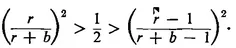
, or
One could just start with b = 1 and try successive values of r, then go to b = 2 and try again, and so on. That would get the answers quickly. Or we could play along with a little more mathematics. Notice that
Therefore we can create the inequalities
Taking square roots, we have, for r > 1,
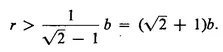
From the first inequality we get
or
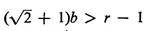
From the second we get
or all told
For b = 1, r must be greater than 2.414 and less than 3.414, and so the candidate is r = 3. For r = 3, b = 1, we get
And so the smallest number of socks is 4.
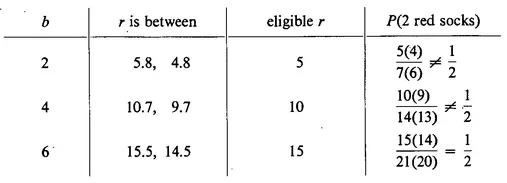
Beyond this we investigate even values of b.
And so 21 socks is the smallest number when b is even. If we were to go on and ask for further values of r and b so that the probability of two red socks is
, we would be wise to appreciate that this is a problem in the theory of numbers. It happens to lead to a famous result in Diophantine Analysis obtained from Pell’s equation.3 Try r = 85, b = 35.
2. Successive Wins
To encourage Elmer’s promising tennis career, his father offers him a prize if he wins (at least) two tennis sets in a row in a three-set series to be played with his father and the club champion alternately: father-champion-father or champion-father-champion, according to Elmer’s choice. The champion is a better player than Elmer’s father. Which series should Elmer choose?
Solution for Successive Wins
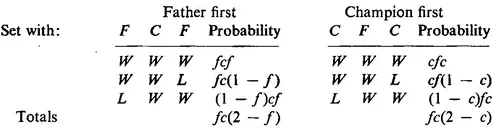
Since the champion plays better than the father, it seems reasonable that fewer sets should be played with the champion. On the other hand, the middle set is the key one, because Elmer cannot have two wins in a row without winning the middle one. Let C stand for champion, F for father, and W and L for a win and a loss by Elmer. Let f be the probability of Elmer’s winning any set from his father, c the corresponding probability of winning from the champion. The table shows the only possible prize-winning sequences together with their probabilities, given independence between sets, for the two choices.
Since Elmer is more likely to best his father than to best the champion, f is larger than c, and 2 — f is smaller than 2 — c, and so Elmer should choose CFC. For example, for f = 0.8, c = 0.4, the chance of winning the prize with FCF is 0.384, that for CFC is 0.512. Thus the importance of winning the middle game outweighs the disadvantage of playing the champion twice.
Many of us have a tendency to suppose that the higher the expected number of successes, the higher the probability of winning a prize, and often this supposition ...
Table of contents
DOVER BOOKS ON MATHEMATICS
Dedication
Title Page
Copyright Page
Preface
Table of Contents
Fifty Challenging Problems in Probability
Solutions for Fifty Challenging Problems in Probability