"A truly admirable book." — Bookman's Journal and Print Collector
"As a book of reference to the practicing artists who wants to solve some particular difficulty, the book could hardly be bettered." — Field
Rex Vicat Cole makes learning about perspective an enjoyable and fascinating pursuit in this clearly written and profusely illustrated book. Over 390 diagrams illustrate every aspect of the text, and more than 80 illustrations reproduce drawings and paintings — by old masters and by the author — that indicate how perspective is utilized in practice. The book is so well illustrated that many perspective problems can be answered without reference to the text at all.
The text itself clarifies the theory of perspective and offers numerous practice exercises. Among the topics covered are the principle of perspective in theory, the rules of perspective and their application, depths, the use of plans in sketching foreshortened surfaces, inclined planes, the circle, arches, how to draw curves by straight lines, perspective of the sky and sea, perspective of shadows, and more. Two additional sections cover perspective in the history of art and mechanical perspective.
A noted landscape painter and art instructor, Mr. Cole combines common sense with an understanding of Nature's laws to make perspective a subject that every artist can approach with confidence. Art students will also find this book extremely valuable.
- 288 pages
- English
- ePUB (mobile friendly)
- Available on iOS & Android
eBook - ePub
Perspective for Artists
About this book
Information
Topic
ArtSubtopic
Art TechniquesPART I
NATURE’S PERSPECTIVE AS SEEN AND USED DAILY BY PAINTERS
CHAPTER I
THE PRINCIPLE OF PERSPECTIVE IN THEORY
“ If you do not rest on the good foundation of nature, you will labour with little honour and less profit.”
—LEONARDO DA VINCI.
LINEAR Perspective is a study that deals with the appearance of objects1 as regards their size and the direction of their lines seen at varying distances and from any point of view. When practising it we are not concerned with their apparent changes of colour or tone, though those also help us to recognise the distance separating us, or that of one object from another.
Visual rays.—The Theory of Perspective is based on the fact that from every point of an object that we are looking at, a ray of light is carried in a straight line to our eye.2 By these innumerable rays we gain the impression of that object (Fig. 1).
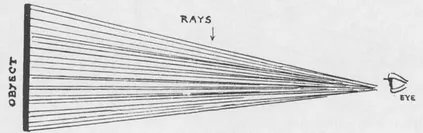
FIG. 1.
Tracing on glass.—If we look at an object through a sheet of glass we can trace on that glass the apparent height or width of that object (Fig. 2) ; in other words, we can mark off on the glass those points where the rays from the extremities of the object on the way to our eye pass through it.
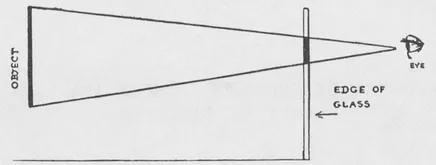
FiG. 2.—Upright sheet of glass, object, and eye ; showing the rays from the extremities of the object passing through the glass and marking its height on it.
Height of objects at varying distances traced on glass.—If we now place two objects of similar height one behind the other (Fig. 3) our tracing of each discovers the one farthest off to appear on the glass shorter than the one close at hand. Fig. 3 makes it evident that this apparent difference in size is due to the fact that the converging rays from the further object have the longest distance to travel, and so are nearly together where they pass through the glass. On the other hand, the rays from the object close to the glass have only just started on their journey and so are still wide apart.
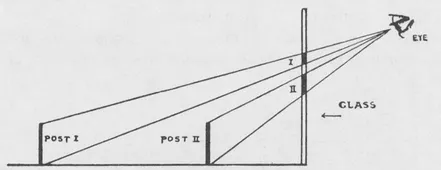
FIG. 3.—Side view (i.e. elevation) of posts, an upright glass, and painter’s eye.
Width of objects traced.—Let us repeat the experiment with two pencils of equal length lying on a flat surface, one behind the other. We shall be satisfied that their apparent length, as traced on the glass (Fig. 4), is also determined by these rays, and that the near one looks longer than the distant one.
We have seen that the height and width of objects as they appear to us is determined by the converging rays from their extremities to our eye ; that objects really equal in size appear shorter and narrower when further away.
Depths of objects on a level surface traced.—It only remains to find out that the depths on a receding surface are governed by the same laws.
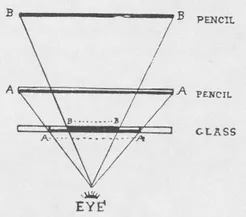
FIG. 4.—Two pencils, glass, and eye, as seen from above (i.e. ground plan).
Fig. 5 represents three pinheads in a row, one behind the other, on the far side of the glass from the position of the eye. Notice, however, that the eye is above the pins (i.e. looking down on them), and so the points where their rays cut the glass are one above the other in regular order, the nearest pin (3) appearing the lowest down on the glass.
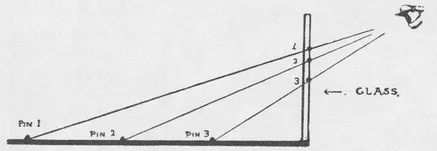
FIG. 5.—Side view (i.e. elevation) of the painter’s eye, an upright glass, and a level board on which three pins are equally spaced.
Since the pins were placed at equal distances apart, their spacing, as shown on the glass, would also fix the depths of the ground surface between them (Fig. 6).
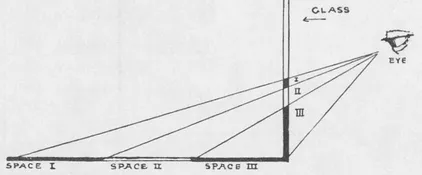
FIG. 6.—Same as Fig. 5, showing the spaces between the pins and as they appear on the glass.
Theory of tracing applied to measurements on a canvas.—Up to now we have supposed ourselves tracing objects through a sheet of glass. In a perspective drawing our canvas is supposed to be a glass, and on it we trace only those objects that we can see through it without moving our heads. But painters should be practical ; so set up a canvas and prove to yourself that objects of equal size when far off appear narrower, shorter, and less deep than the near ones, and that the spaces between them undergo a corresponding reduction. To do this, follow the instructions in Figs. 9 and 11.
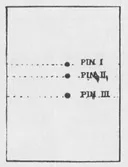
FIG. 7.—The glass (as in Fig. 5) with the pins traced on it, seen full-face.
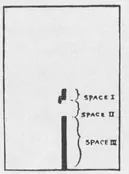
FIG. 8.—The glass (as in Fig. 6) showing the spaces traced on it.
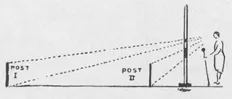
FIG. 9.—Posts the same height, one behind the other.
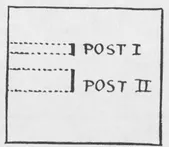
FIG. 10.—Front view of canvas. Posts marked on edge and carried across to required position.
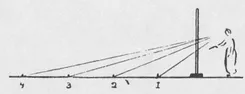
FIG. 11.—Four nails evenly spaced.
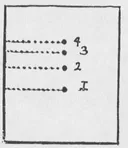
FIG. 12.—Front view, showing nails marked on edge of canvas and carried across to required position.
Fig. 9. Be yourself the “Painter.” See that your canvas is vertical and so placed that the posts are just visible at one edge. With one eye shut and...
Table of contents
- DOVER BOOKS ON ART INSTRUCTION AND ANATOMY
- Title Page
- Copyright Page
- PREFACE
- Table of Contents
- Table of Figures
- PART I - NATURE’S PERSPECTIVE AS SEEN AND USED DAILY BY PAINTERS
- PART II - PERSPECTIVE AS PRACTISED BY OTHER NATIONS AND AT OTHER TIMES
- PART III - MECHANICAL PERSPECTIVE
- APPENDIX
- BIBLIOGRAPHY
- INDEX
- A CATALOG OF SELECTED DOVER BOOKS IN ALL FIELDS OF INTEREST
Trusted by 375,005 students
Access to over 1.5 million titles for a fair monthly price.
Study more efficiently using our study tools.
Frequently asked questions
Yes, you can cancel anytime from the Subscription tab in your account settings on the Perlego website. Your subscription will stay active until the end of your current billing period. Learn how to cancel your subscription
No, books cannot be downloaded as external files, such as PDFs, for use outside of Perlego. However, you can download books within the Perlego app for offline reading on mobile or tablet. Learn how to download books offline
Perlego offers two plans: Essential and Complete
- Essential is ideal for learners and professionals who enjoy exploring a wide range of subjects. Access the Essential Library with 800,000+ trusted titles and best-sellers across business, personal growth, and the humanities. Includes unlimited reading time and Standard Read Aloud voice.
- Complete: Perfect for advanced learners and researchers needing full, unrestricted access. Unlock 1.5M+ books across hundreds of subjects, including academic and specialized titles. The Complete Plan also includes advanced features like Premium Read Aloud and Research Assistant.
We are an online textbook subscription service, where you can get access to an entire online library for less than the price of a single book per month. With over 1.5 million books across 990+ topics, we’ve got you covered! Learn about our mission
Look out for the read-aloud symbol on your next book to see if you can listen to it. The read-aloud tool reads text aloud for you, highlighting the text as it is being read. You can pause it, speed it up and slow it down. Learn more about Read Aloud
Yes! You can use the Perlego app on both iOS and Android devices to read anytime, anywhere — even offline. Perfect for commutes or when you’re on the go.
Please note we cannot support devices running on iOS 13 and Android 7 or earlier. Learn more about using the app
Please note we cannot support devices running on iOS 13 and Android 7 or earlier. Learn more about using the app
Yes, you can access Perspective for Artists by Rex Vicat Cole in PDF and/or ePUB format, as well as other popular books in Art & Art Techniques. We have over 1.5 million books available in our catalogue for you to explore.