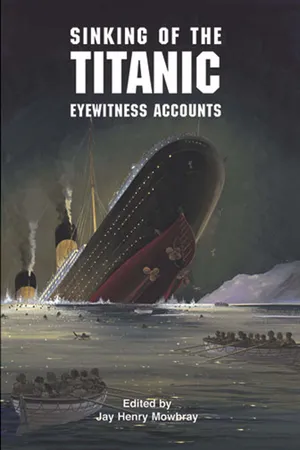
Published in 1912 within months of the sinking of the Titanic, this "memorial edition" of first-hand accounts by survivors, people in rescue boats, and other on-the-scene witnesses offers heart-wrenching testimony about the great disaster, steeped in the sentiments of the day.
Surviving passengers recount heart-breaking tales of parting with loved ones, watching the great ship sink while the steadfast band played "Nearer, My God, to Thee," and floating helplessly for long hours on icy seas. The search for responsibility began amid the grief of widows and orphans aboard the rescue vessel Carpathia, with accusations of ignored warnings, reckless attempts at record-setting, and the woefully inadequate supply of lifeboats.
Enhancing the text are drawings of the ship's decks and luxurious interiors, along with numerous rare photographs of celebrity passengers, captain and crew, poignant images of survivors huddled in lifeboats, and many more striking scenes. Readers will be spellbound by the gripping, you-are-there quality of this unique volume and its remarkable vision of one of the great maritime disasters of history.
- 336 pages
- English
- ePUB (mobile friendly)
- Available on iOS & Android
eBook - ePub
About this book
Information
Subtopic
Transporte marítimoCHAPTER I.
FROM A DAY OF DELIGHT TO DEATH.
April 14, 1912, a Fateful Date—Lulled to False Security—Peaceful Sabbath Ends in Dire Disaster—Hopes Sink Beneath the Cruel and Treacherous Waves of the Atlantic—Man’s Proudest Craft Crumbles Like an Eggshell
The hands of the ship’s clock pointed to 11.40. The beautiful day of April 14, 1912, rapidly was drawing to its close.
A solemn hush brooded over the ocean, the stillness broken only by the swish of the waters as they protested against being so rudely brushed aside by the mammoth creation of man. Then, too, the soft cadences of sacred music from the ship’s orchestra sent their strains dancing o’er the billows to mingle with the star beam and intensify rather than mar the stillness.
Above, the stars and planets twinkled and glittered as they beam only in the rarified atmosphere of the far northern latitudes.
The day had been one of rare beauty. A soft and caressing breeze had kissed the sea and rocked the waves in a harmonious symphony against the steel-ribbed sides of the world’s largest, greatest and most luxurious floating palace, the majestic Titanic, the newest addition to the trans-Atlantic fleet of the White Star Line of the International Navigation Company.
The star-sprinkled dome of heaven and the phosphorescent sea alike breathed forth peace, quiet and security.
Despite the lateness of the hour, aboard the Titanic all was animation. A few, to be sure, had wearied of Nature’s marvels and had sought their slumber, but the gorgeous quarters of the first cabin and the scarcely less pretentious sections set apart for second class passengers were alike teeming with life and light.
Meanwhile, as they had for days past, the mighty engines of this monster of the sea pulsed and throbbed, while the rhythmic beat of the Titanic’s great bronze-bladed propellors churned up a fast and steadily lengthening wake behind the speeded vessel.
“We’ll break the record today,” her officers laughed, and the passengers gleefully shared their mirth.
A record; a record!
And a record she made—but of death and destruction!
But who could know? And since no mortal could, why not eat, drink and be merry?
Britain’s shores had been left behind far back across the waste of waters. America, the land of hope, was almost in sight ahead.
TALK OF HOME AND FRIENDS AND LIFE.
Small wonder that hundreds still strolled the Titanic’s spotless, unsullied decks and talked of home and friends and life and joy and hope. Small wonder that other hundreds lounged at ease in her luxurious saloons and smoking rooms, while other scores of voyagers, their appetites whetted by the invigorating air, sat at a midnight supper to welcome the new week with a feast.
Why sleep when the wealth, the beauty, the brains, the aristocracy as well as the bone and sinew of a nation were all around one?
For, be it known, never before did ship carry so distinguished a company—a passenger list that reads like a Social Blue Book.
This maiden trip of the Titanic was an event that was to go down in history, they thought.
And so it will, but with tears on every page of the narrative and the wails of women and children in every syllable.
But since the future is unrolled only in God’s own good time, how could they know?
Why wonder at their presence?
Was this not the first trip of the greatest triumph of marine architecture?
Had not the wealth and fashion of two continents so arranged their plans as to be numbered on its first passenger list?
Had not the hardy immigrant skimped and saved and schemed that he and his family should be carried to the Land of Promise aboard this greatest of all ships?
What mattered it to him that his place was in the steerage? Did not each pulsing throb of the Titanic’s mighty engines bear him as far and as fast as though he, too, already held in his hand the millions he felt he was destined to win in this golden land of opportunity beyond the seas?
And so, from the loftiest promenade deck to the lowest stoke hole in the vitals of the ship peace and comfort and happiness reigned.
APPROACHING HOME AND FRIENDS.
To some the rapidly-nearing shores of America meant home —and friends. To others, opportunity—and work. Yet to all it meant the culmination of a voyage which, so far, had been one all-too-short holiday from the bustle and turmoil of a busy world.
“Man proposes, but God disposes!”
Never were truer words uttered, nor phrase more fitting to that fateful hour.
“In the midst of life we are in death.”
Yet the soft breeze from the south still spread its balmy, salt-laden odors to delight their senses and to lull them to a feeling of complete security.
What was that?
A cold breath as from the fastnesses of the Frost King swept the steamer’s decks.
A shiver of chill drove the wearied passengers below, but sent the ship’s officers scurrying to their stations. The seaman, and the seaman alone, knew that that icy chill portended icebergs —and near at hand.
Besides, twice in the last few hours had the wireless ticked its warnings from passing vessels that the Titanic was in the vicinity of immense floes.
Why had the warning not been heeded?
Why had the ponderous engines continued to thunder with the might of a hundred thousand horses, and the ship to plunge forward into the night with the unchecked speed of an express train?
God knows!
The captain knew, but his lips are sealed in death as, a self-inflicted bullet in his brain, he lies in the cold embrace of the sea he had loved and had defied—too long.
THE LOOKOUT’S WARNING CRY.
Perhaps Bruce Ismay, the managing director of the line, who was on board—and survived when women drowned—also knows. Perhaps he will tell by whose orders those danger warnings were scoffed at and ignored.
Perhaps; perhaps!
The lookout uttered a sharp cry!
Too late!
One grinding crash and the Titanic had received its death blow. Man’s proudest craft crumbled like an eggshell.
Ripped from stern to engine room by the great mass of ice she struck amidships, the Titanic’s side was laid open as if by a gigantic can opener. She quickly listed to starboard and a shower of ice fell on to the forecastle deck.
Shortly before she sank she broke in two abaft the engine room, and as she disappeared beneath the water the expulsion of air or her boilers caused two explosions, which were plainly heard by the survivors adrift.
A moment more and the Titanic had gone to her doom with the fated hundreds grouped on the after deck. To the survivors they were visible to the last, and their cries and moans were pitiable.
The one alleviating circumstance in the otherwise unmitigable tragedy is the fact that the men stood aside and insisted that the women and the children should first have places in the boats.
There were men whose word of command swayed boards of directors, governed institutions, disposed of millions. They were accustomed merely to pronounce a wish to have it gratified.
Thousands “posted at their bidding;” the complexion of the market altered hue when they nodded; they bought what they wanted, and for one of the humblest fishing smacks or a dory they could have given the price that was paid to build and launch the ship that has become the most imposing mausoleum that ever housed the bones of men since the Pyramids rose from the desert sands.
But these men stood aside—one can see them—and gave place not merely to the delicate and the refined, but to the scared Czech woman from the steerage, with her baby at her breast; the Croatian with a toddler by her side, coming through the very gate of Death and out of the mouth of Hell to the imagined Eden of America.
HARDER TO GO THAN TO STAY.
To many of those who went it was harder to go than to stay there on the vessel gaping with its mortal wounds and ready to go down. It meant that tossing on the waters they must wait in suspense, hour after hour even after the lights of the ship were engulfed in appalling darkness, hoping against hope for the miracle of a rescue dearer to them than their own lives.
It was the tradition of Anglo-Saxon heroism that was fulfilled in the frozen seas during the black hours of that Sunday night. The heroism was that of the women who went, as well as of the men who remained.
The most adequate story of the terrible disaster is told by a trained newspaper man, who was on the Carpathia. He says:
Cause, responsibility and similar questions regarding the stupendous disaster will be taken up in time by the British marine authorities. No disposition has been shown by any survivor to question the courage of the crew, hundreds of whom saved others and gave their own lives with a heroism which equaled, but could not exceed, that of John Jacob Astor, Henry B. Harris, Jacques Futrelle and others in the long list of the first cabin missing.
Facts which I have established by inquiries on the Carpathia, as positively as they could be established in view of the silence of the few surviving officers, are:
That the Titanic’s officers knew, several hours before the crash, of the possible nearness of icebergs.
That the Titanic’s speed, nearly twenty-three knots an hour, was not slackened.
INSUFFICIENT LIFE-BOATS.
That the number of lifeboats on the Titanic was insufficient to accommodate much more than one-third of the passengers, to say nothing of the crew. Most members of the crew say there were sixteen lifeboats and two collapsibles; none say there were more than twenty boats in all. The 700 who escaped filled most of the sixteen lifeboats and the one collapsible which got away, to the limit of their capacity.
That the “women first” rule, in some cases, was applied to the extent of turning back men who were with their families, even though not enough women to fill the boats were at hand on that particular part of the deck. Some few boats were thus lowered without being completely filled, but most of these were soon filled with sailors and stewards, picked up out of the water, who helped man them.
That the bulkhead system, though probably working in the manner intended, availed only to delay the ship’s sinking. The position and length of the ship’s wound (on the starboard quarter) admitted icy water, which caused the boilers to explode and these explosions practically broke the ship in two.
Had the ship struck the iceberg head-on, at whatever speed, and with whatever resultant shock, the bulkhead system of water-tight compartments would probably have saved the vessel. As one man expressed it, i...
Table of contents
- MEMORIAL EDITION
- Title Page
- Copyright Page
- PREFACE.
- INTRODUCTION.
- Table of Contents
- GREAT MARINE DISASTERS FROM 1866 TO 1911.
- HUNDREDS WEEP AT MEMORIAL SERVICES HELD FOR “ARCHIE” BUTT.
- CHAPTER I. - FROM A DAY OF DELIGHT TO DEATH.
- CHAPTER II. - HEART-RENDING SCENES ON CARPATHIA.
- CHAPTER III. - BAND PLAYED TO THE LAST.
- CHAPTER IV. - NEGLECT CAUSED DISASTER.
- CHAPTER V. - BELIEVED SHIP UNSINKABLE.
- CHAPTER VI. - HOW SURVIVORS ESCAPED.
- CHAPTER VII. - WOMAN’S THRILLING NARRATIVE.
- CHAPTER VIII. - SURVIVORS’ STIRRING STORIES.
- CHAPTER IX. - HOW ASTOR WENT TO DEATH.
- CHAPTER X. - NOTABLE WOMAN SAVED.
- CHAPTER XI. - MAJOR BUTT, MARTYR TO DUTY.
- CHAPTER XII. - MRS. ASTOR’S BRAVERY.
- CHAPTER XIII. - LIFEBOATS BUNGLINGLY HANDLED.
- CHAPTER XIV. - NOT LIKE BOURGOGNE DISASTER.
- CHAPTER XV. - BOY’S DESPERATE FIGHT FOR LIFE.
- CHAPTER XVI. - CARPATHIA TO THE RESCUE.
- CHAPTER XVII. - REFUSED TO LEAVE HUSBAND.
- CHAPTER XVIII. - LADY DUFF-GORDON’S EXPERIENCES.
- CHAPTER XIX. - SENATORS HEAR STARTLING STORIES.
- CHAPTER XX. - SURVIVING OPERATOR’S EXPERIENCES.
- CHAPTER XXI. - THE FUNERAL SHIP AND ITS DEAD.
- CHAPTER XXII. - INQUIRY BY UNITED STATES SENATE.
- LIST OF TITANIC PASSENGERS MISSING AND RESCUED
- A CATALOG OF SELECTED DOVER BOOKS IN ALL FIELDS OF INTEREST
- DOVER MARITIME BOOKS
Trusted by 375,005 students
Access to over 1.5 million titles for a fair monthly price.
Study more efficiently using our study tools.
Frequently asked questions
Yes, you can cancel anytime from the Subscription tab in your account settings on the Perlego website. Your subscription will stay active until the end of your current billing period. Learn how to cancel your subscription
No, books cannot be downloaded as external files, such as PDFs, for use outside of Perlego. However, you can download books within the Perlego app for offline reading on mobile or tablet. Learn how to download books offline
Perlego offers two plans: Essential and Complete
- Essential is ideal for learners and professionals who enjoy exploring a wide range of subjects. Access the Essential Library with 800,000+ trusted titles and best-sellers across business, personal growth, and the humanities. Includes unlimited reading time and Standard Read Aloud voice.
- Complete: Perfect for advanced learners and researchers needing full, unrestricted access. Unlock 1.5M+ books across hundreds of subjects, including academic and specialized titles. The Complete Plan also includes advanced features like Premium Read Aloud and Research Assistant.
We are an online textbook subscription service, where you can get access to an entire online library for less than the price of a single book per month. With over 1.5 million books across 990+ topics, we’ve got you covered! Learn about our mission
Look out for the read-aloud symbol on your next book to see if you can listen to it. The read-aloud tool reads text aloud for you, highlighting the text as it is being read. You can pause it, speed it up and slow it down. Learn more about Read Aloud
Yes! You can use the Perlego app on both iOS and Android devices to read anytime, anywhere — even offline. Perfect for commutes or when you’re on the go.
Please note we cannot support devices running on iOS 13 and Android 7 or earlier. Learn more about using the app
Please note we cannot support devices running on iOS 13 and Android 7 or earlier. Learn more about using the app
Yes, you can access Sinking of the Titanic by Jay Henry Mowbray in PDF and/or ePUB format, as well as other popular books in Tecnología e ingeniería & Transporte marítimo. We have over 1.5 million books available in our catalogue for you to explore.