![]()
CHAPTER I
FIRST NEWS OF THE GREATEST MARINE DISASTER IN HISTORY
“THE TITANIC IN COLLISION, BUT EVERYBODY SAFE”—ANOTHER
TRIUMPH SET DOWN TO WIRELESS TELEGRAPHY—THE WORLD
GOES TO SLEEP PEACEFULLY—THE SAD AWAKENING.
LIKE a bolt out of a clear sky came the wireless message on Monday, April 15, 1912, that on Sunday night the great Titanic, on her maiden voyage across the Atlantic, had struck a gigantic iceberg, but that all the passengers were saved. The ship had signaled her distress and another victory was set down to wireless. Twenty-one hundred lives saved!
Additional news was soon received that the ship had collided with a mountain of ice in the North Atlantic, off Cape Race, Newfoundland, at 10.25 Sunday evening, April 14th. At 4.15 Monday morning the Canadian Government Marine Agency received a wireless message that the Titanic was sinking and that the steamers towing her were trying to get her into shoal water near Cape Race, for the purpose of beaching her.
Wireless despatches up to noon Monday showed that the passengers of the Titanic were being transferred aboard the steamer Carpathia, a Cunarder, which left New York, April 13th, for Naples. Twenty boat-loads of the Titanic’s passengers were said to have been transferred to the Carpathia then, and allowing forty to sixty persons as the capacity of each life-boat, some 800 or 1200 persons had already been transferred from the damaged liner to the Carpathia. They were reported as being taken to Halifax, whence they would be sent by train to New York.
Another liner, the Parisian, of the Allan Company, which sailed from Glasgow for Halifax on April 6th, was said to be close at hand and assisting in the work of rescue. The Baltic, Virginian and Olympic were also near the scene, according to the information received by wireless.
While badly damaged, the giant vessel was reported as still afloat, but whether she could reach port or shoal water was uncertain. The White Star officials declared that the Titanic was in no immediate danger of sinking, because of her numerous water-tight compartments.
“While we are still lacking definite information,” Mr. Franklin, vice-president of the White Star Line, said later in the afternoon, “we believe the Titanic’s passengers will reach Halifax, Wednesday evening. We have received no further word from Captain Haddock, of the Olympic, or from any of the ships in the vicinity, but are confident that there will be no loss of life.”
With the understanding that the survivors would be taken to Halifax the line arranged to have thirty Pullman cars, two diners and many passenger coaches leave Boston Monday night for Halifax to get the passengers after they were landed. Mr. Franklin made a guess that the Titanic’s passengers would get into Halifax on Wednesday. The Department of Commerce and Labor notified the White Star Line that customs and immigration inspectors would be sent from Montreal to Halifax in order that there would be as little delay as possible in getting the passengers on trains.
Monday night the world slept in peace and assurance. A wireless message had finally been received, reading:
“All Titanic’s passengers safe.”
It was not until nearly a week later that the fact was discovered that this message had been wrongly received in the confusion of messages flashing through the air, and that in reality the message should have read:
“Are all Titanic’s passengers safe?”
With the dawning of Tuesday morning came the awful news of the true fate of the Titanic.
![]()
CHAPTER II
THE MOST SUMPTUOUS PALACE AFLOAT
DIMENSIONS OF THE TITANIC—CAPACITY—PROVISIONS FOR THE
COMFORT AND ENTERTAINMENT OF PASSENGERS—MECHANICAL
EQUIPMENT—THE ARMY OF ATTENDANTS REQUIRED.
THE statistical record of the great ship has news value at this time.
Early in 1908 officials of the White Star Company announced that they would eclipse all previous records in shipbuilding with a vessel of staggering dimensions. The Titanic resulted.
The keel of the ill-fated ship was laid in the summer of 1909 at the Harland & Wolff yards, Belfast. Lord Pirrie, considered one of the best authorities on shipbuilding in the world, was the designer. The leviathan was launched on May 31, 1911, and was completed in February, 1912, at a cost of $10,000,000.
SISTER SHIP OF OLYMPIC
The Titanic, largest liner in commission, was a sister ship of the Olympic. The registered tonnage of each vessel is estimated as 45,000, but officers of the White Star Line say that the Titanic measured 45,328 tons. The Titanic was commanded by Captain E. J. Smith, the White Star admiral, who had previously been on the Olympic.
She was 882½ feet long, or about four city blocks, and was 5000 tons bigger than a battleship twice as large as the dreadnought Delaware.
Like her sister ship, the Olympic, the Titanic was a four-funneled vessel, and had eleven decks. The distance from the keel to the top of the funnels was 175 feet. She had an average speed of twenty-one knots.
The Titanic could accommodate 2500 passengers. The steamship was divided into numerous compartments, separated by fifteen bulkheads. She was equipped with a gymnasium, swimming pool, hospital with operating room, and a grill and palm garden.
CARRIED CREW OF 860
The registered tonnage was 45,000, and the displacement tonnage 66,000. She was capable of carrying 2500 passengers and the crew numbered 860.
The largest plates employed in the hull were 36 feet long, weighing 4½ tons each, and the largest steel beam used was 92 feet long, the weight of this double beam being 4 tons. The rudder, which was operated electrically, weighed 100 tons, the anchors 15½ tons each, the center (turbine) propeller 22 tons, and each of the two “wing” propellers 38 tons each. The after “boss-arms,” from which were suspended the three propeller shafts, tipped the scales at 73½ tons, and the forward “boss-arms” at 45 tons. Each link in the anchor-chains weighed 175 pounds. There were more than 2000 side-lights and windows to light the public rooms and passenger cabins.
Nothing was left to chance in the construction of the Titanic. Three million rivets (weighing 1200 tons) held the solid plates of steel together. To insure stability in binding the heavy plates in the double bottom, half a million rivets, weighing about 270 tons, were used.
All the plating of the hulls was riveted by hydraulic power, driving seven-ton riveting machines, suspended from traveling cranes. The double bottom extended the full length of the vessel, varying from 5 feet 3 inches to 6 feet 3 inches in depth, and lent added strength to the hull.
MOST LUXURIOUS STEAMSHIP
Not only was the Titanic the largest steamship afloat but it was the most luxurious. Elaborately furnished cabins opened onto her eleven decks, and some of these decks were reserved as private promenades that were engaged with the best suites. One of these suites was sold for $4350 for the boat’s maiden and only voyage. Suites similar, but which were without the private promenade decks, sold for $2300.
The Titanic differed in some respects from her sister ship. The Olympic has a lower promenade deck, but in the Titanic’s case the staterooms were brought out flush with the outside of the superstructure, and the rooms themselves made much larger. The sitting rooms of some of the suites on this deck were 15 x 15 feet.
The restaurant was much larger than that of the Olympic and it had a novelty in the shape of a private promenade deck on the starboard side, to be used exclusively by its patrons. Adjoining it was a reception room, where hosts and hostesses could meet their guests.
Two private promenades were connected with the two most luxurious suites on the ship. The suites were situated about amidships, one on either side of the vessel, and each was about fifty feet long. One of the suites comprised a sitting room, two bedrooms and a bath.
These private promenades were expensive luxuries. The cost figured out something like forty dollars a front foot for a six days’ voyage. They, with the suites to which they are attached, were the most expensive transatlantic accommodations yet offered.
THE ENGINE ROOM
The engine room was divided into two sections, one given to the reciprocating engines and the other to the turbines. There were two sets of the reciprocating kind, one working each of the wing propellers through a four-cylinder triple expansion, direct acting inverted engine. Each set could generate 15,000 indicated horse-power at seventy-five revolutions a minute. The Parsons type turbine takes steam from the reciprocating engines, and by developing a horse-power of 16,000 at 165 revolutions a minute works the third of the ship’s propellers, the one directly under the rudder. Of the four funnels of the vessel three were connected with the engine room, and the fourth or after funnel for ventilating the ship including the gallery.
Practically all of the space on the Titanic below the upper deck was occupied by steam-generating plant, coal bunkers and propelling machinery. Eight of the fifteen water-tight compartments contained the mechanical part of the vessel. There were, for instance, twenty-four double end and five single end boilers, each 16 feet 9 inches in diameter, the larger 20 feet long and the smaller 11 feet 9 inches long. The larger boilers had six fires under each of them and the smaller three furnaces. Coal was stored in bunker space along the side of the ship between the lower and middle decks, and was first shipped from there into bunkers running all the way across the vessel in the lowest part. From there the stokers handed it into the furnaces.
One of the most interesting features of the vessel was the refrigerating plant, which comprised a huge ice-making and refrigerating machine and a number of provision rooms on the after part of the lower and orlop decks. There were separate cold rooms for beef, mutton, poultry, game, fish, vegetables, fruit, butter, bacon, cheese, flowers, mineral water, wine, spirits and champagne, all maintained at different temperatures most suitable to each. Perishable freight had a compartment of its own, also chilled by the plant.
COMFORT AND STABILITY
Two main ideas were carried out in the Titanic. One was comfort and the other stability. The vessel was planned to be an ocean ferry. She was to have only a speed of twenty-one knots, far below that of some other modern vessels, but she was planned to make that speed, blow high or blow low, so that if she left one side of the ocean at a given time she could be relied on to reach the other side at almost a certain minute of a certain hour.
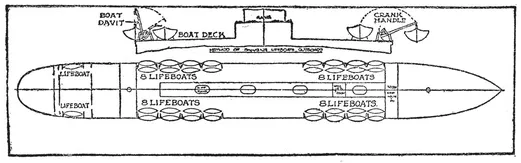
LIFE-BOAT AND DAVITS ON THE TITANIC
This diagram shows very clearly the arrangement of the life-boats and the manner in which they were launched.
One who has looked into modern methods for safeguarding a vessel of the Titanic type can hardly imagine an accident that could cause her to founder. No collision such as has been the fate of any ship in recent years, it has been thought up to this time, could send her down, nor could running against an iceberg do it unless such an accident were coupled with the remotely possible blowing out of a boiler. She would sink at once, probably, if she were to run over a submerged rock or derelict in such manner that both her keel plates and her double bottom were torn away for more than half her length; but such a catastrophe was so remotely possible that it did not even enter the field of conjecture.
The reason for all this is found in the modern arrangement of water-tight steel compartments into which all ships now are divided and of which the Titanic had fifteen so disposed that half of them, including the largest, could be flooded without impairing the safety of the vessel. Probably it was the working of these bulkheads and the water-tight doors between them as they are supposed to work that saved the Titanic from foundering when she struck the iceberg.
These bulkheads were of heavy sheet steel and started at the very bottom of the ship and extended right up to the top side. The openings in the bulkheads were just about the size of the ordinary doorway, but the doors did not swing as in a house, but fitted into water-tight grooves above the opening. They could be released instantly in several ways, and once closed formed a barrier to the water as solid as the bulkhead itself.
In the Titanic, as in other great modern ships, these doors were held in place above the openings by friction clutches. On the bridge was a switch which connected with an electric magnet at the side of the bulkhead opening. The turning of this switch caused the magnet to draw down a heavy weight, which instantly released the friction clutch, and allowed the door to fall or slide down over the opening in a second. If, however, through accident the bridge switch was rendered useless the doors would close automatically in a few seconds. This was arranged by means of large metal floats at the side of the doorways, which rested just above the level of the double bottom, and as the water entered the compartments these floats would rise to it and directly release the clutch holding the door open. These clutches could also be released by hand.
It was said of the Titanic that her compartments could be flooded as far back or as far forward as the engine room and she would float, though she might take on a heavy list, or settle considerably at one end. To provide against just such an accident as she is said to have encountered she had set back a good distance from the bows an extra heavy cross partition known as the collision bulkhead, which would prevent water getting in amidships, even though a good part of her bow should be torn away. What a ship can stand and still float was shown a few years ago when the Suevic of the White Star Line went on the rocks on the British coast. The wreckers could not move the forward part of her, so they separated her into two sections by the use of dynamite, and after putting in a temporary bulkhead floated off the after half of the ship, put it in dry dock and built a new forward part for her. More recently the battleship Maine, or what was left of her, was floated out to sea, and kept on top of the water by her water-tight compartments only.
![]()
CHAPTER III
THE MAIDEN VOYAGE OF THE TITANIC
PREPARATIONS FOR THE VOYAGE—SCENES OF GAYETY—THE BOAT
SAILS—INCIDENTS OF THE VOYAGE—A COLLISION NARROWLY
AVERTED—THE BOAT ON FIRE—WARNED OF...