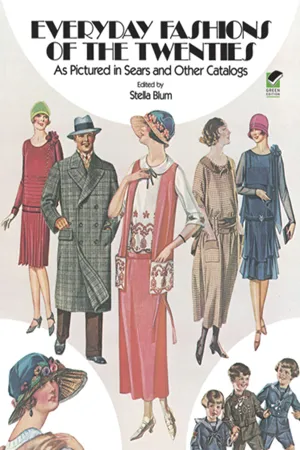
The Roaring Twenties, age of jazz and flappers, Model T Fords and Hollywood movie stars, was also a time when for millions the bulky catalogs of Montgomery Ward or Sears, Roebuck were a substitute for the window displays of Paris or New York fashion shops. Buying clothing through the mails had become an American institution, and entire families were often dressed via the U.S. Post Office. More conservative than the up-to-the-minute fashion shops, mail-order catalogs nevertheless offered surprisingly much of the haute couture. But, above all, they accurately record what men, women, and children were actually wearing in the 1920s.
Now Stella Blum (Curator of the Costume Institute at the Metropolitan Museum of Art, New York) has distilled into this volume the essence of the fashion pages of the Sears, Roebuck and other mail-order catalogs of the Twenties. Her informative text and selection of over 150 representative catalog pages — comprising over 750 illustrations with original captions — gradually trace the evolution of dress modes from the vogue of stodgy postwar fashions to the impact on costume of the crash of '29. In a year-by-year survey, Mrs. Blum's introductory texts relate the trends in fashion to the social changes of the dynamic and restless era, assessing the influence of war and technological developments on the high hemlines, flattened busts and hips, geometric patterns and "bobbed" hairstyles of the boyish flapper look. And as she notes, it was through the Sears catalogs that Parisian designers like Coco Chanel, Jeanne Lanvin, and Madeleine Vionnet made their influence felt on Midwestern farms and in urban ghettos.
You'll find here a marvelous panorama of "smart," "modish," "chic," "stylish," and "ultra fashionable" apparel, as well as more traditional garments: for women and "misses" there are Middy blouses, Russian boots modeled by Gloria Swanson, "Bob" hats modeled by Clara Bow and Joan Crawford; coats, suits, dresses (including the first maternity dresses), sweaters, capes; silk and rayon stockings, corsets, chemises, camisoles, negligees; and accessories like necklaces, belts, combs, headbands, umbrellas, gloves, compacts, hand bags, wristwatches, and powderpuff cases. You'll see slower-to-change men's fashions — shirts, ties, suits, sweaters, and sports clothes — become trimmer, brighter, smarter. And you can follow the trends in children's fashions as well.
For historians of costume, nostalgia buffs, and casual browsers, these pages afford a rare picture — unspoiled by recent myths about the Roaring Twenties — of how average people really dressed in the jazz age.
- 160 pages
- English
- ePUB (mobile friendly)
- Available on iOS & Android
eBook - ePub
About this book
Information
Topic
DesignSubtopic
Fashion DesignPart One: 1919—1924
In 1919, people in Europe and America, exhausted and depleted by World War I, longed to return to what they considered normalcy, to the way of life they had known before the war. Fashions reverted to those of 1913—1914, as though they had only been dropped for the duration. A new view of how women should dress had begun around 1909 and the course toward freedom, youth and equality was established even before 1914. By 1920, after a few steps backwards, the movement was accelerated by the experience and changes brought on by the war. During the next several years, the fashion ideal became younger and younger and proceeded to divest itself of many of the physical and mental trappings of the nineteenth century.
Growing urbanization, increased affluence, shorter working hours and paid vacations allowed for more leisure time and extra energy. As a result, interest in sports escalated, necessitating a whole range of special clothes designed for active and spectactor sports. Gradually this freer concept of dressing crept into daywear. Clothes became simpler and lighter in weight. Feminine curves, long a symbol of a woman’s frailty, were negated by the fashion for the new streamlined vertical lines. These six years were essentially a transitional period in women’s fashions. The new style was to emerge fully in 1925.
By 1919 pregnancy was no longer veiled in gowns for déshabillé or at-home robes. Maternity dresses designed in the styles of the period, along with maternity corsets, were illustrated graphically with explicit text explaining their function and virtues ...
Table of contents
- DOVER BOOKS ON FASHION
- Title Page
- Copyright Page
- Table of Contents
- INTRODUCTION
- Part One: 1919—1924
- Part Two: 1925-1931
Trusted by 375,005 students
Access to over 1.5 million titles for a fair monthly price.
Study more efficiently using our study tools.
Frequently asked questions
Yes, you can cancel anytime from the Subscription tab in your account settings on the Perlego website. Your subscription will stay active until the end of your current billing period. Learn how to cancel your subscription
No, books cannot be downloaded as external files, such as PDFs, for use outside of Perlego. However, you can download books within the Perlego app for offline reading on mobile or tablet. Learn how to download books offline
Perlego offers two plans: Essential and Complete
- Essential is ideal for learners and professionals who enjoy exploring a wide range of subjects. Access the Essential Library with 800,000+ trusted titles and best-sellers across business, personal growth, and the humanities. Includes unlimited reading time and Standard Read Aloud voice.
- Complete: Perfect for advanced learners and researchers needing full, unrestricted access. Unlock 1.5M+ books across hundreds of subjects, including academic and specialized titles. The Complete Plan also includes advanced features like Premium Read Aloud and Research Assistant.
We are an online textbook subscription service, where you can get access to an entire online library for less than the price of a single book per month. With over 1.5 million books across 990+ topics, we’ve got you covered! Learn about our mission
Look out for the read-aloud symbol on your next book to see if you can listen to it. The read-aloud tool reads text aloud for you, highlighting the text as it is being read. You can pause it, speed it up and slow it down. Learn more about Read Aloud
Yes! You can use the Perlego app on both iOS and Android devices to read anytime, anywhere — even offline. Perfect for commutes or when you’re on the go.
Please note we cannot support devices running on iOS 13 and Android 7 or earlier. Learn more about using the app
Please note we cannot support devices running on iOS 13 and Android 7 or earlier. Learn more about using the app
Yes, you can access Everyday Fashions of the Twenties by Stella Blum in PDF and/or ePUB format, as well as other popular books in Design & Fashion Design. We have over 1.5 million books available in our catalogue for you to explore.