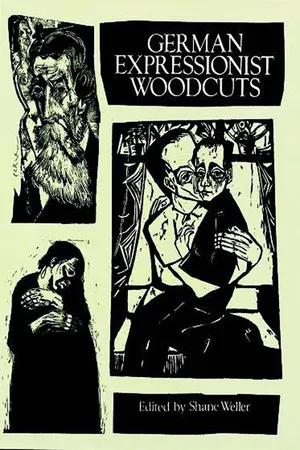
German Expressionism was an extraordinarily vivid presence in the art of the early twentieth century, its violent colors and often distorted, stylized forms reflecting not only the rebellious spirit of its participants, but the revolutionary mood of the new century itself. One of the most popular media used by the German Expressionists was the woodcut, important in the history of German art from the time of Albrecht Dürer (1471–1528), and especially suited to Expressionism's bold graphics.
This superb collection presents over 100 finely reproduced woodcuts from the work of nearly 30 major artists in the movement who worked in the woodcut medium. Among them are Ernst Barlach, Max Beckmann, Lyonel Feininger, Ernst Ludwig Kirchner, Käthe Kollwitz, Franz Marc, Emil Nolde, Max Pechstein, and many others. Most of the woodcuts reproduced here date from the first three decades of the twentieth century. They are powerful works, ranging in mood from Felix Müller's pensive portrait of Carl Sternheim (1925) to Franz Marc's electric Riding School (1913) and Ernst Barlach's profoundly moving Christ on the Mount of Olives (1920).
Readers interested in the art of the woodcut as well as students and enthusiasts of twentieth-century art will find this volume ideal for browsing and study. Individual captions for each selection, notes on each artist, and an informative introduction to the art of the woodcut and the German Expressionist movement add to the book's value as a reference work.
- 160 pages
- English
- ePUB (mobile friendly)
- Available on iOS & Android
eBook - ePub
German Expressionist Woodcuts
About this book
Information
Topic
ArtSubtopic
Art GeneralTHE ARTISTS
(Unless otherwise noted, the artists are German.)
BARLACH, ERNST (1870–1938; pages 1 & 2). Barlach studied at the academies in Hamburg and Dresden and at the Académie Julian, Paris. His work, especially his wood sculpture and engravings, is strongly influenced by the late German Gothic. Barlach also drew for the famed periodical Simplicissimus. At the time of his death, he had fallen into disfavor with the Nazis, who removed his work from public view.
BECKMANN, MAX (1884–1950; pages 3–5). A member of the Berlin Secession, Beckmann was influenced by Lovis Corinth and Edvard Munch. His experiences in the medical corps during World War I contributed a raw power to his work. He fled the Nazis, settling in New York.
CAMPENDONK, HEINRICH (889–957; pages 6 & 7). In a style that is a fusion of African/Oceanic art, post-Cubism and Expressionism, Campendonk created a unique approach to rustic scenes. He taught at the School of Fine Arts in Düsseldorf, but fled Germany for Holland, where he continued to teach. In his later years he designed fabrics, stained glass and theatrical sets.
FEININGER, LYONEL (American, 1871–1956; pages 8–14). Having left the United States in 1887 to study music in Europe, Feininger redirected his studies to fine art. He became a popular cartoonist, but returned to painting, developing a prismatic style in part influenced by Robert Delaunay. A figure central to the Bauhaus and Der Blaue Reiter, he returned to the United States after the Nazis ...
Table of contents
- DOVER BOOKS ON FINE ART
- Title Page
- Copyright Page
- Table of Contents
- INTRODUCTION
- THE ARTISTS
Trusted by 375,005 students
Access to over 1.5 million titles for a fair monthly price.
Study more efficiently using our study tools.
Frequently asked questions
Yes, you can cancel anytime from the Subscription tab in your account settings on the Perlego website. Your subscription will stay active until the end of your current billing period. Learn how to cancel your subscription
No, books cannot be downloaded as external files, such as PDFs, for use outside of Perlego. However, you can download books within the Perlego app for offline reading on mobile or tablet. Learn how to download books offline
Perlego offers two plans: Essential and Complete
- Essential is ideal for learners and professionals who enjoy exploring a wide range of subjects. Access the Essential Library with 800,000+ trusted titles and best-sellers across business, personal growth, and the humanities. Includes unlimited reading time and Standard Read Aloud voice.
- Complete: Perfect for advanced learners and researchers needing full, unrestricted access. Unlock 1.5M+ books across hundreds of subjects, including academic and specialized titles. The Complete Plan also includes advanced features like Premium Read Aloud and Research Assistant.
We are an online textbook subscription service, where you can get access to an entire online library for less than the price of a single book per month. With over 1.5 million books across 990+ topics, we’ve got you covered! Learn about our mission
Look out for the read-aloud symbol on your next book to see if you can listen to it. The read-aloud tool reads text aloud for you, highlighting the text as it is being read. You can pause it, speed it up and slow it down. Learn more about Read Aloud
Yes! You can use the Perlego app on both iOS and Android devices to read anytime, anywhere — even offline. Perfect for commutes or when you’re on the go.
Please note we cannot support devices running on iOS 13 and Android 7 or earlier. Learn more about using the app
Please note we cannot support devices running on iOS 13 and Android 7 or earlier. Learn more about using the app
Yes, you can access German Expressionist Woodcuts by Shane Weller in PDF and/or ePUB format, as well as other popular books in Art & Art General. We have over 1.5 million books available in our catalogue for you to explore.