Andrea Palladio (1508–1580) was one of the most celebrated architects of the Renaissance, so important that the term Palladian has been applied to a particular style of architecture that adheres to classical concepts. The wide spread of Palladianism was due partly to the private and public buildings he constructed in Italy, the designs of which were copied throughout Europe. But of even greater consequence was his remarkable magnum opus, "I Quattro Libri dell'Architettura"; translated into every major Western European language in the two centuries following its publication in 1570, it has been one of the most influential books in the history of architecture.
The Four Books of Architecture offers a compendium of Palladio's art and of the ancient Roman structures that inspired him. The First Book is devoted to building materials and techniques and the five orders of architecture: Tuscan, Doric, Ionic, Corinthian, and Composite. Palladio indicates the characteristic features of each order and supplies illustrations of various architectural details. The Second Book deals with private houses and mansions, almost all of Palladio's own design. Shown and described are many of his villas in and near Venice and Vicenza (including the famous Villa Capra, or "The Rotunda," the Thiene Palace, and the Valmarana Palace). Each plate gives a front view drawing of the building and the general floor plan. The Third Book is concerned with streets, bridges, piazzas, and basilicas, most of which are of ancient Roman origin. In the Fourth Book, Palladio reproduces the designs of a number of ancient Roman temples. Plates 51 to 60 are plans and architectural sketches of the Pantheon.
In all, the text is illustrated by over 200 magnificently engraved plates, showing edifices, either of Palladio's own design or reconstructed (in these drawings) by him from classical ruins and contemporary accounts.
All the original plates are reproduced in this new single-volume edition in full size and in clear, sharp detail. This is a republication of the Isaac Ware English edition of 1738. Faithful and accurate in the translation and in its reproduction of the exquisite original engravings, it has long been a rare, sought-after work. This edition makes The Four Books available for the first time in more than 200 years to the English-speaking public.
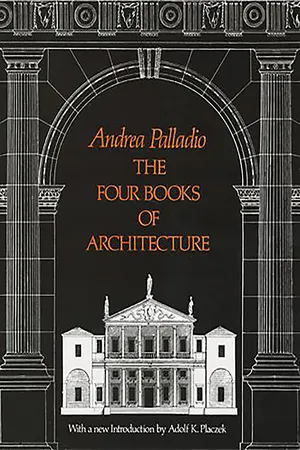
- 352 pages
- English
- ePUB (mobile friendly)
- Available on iOS & Android
eBook - ePub
The Four Books of Architecture
About this book
Information
Topic
ArchitectureSubtopic
History of ArchitectureTHE FOURTH BOOK OF Andrea Palladio’s ARCHITECTURE.
The PREFACE to the READER.
IF upon any fabrick labour and induſtry may be beſtowed, that it may be comparted with beautiful meaſure and proportion; this, without any doubt, ought to be done in temples; in which the maker and giver of all things, the almighty and ſupream God, ought to be adored by us, and be praiſed, and thanked for his continual benefactions to us, in the beſt manner that our ſtrength will permit. If, therefore, men in building their own habitations, take very great care to find out excellent and expert architects, and able artificers, they are certainly obliged to make uſe of ſtill much greater care in the building of churches. And if in thoſe they attend chiefly to conveniency, in theſe they ought to have a regard to the dignity and grandeur of the Being there to be invoked and adored ; who being the ſupream good, and higheſt perſection, it is very proper, that all things conſecrated to him, ſhould be brought to the greateſt perfection we are capable of. And indeed, if we conſider this beautiful machine of the world, with how many wonderful ornaments it is filled, and how the heavens, by their continual revolutions, change the ſeaſons according as nature requires, and their motion preſerves itſelf by the ſweeteſt harmony of temperature; we cannot doubt, but that the little temples we make, ought to reſemble this very great one, which, by his immenſe goodneſs, was perfectly compleated with one word of his; or imagine that we are not obliged to make in them all the ornaments we poſſibly can, and build them in ſuch a manner, and with ſuch proportions, that all the parts together may convey a ſweet harmony to the eyes of the beholders, and that each of them ſeparately may ſerve agreeably to the uſe for which it ſhall be appointed. For which reaſon, although they are worthy to be much commended, who being guided by an exceeding good ſpirit, have already built temples to the ſupream God, and ſtill build them ; it does not ſeem, nevertheleſs, that they ought to remain without ſome little reprehenſion, if they have not alſo endeavoured to make them in the beſt and moſt noble form our condition will permit.
HENCE, becauſe the antient Greeks and Romans employed the utmoſt care in building the temples to their Gods, and compoſed them of the moſt beautiful architecture, that they might be made with ſo much greater ornaments, and in greater proportion, as that they might be ſuitable for the God to whom they were conſecrated ; I ſhall ſhew in this book the form and the ornaments of many antient temples, of which the ruins are ſtill to be ſeen, and by me have been reduced into deſigns, that every one may know in what form, and with what ornaments churches ought to be built. And although there is but a ſmall part of ſome of them to be ſeen ſtanding above-ground, I nevertheleſs from that ſmall part, (the foundations that could be ſeen being alſo conſidered) have endeavoured, by conjecture, to ſhewn what they muſt have been when they were entire. And in this VITRUVIUS has been a very great help to me ; becauſe, what I ſaw, agreeing with what he teacheth us, it was not difficult for me to come at the knowledge of their aſpect, and of their form.
BUT to the ornaments, that is, the baſes, columns, capitals, cornices, and ſuch like things, I have added nothing of my own ; but they have been meaſured by me with the utmoſt attention, from different fragments, found in the places where theſe temples ſtood. And I make no doubt, but that they, who ſhall read this book, and ſhall confider the deſigns in it carefully, may be able to underſtand many places, which in VITRUVIUS are reputed very difficult, and to direct their mind to the knowledge of the beautiful and proportionable forms of temples, and to draw from them various very noble inventions; making uſe of which in a proper time and place, they may ſhew, in their works, how one may, and ought to vary, without departing from the precepts of the art, and how laudable and agreeable ſuch variations are.
BUT before we come to the deſigns, I ſhall, as I uſually do, briefly mention thoſe ad-vertences, that in building of temples ought to be obſerved ; having alſo taken them from VITRUVIUS, and from other very excellent men, who have written of ſo noble an art.
CHAPTER I.
Of the SITE that ought to be choſen for the building of temples.
TUSCANY was not only the firſt to receive architecture into Italy, as a ſtranger, from whence the order called Tuſcan had its measures; but alſo the things belonging to the Gods, which the greateſt part of the world, led into blind error, adored. She was miſtreſs of the neighbouring people, and ſhewed what fort of temples, and in what place,...
Table of contents
- DOVER BOOKS ON ARCHITECTURE
- Title Page
- Copyright Page
- Table of Contents
- Introduction to Dover Edition
- Dedication
- THE NAMES OF THE SUBSCRIBERS.
- REFERENCES to ſuch Places of the AUTHOR, where his Terms of Art are by himſelf beſt explained, alphabetically diſpoſed.
- ERRATA.
- ADVERTISEMENT.
- THE AUTHOR’S PREFACE - TO THE READER.
- THE FIRST BOOK OF Andrea Palladio’s ARCHITECTURE.
- THE SECOND BOOK OF Andrea Palladio’s ARCHITECTURE.
- THE THIRD BOOK OF Andrea Palladio’s ARCHITECTURE.
- THE FOURTH BOOK OF Andrea Palladio’s ARCHITECTURE.
Trusted by 375,005 students
Access to over 1.5 million titles for a fair monthly price.
Study more efficiently using our study tools.
Frequently asked questions
Yes, you can cancel anytime from the Subscription tab in your account settings on the Perlego website. Your subscription will stay active until the end of your current billing period. Learn how to cancel your subscription
No, books cannot be downloaded as external files, such as PDFs, for use outside of Perlego. However, you can download books within the Perlego app for offline reading on mobile or tablet. Learn how to download books offline
Perlego offers two plans: Essential and Complete
- Essential is ideal for learners and professionals who enjoy exploring a wide range of subjects. Access the Essential Library with 800,000+ trusted titles and best-sellers across business, personal growth, and the humanities. Includes unlimited reading time and Standard Read Aloud voice.
- Complete: Perfect for advanced learners and researchers needing full, unrestricted access. Unlock 1.5M+ books across hundreds of subjects, including academic and specialized titles. The Complete Plan also includes advanced features like Premium Read Aloud and Research Assistant.
We are an online textbook subscription service, where you can get access to an entire online library for less than the price of a single book per month. With over 1.5 million books across 990+ topics, we’ve got you covered! Learn about our mission
Look out for the read-aloud symbol on your next book to see if you can listen to it. The read-aloud tool reads text aloud for you, highlighting the text as it is being read. You can pause it, speed it up and slow it down. Learn more about Read Aloud
Yes! You can use the Perlego app on both iOS and Android devices to read anytime, anywhere — even offline. Perfect for commutes or when you’re on the go.
Please note we cannot support devices running on iOS 13 and Android 7 or earlier. Learn more about using the app
Please note we cannot support devices running on iOS 13 and Android 7 or earlier. Learn more about using the app
Yes, you can access The Four Books of Architecture by Andrea Palladio in PDF and/or ePUB format, as well as other popular books in Architecture & History of Architecture. We have over 1.5 million books available in our catalogue for you to explore.