"An outstanding textbook." — Scientific, Medical and Technical Books Almost unsurpassed as a balanced, well-written account of fundamental fluid dynamics, Theory of Flight may still be recommended for a clearer presentation than is to be forced in many more recent works, though it is limited to situations in which air compressibility effects are unimportant. Designed for the college senior or beginning graduate student, the text assumes a knowledge of the principles of calculus and some training in general mechanics. It is unusual in offering a well-balanced introduction, stressing equally theory and practice. It avoids the formidable mathematical structure of fluid dynamics, while conveying by often unorthodox methods a full understanding of the physical phenomena and mathematical concepts of aeronautical engineering. Theory of Flight contains perhaps the best introduction to the general theory of stability, while the introduction to dynamics of incompressible fluids and the chapters on wing theory remain particularly valuable for their clarity of exposition and originality of thought. Mises' position as one of the great pioneers in the development of the aeronautical sciences lends a flavor of authenticity not found in more conventional textbooks. Any student who has made himself familiar with his exposition of the fundamentals and applications will have acquired an excellent background for additional, more specialized fields of modern aeronautical engineering.
In kinetic theory a gas is considered as composed of discrete molecules in vigorous, irregular motion, continually colliding with one another. In fluid dynamics one substitutes for this picture the simpler one of continuously distributed matter moving without sudden changes of velocity.
At any point P of a region in space occupied by such a continuous medium, or continuum, the density can be defined in the following way: Consider the mass and the volume of the substance that is contained in a small region R surrounding the point P. The density at P then is the limiting value of the ratio of the mass to the volume as the linear dimensions of R tend simultaneously to zero.
In this book the density will be denoted by ρ. In the engineering system the unit of density is one slug per cubic foot. At 59°F. and standard atmospheric pressure (29.921 in. Hg) the density of dry air is 0.002378 slug/ft.3
The specific weight γ, defined as the weight per unit of volume, is the product of the density and the acceleration g of free fall: γ = gρ. In the engineering system the unit of specific weight is the pound per cubic foot. With g = 32.174 ft./sec.2, the specific weight of dry air at 59°F. and standard pressure is seen to be 0.07651 lb./ft.3
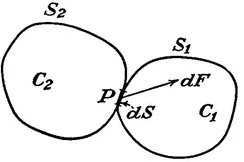
Consider two portions C1 and C2 of the continuum touching each other at the point P. Around P mark off an infinitesimal area dS (Fig. 1). Across dS the portion C2 exerts an infinitesimal force on the portion C1. Denote the magnitude of this force by dF. The stress that C2 exerts at P across the surface S on the portion C1 of the continuum then is defined as the vector whose magnitude is dF/dS and whose direction is that of the infinitesimal force dF. It follows from Newton’s third law of motion that the stress which C1 exerts at P across the surface S on the portion C2 is given by a vector of the same magnitude and the opposite direction.
It is a fundamental assumption of the mechanics of continua that the stress transmitted at P across dS will not depend on the shape of the surfaces S1 and S2 as long as the tangential plane of both surfaces at P remains the same. We thus can speak of the stress transmitted across a surface element without defining the surfaces to which this element belongs and the portions C1 and C2 which they confine.
The stress transmitted across a surface element is in general oblique to it. The stress components perpendicular and parallel to the surface element are called normal stress and shearing stress, respectively. The normal stress can be a thrust or a tension.
FIG. 1.
In this book the continuum to be considered is the atmospheric air. Its mechanical properties are essentially the same as those of other gases and partly the same as those of liquids. The word “fluid” will be used to designate both gases and liquids. It is assumed as the characteristic property of fluids that in a state of rest no shearing stresses are transmitted and that the normal stress on any surface element is a thrust. Moreover, this assumption is maintained in most problems of fluid in motion. If we do this we call the fluid a perfect fluid (see Sec. II.2).
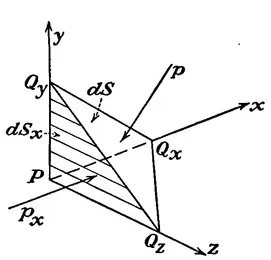
By considering a small portion of fluid enclosing a point P we can prove that the normal stress has the same value for any surface element through P if no shearing stress exists. Take a small tetrahedron PQxQyQz, three edges of which are parallel to the axes of a system of rectangular coordinates (Fig. 2). Let dS be the area of the face QxQyQz oblique to these edges and α its angle with the y-z-plane. Then dSx = dS cos α is the area of the face parallel to the y-z-plane. Denote the normal stresses transmitted across the faces dSx and dS by px and p, respectively. The force exerted by the fluid outside the tetrahedron on the face dSx has the direction of the x-axis and the intensity pxdSx. The force p dS acting on the face dS is perpendicular to this face and thus makes the angle α with the x-axis. The forces acting on the two remaining faces are perpendicular to the x-axis. Thus the sum of the x-components of the forces acting on the portion of fluid under consideration is
pxdSx− p dS cos α = (px− p) dSx
because dSx = dS cos α. According to Newton’s second law this sum must equal the product of mass times acceleration component ax in the x-direction. The mass is the product of the density ρ and the volume, which is
. Therefore,
FIG. 2.
To secure a finite value of ax we have to assume that px − p tends toward zero if
becomes smaller and smaller, i.e., if the tetrahedron reduces to the point P. Thus the two stresses px and p on the two surface elements in P must be equal. Since the direction of the x-axis can be chosen arbitrarily, there exists only one stress value in P, or the state of stress at any point P of a perfect fluid, or of any fluid in equilibrium, is completely specifie...
Table of contents
DOVER BOOKS ON PHYSICS
Title Page
Copyright Page
Dedication
INTRODUCTION TO DOVER EDITION
PREFACE
Table of Contents
Part One - EQUILIBRIUM AND STEADY FLOW IN THE ATMOSPHERE
Part Two - THE AIRPLANE WING
Part Three - PROPELLER AND ENGINE
Part Four - AIRPLANE PERFORMANCE
Part Five - AIRPLANE CONTROL AND STABILITY
BIBLIOGRAPHICAL AND HISTORICAL NOTES
INDEX
Trusted by 375,005 students
Access to over 1.5 million titles for a fair monthly price.
Study more efficiently using our study tools.
Frequently asked questions
Yes, you can cancel anytime from the Subscription tab in your account settings on the Perlego website. Your subscription will stay active until the end of your current billing period. Learn how to cancel your subscription
No, books cannot be downloaded as external files, such as PDFs, for use outside of Perlego. However, you can download books within the Perlego app for offline reading on mobile or tablet. Learn how to download books offline
Perlego offers two plans: Essential and Complete
Essential is ideal for learners and professionals who enjoy exploring a wide range of subjects. Access the Essential Library with 800,000+ trusted titles and best-sellers across business, personal growth, and the humanities. Includes unlimited reading time and Standard Read Aloud voice.
Complete: Perfect for advanced learners and researchers needing full, unrestricted access. Unlock 1.5M+ books across hundreds of subjects, including academic and specialized titles. The Complete Plan also includes advanced features like Premium Read Aloud and Research Assistant.
Both plans are available with monthly, semester, or annual billing cycles.
We are an online textbook subscription service, where you can get access to an entire online library for less than the price of a single book per month. With over 1.5 million books across 990+ topics, we’ve got you covered! Learn about our mission
Look out for the read-aloud symbol on your next book to see if you can listen to it. The read-aloud tool reads text aloud for you, highlighting the text as it is being read. You can pause it, speed it up and slow it down. Learn more about Read Aloud
Yes! You can use the Perlego app on both iOS and Android devices to read anytime, anywhere — even offline. Perfect for commutes or when you’re on the go. Please note we cannot support devices running on iOS 13 and Android 7 or earlier. Learn more about using the app
Yes, you can access Theory of Flight by Richard von Mises in PDF and/or ePUB format, as well as other popular books in Technology & Engineering & Aeronautic & Astronautic Engineering. We have over 1.5 million books available in our catalogue for you to explore.