In ancient Rome, any citizen who had brought disgrace upon the state could be subject to a judgment believed to be worse than death: damnatio memoriae, condemnation of memory. The Senate would decree that every trace of the citizen's existence be removed from the city as if they had never existed in the first place. Once reserved for individuals, damnatio memoriae in different forms now extends to social classes, racial and ethnic groups, and even entire peoples. In modern times, the condemned go by different names—"enemies of the people;" the "missing," the "disappeared," "ghost" detainees in "black sites"—but they are subject to the same fate of political erasure.
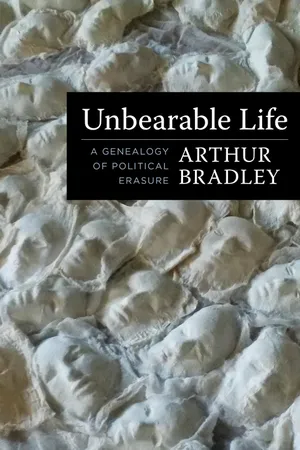
Arthur Bradley explores the power to render life unlived from ancient Rome through the War on Terror. He argues that sovereignty is the power to decide what counts as being alive and what does not: to make life "unbearable," unrecognized as having lived or died. In readings of Augustine, Shakespeare, Hobbes, Robespierre, Schmitt, and Benjamin, Bradley asks: What is the "life" of this unbearable life? How does it change and endure across sovereign time and space, from empires to republics, from kings to presidents? To what extent can it be resisted or lived otherwise? A profoundly interdisciplinary and ambitious work, Unbearable Life rethinks sovereignty, biopolitics, and political theology to find the radical potential of a life that neither lives or dies.
- English
- ePUB (mobile friendly)
- Available on iOS & Android
eBook - ePub
About this book
Information
Subtopic
Critical Theory1
UNBEARABLE
Foucault and the Birth of Nihilopolitics
What does having the right of life and death actually mean? In one sense, to say that the sovereign has a right of life and death means that he can, basically, either have people put to death or let them live, or in any case that life and death are not natural or immediate phenomena which are primal or radical, and which fall outside the field of power. If we take the argument a little further, or to the point where it becomes paradoxical, it means that in terms of his relationship with the sovereign, the subject is, by rights, neither dead nor alive. From the point of view of life and death, the subject is neutral [neutre], and it is thanks to the sovereign that the subject has the right to be alive or, possibly, the right to be dead. In any case, the lives and deaths of subjects become rights only as a result of the will of the sovereign.
—Michel Foucault, “Society Must Be Defended”: Lectures at the Collège de France, 1975–76
In a lecture first delivered on March 17, 1976, at the Collège de France, and published posthumously in “Society Must Be Defended” (2003), Michel Foucault briefly proposes an intriguing thought experiment about sovereignty. It is, rightly or wrongly, a commonplace of political theory that the fundamental right of the classical sovereign is the power of life and death (vitae necisque potestas) over his subjects.1 As Foucault observes, the sovereign power to put people to death or let them live has its origins in the Roman right of the father (patria potestas) to dispose of his children’s lives. Yet, he contends, this classic formula also contains a previously unnoticed aporia, or paradox, that extends sovereignty into a new virtual territory. To put it in Foucault’s own terms, sovereign power over both life and death—if it really does what it claims to do—logically positions the political subject in an a priori state of political exception outside the life/death matrix unless and until the sovereign decision is taken: “the subject is neutral and it is thanks to the sovereign that the subject has the right to be alive or possibly, the right to be dead.” If he does not go on to unpack the full implications of this thought experiment anywhere in his later work, I want to propose that Foucault nonetheless offers the first, most succinct, and penetrating formulation of what this book will call “unbearable life”: a life rendered unlived, nonexistent, unbearable by sovereign power. For classical sovereignty, sovereign power is not merely the power to decide upon whether a living subject should continue to live or die but, fundamentally, to decide on whether that subject (now radically divested of any intrinsic natural rights or properties) ever possessed the right to be considered “alive” in the first place: sovereign is he who decides, not on life and death, but on unbearable life.2 This opening chapter proposes that Foucault’s famous history of the “birth” of biopolitics—of the politics of making life live and letting die—from early modern social contract theory to the Nazi camps is also the story of the naissance of nihilopolitics, of the politics of making life neither live nor die. In what follows, I offer a counter-genealogy of Foucault’s thought experiment that tracks the historical production of a very singular set of sovereign bodies, that could all be said to exist outside the life/death matrix: the never born, the living dead, the already dead. What, then, is the “life” of unbearable life? How does it emerge across the field of modern political theory from Hobbes through Rousseau to contemporary biopolitical theorists like Esposito? To what extent might it be possible for the subject to resist this sovereign power over life and death?

In the Collège de France lectures and contemporaneous texts, Foucault famously narrates a larger historical story about the passage from absolute to popular sovereignty, sovereignty to governmentality, and, more broadly, sovereign power to biopower. To quickly reconstruct this genealogy, I begin by returning to the French philosopher’s famous claim in the opening sentence of the chapter “Right of Death and Power over Life” from The Will to Knowledge: “one of the characteristic privileges of sovereign power was the right to decide life and death.”3 For Foucault, recall, classical sovereignty is essentially a right of seizure: “of things, time, bodies, and ultimately life itself; it culminated in the privilege to seize hold of life in order to suppress it.”4 Yet, in the nineteenth century classical sovereignty metastasizes into a proliferation of new disciplinary regimes, apparatuses, and technologies, he argues, which supplement, and reverse, its classical privilege. If the basic signature of sovereign power over the individual subject was “to make die and let live” (faire mourir ou laisser vivre), biopower exerts itself not over citizens but over populations, races, and species-existence itself with the exact opposite imperative: to “make live and let die” (faire vivre et laisser mourir).5 This new power is dedicated to “generating forces, making them grow, and ordering them” rather than “impeding them, making them submit, or destroying them.”6 In inaugurating a new epoch in the history of power, biopolitics also brings about a radical transformation in the subject of power from Aristotle’s political animal (zoon politikon) to a new man who has been animalized by politics: “For millennia, man remained what he was for Aristotle: a living animal with the additional capacity for a political existence; modern man is an animal whose politics places his existence as a living being in question.”7 What is the place of Foucault’s thought experiment on the classic sovereign power of life and death within this larger genealogy?
To start with, Foucault’s hypothesis seems to problematize this story of the irreversible historical mutation of sovereign power into biopower: what the French philosopher calls the sovereign “right of life and death” is neither the power to make live nor make die, strictly speaking, but the power to make life neither live nor die, to render life neutral. It is not surprising, then, to see “Society Must Be Defended” immediately go on to reinforce the very opposition it has just inadvertently called into question. According to Foucault, the “theoretical paradox” he locates in the classical theory of sovereignty contains “a practical disequilibrium,” which (conveniently) permits him to disregard it altogether. If a sovereign “obviously” (bien entendu)8 cannot grant life in the same way that he inflicts death—and we will return in a moment to this unargued assumption that “life” must precede sovereignty—then his supposed power over life and death is always exercised in an unbalanced way that tips the scales in favor of death. For Foucault, sovereign power over “life” is in reality nothing but the tautological repetition of the “right of the sword”: “it is at the moment when the sovereign can kill that he exercises his right over life.”9 This is why The Will to Knowledge famously redescribes the sovereign “power of life and death” as the power to take life or let live, to kill or refrain from killing.10 In Foucault’s genealogy, it will only be with the birth of the epoch of biopolitics proper that biological life ceases to be merely the pre-political substrate or condition of politics and becomes something close to its end or goal—and so he returns unbearable life to the critical obscurity where he first found it.
In what follows, though, I want to argue that Foucault’s remarkable thought experiment on classic sovereignty exceeds the various conceptual antinomies (theory versus practice; sovereign power versus biopower; killing and making live) in which he seeks to capture it: unbearable life will never quite stay where he seeks to put it. It is worth noting at the outset here that this attempt to reduce the sovereign right of life to nothing more than the tautological repetition of the right to kill comes at the risk of what we will see to be a curiously retroactive depoliticization and re-naturalization—even a revitalization—of “life” under sovereignty that reverberates through the history of biopolitics. After all, any attempt to limit sovereign power to nothing but the power to kill can only mean that the subject would no longer really be “neutral” vis-à-vis life and death, but must already somehow be given as a living being (zoon), as if life really were a “natural or immediate” phenomenon. To take Foucault’s hypothesis about sovereignty over life and death seriously, we must thus begin to imagine a counter-genealogy—a kind of unbearable life—of his familiar genealogy of “life” as the historical passage from sovereign power to biopower, sovereignty to governmentality, making die to making live, and so on—in short, of the entire history of what has come to be known as “biopolitics.” If sovereignty is not simply reducible to the power to kill, if a sovereign really does have the power to “grant life in the same way that he can inflict death,”11 if life was never a natural or immediate phenomenon that was simply outside the domain of the political but something that has always been permeated by political power, then arguably an obscure form of power starts to emerge in the theoretical, historical, and philosophical interstices between sovereignty and biopolitics, life and death, killing and living. In rereading Foucault’s history of the birth of biopolitics against itself, we can begin to glimpse the naissance of nihilopolitics.
In the March 17 lecture, Foucault intriguingly goes on to assert that the birth of biopolitics—which he normally dates to the beginning of the nineteenth century—is already under way more than 150 years earlier in social contract theory: “The jurists of the seventeenth and especially the eighteenth century were, you see, already asking this question about the right of life and death.”12 It is with the canonical signatures Hobbes, Locke, and Rousseau (who, though never explicitly named, are some of the likely targets here) and the classic debates around the social contract (natural versus civil rights, individual liberties versus political obligations) stretching from the English Civil War to the French Revolution that we can begin to glimpse the emergence of something like biological life as the referent object of political power. To say the very least, Foucault’s attempt to reclaim a figure like Thomas Hobbes as a theorist of biopower avant la lettre here is somewhat surprising, because, of course, the twentieth-century French philosopher axiomatically sets his own theory of politics against that of the seventeenth-century English political theorist: Foucault famously insists here and elsewhere that we must “eschew the model of Leviathan in the study of power” in order to understand the new architecture of the political.13 In Foucault’s lecture, though, he also seems to identify something close to Hobbesian social contract theory less as the dying breath of sovereign absolutism, say, and more as the birth pangs of what will become known as biopower. What if, contrary to everything Foucault previously led us to believe, Hobbes had already cut off the king’s head?14
To quickly unpack Foucault’s hypothesis here, Hobbes’s apology for the classic sovereign power to make die and let live ironically ends up anticipating the equal and opposite biopolitical power to make live and let die.15 It is our natural right to preserve our own physical existence; recall, that is the foundation of what Hobbes famously calls “the mutual Relation between Protection and Obedience.”16 According to Foucault, though, social contract theory’s recognition that the subject’s natural right to life—a right that Hobbes famously argues cannot be alienated by society—necessarily precedes and delimits the sovereign power to kill is the thin end of a wedge that will ultimately lead to the demise of sovereignty itself. For Foucault, Hobbes’s theory of sovereign power is thus ironically delegitimized by the very authority—the natural right to life—that brought it into existence in the first place:
The jurists ask: When we enter into a contract, what are individuals doing at the level of the social contract, when they come together to constitute a sovereign, to delegate absolute power over them to a sovereign? They do so because they are forced to by some threat or by need. They therefore do so in order to protect their lives. It is in order to live [pouvoir vivre] that they constitute a sovereign. To the extent that this is the case, can life actually become one of the rights of the sovereign? Isn’t life the foundation [fondatrice] of the sovereign’s right, and can the sovereign actually demand that his subjects grant him the right to exercise the power of life and death over them, or in other words, simply the power to kill them? Mustn’t life remain outside the contract [hors contrat] to the extent that it was the first, initial, and foundational reason [motif] for the contract itself?17
Yet, it is again possible to suspect what I have called a certain vitalism in Foucault’s implication that “life” thus constitutes a point of external, or pre-political, r...
Table of contents
- Cover
- Series Statement
- Title Page
- Copyright
- Dedication
- Contents
- Acknowledgments
- Introduction
- 1. Unbearable: Foucault and the Birth of Nihilopolitics
- 2. Ungood: Augustine’s City of Cacus
- 3. Untimely Ripped: Macbeth’s Children
- 4. Uncommon: Hobbes’s Martyrs
- 5. Incorruptible: Robespierre and the Already Dead
- 6. Unleashed: Schmitt and the Katechon
- 7. Undead: Benjamin and the Past to Come
- Conclusion
- Notes
- Bibliography
- Index
- Series List
Trusted by 375,005 students
Access to over 1.5 million titles for a fair monthly price.
Study more efficiently using our study tools.
Frequently asked questions
Yes, you can cancel anytime from the Subscription tab in your account settings on the Perlego website. Your subscription will stay active until the end of your current billing period. Learn how to cancel your subscription
No, books cannot be downloaded as external files, such as PDFs, for use outside of Perlego. However, you can download books within the Perlego app for offline reading on mobile or tablet. Learn how to download books offline
Perlego offers two plans: Essential and Complete
- Essential is ideal for learners and professionals who enjoy exploring a wide range of subjects. Access the Essential Library with 800,000+ trusted titles and best-sellers across business, personal growth, and the humanities. Includes unlimited reading time and Standard Read Aloud voice.
- Complete: Perfect for advanced learners and researchers needing full, unrestricted access. Unlock 1.5M+ books across hundreds of subjects, including academic and specialized titles. The Complete Plan also includes advanced features like Premium Read Aloud and Research Assistant.
We are an online textbook subscription service, where you can get access to an entire online library for less than the price of a single book per month. With over 1.5 million books across 990+ topics, we’ve got you covered! Learn about our mission
Look out for the read-aloud symbol on your next book to see if you can listen to it. The read-aloud tool reads text aloud for you, highlighting the text as it is being read. You can pause it, speed it up and slow it down. Learn more about Read Aloud
Yes! You can use the Perlego app on both iOS and Android devices to read anytime, anywhere — even offline. Perfect for commutes or when you’re on the go.
Please note we cannot support devices running on iOS 13 and Android 7 or earlier. Learn more about using the app
Please note we cannot support devices running on iOS 13 and Android 7 or earlier. Learn more about using the app
Yes, you can access Unbearable Life by Arthur Bradley in PDF and/or ePUB format, as well as other popular books in Politics & International Relations & Critical Theory. We have over 1.5 million books available in our catalogue for you to explore.