![]()
THE ARTILLERY
ARTILLERY was classed partly according to its weight and caliber, and partly by its mobility and the form of its carriage or mounting. “Field” artillery, as the name implies, was ordnance light and mobile enough to move with the army in the field, and to be freely maneuvered in battle. This also included mountain artillery—exceptionally light pieces which could be manhandled if necessary, or transported in pieces on muleback.
Heavy artillery included siege guns and siege mortars, which were mobile, although slow and unwieldly; garrison or fortress artillery; and the great sea coast mortars and pieces like the huge Rodmans, the largest of which weighed 117,000 pounds and fired a 1080-pound projectile 8000 yards.
Ordnance was again divided into types. Guns were comparatively heavy, of long range and flat trajectory. Howitzers were lighter and shorter, fired a relatively heavy shell with a light charge, and usually had a powder chamber smaller than the bore of the gun. Mortars were very short and heavy, and fired large projectiles with a high trajectory. The “workhorse” of the Civil War artillery, the 12-pounder smoothbore “Napoleon,” model of 1857, was a gun-howitzer, being both shorter and lighter than the older 12-pounder gun, but using the same powder charge.
Guns were either smoothbore or rifled, and fired solid shot, shell, spherical case (shrapnel), grapeshot, and canister. The last three were all referred to as “case” shot. Howitzers fired shell and “case,” while mortars fired only shell and spherical case. The last two pieces were smoothbores.
The lighter smoothbore ordnance was usually of bronze (often referred to as “brass”). Some rifled pieces were made of bronze, but the rifling wore too rapidly. Most of the rifled field pieces were of wrought iron, or cast iron with wrought iron reinforcing hoops at the breech. The larger smoothbore weapons, those used in fixed positions, were nearly all of cast iron.
Cast iron was easiest and cheapest to produce, but comparatively weak and brittle, and unequal to the strain of firing with heavy charges in a rifled gun. Steel was superior to cast iron but was expensive and difficult to produce and work in large quantities.
Few of the Civil War guns were breechloaders. Field artillery could be loaded “down the spout” just as fast, if not faster, than a crew could operate the relatively clumsy and complicated breech mechanisms then in use.
Guns of that period had no recoil mechanisms. When fired they leaped back in recoil, and had to be run back and reaimed and pointed after each round. Aiming, rather than loading, took the time.
Gun sights were crude, range-finding apparatus nonexistent, and anything approaching modern fire control unknown. Indirect or night firing by field artillery was considered a waste of time and ammunition.
Fuzes were uncertain, and many shells failed to burst at all, or burst prematurely and blew off the muzzles of the guns which fired them.
A Confederate artilleryman wrote of Chancellorsville, “Although the shells were provided with the fuze igniter attachment, but one in fifteen burst.”
Even when they did explode, shells of that period were far less destructive than modern projectiles of the same caliber.
The walls of the shells were thick, and bursting charges small, especially so in spherical ammunition. Consequently the missiles broke into a few large pieces, which had little velocity. Elongated projectiles for rifled guns held more powder, and some types were scored internally to insure better fragmentation. However, many of the rifle shells were fitted with impact fuzes. On hitting the ground, they were likely to bury themselves before exploding, thus reducing their efficiency. The effect of such fire against infantry under cover was so small that long-range cannonading was looked upon by veteran troops with contempt.
The field artilleryman’s most lethal load was canister. The tin cylinders filled with iron shot or musket balls turned a cannon into a monster sawed-off shot-gun. Against troops in mass formation it was devastating; and it undoubtedly caused more casualties than all other artillery projectiles combined.
Napoleon had used it with deadly effect, pushing his field artillery well forward and “softening up” the enemy formations before his own columns attacked. But in his day canister, with its effective range of some three hundred yards, out-ranged the smoothbore musket. The Minié ball and the rifled musket, with its effective range of five hundred yards, changed the picture completely.
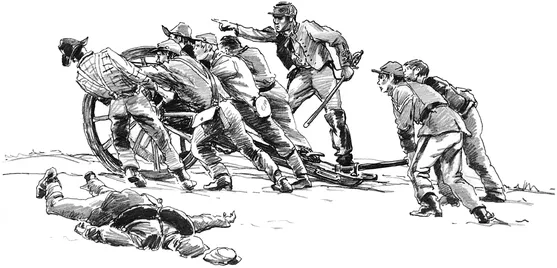
To use his most effective weapon, the Civil War gunner had to bring his piece into action well within range of the enemy riflemen. Against sharpshooting veterans this was suicide. Although in many instances batteries were galloped up to close range, to unlimber amid a hail of rifle bullets, it was looked upon as a sacrifice move, to be made only in moments of dire necessity, and at an inevitably high cost in men and horses.
At the Bloody Angle, Spotsylvania, a section of Battery C, 5th U. S. Artillery, was brought into action. “... Lieutenant Metcalf gave the command ‘Limber the guns,’ ‘Drivers mount,’ ‘Cannoneers mount,’ ‘Caissons rear,’ and away we went, up the hill, past our infantry, and into position.... We were a considerable distance in front of our infantry, and of course artillery could not live long under such a fire as the enemy were putting through there. Our men went down in short order. The left gun fired nine rounds, I fired fourteen with mine.... Our section went into action with 23 men and one officer. The only ones who came out sound were the lieutenant and myself. Every horse was killed, 7 of the men were killed outright, 16 wounded; the gun carriages were so cut with bullets as to be of no further service.... 27 balls passed through the lid of the limber chest while number six was getting out ammunition. The sponge bucket on my gun had 39 holes in it being perforated like a sieve.”
So from an assault weapon the field gun became mainly a weapon of support, and the infantry, both Union and Confederate, usually made their attacks against an enemy unshaken by effective preliminary bombardment.
In both North and South huge numbers of guns were tied up in permanent fortifications. Most of them never fired a shot at an enemy throughout the entire war. The Washington defenses alone contained 807 guns and 98 mortars.
FIELD ARTILLERY
Field guns were grouped in batteries. Six guns were considered the ideal number, although four-gun batteries were common, especially in the Confederate service. A six-gun battery, reduced by casualties, might operate as a four-gun unit until replacements enabled it to man six guns once more. The battery commander was usually a captain. Two ...