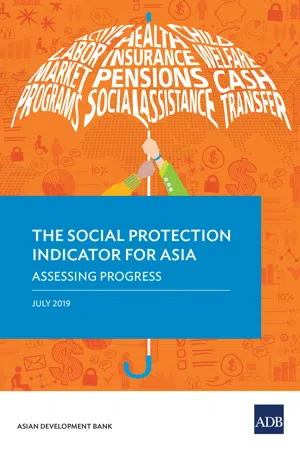
This publication provides updates on Social Protection Indicators of 24 countries in Asia, with an analysis of 2015 data on social protection programs. It shows progress in expenditure, primarily driven by social insurance and coverage between 2009 and 2015. Spending on women has improved in several countries, yet others continued to favor the nonpoor over the poor, and men over women. The Social Protection Index---now the Social Protection Indicator---was developed by the Asian Development Bank and its partners as the first comprehensive and quantitative measure of social protection systems in Asia and the Pacific.
- 120 pages
- English
- ePUB (mobile friendly)
- Available on iOS & Android
eBook - ePub
About this book
Information
Subtopic
Sozialpolitik1
Overview and Methodology
This report presents the analysis of comprehensive 2015 data on government social protection programs in 25 countries in Asia (excluding, notably, India). It uses the Social Protection Indicator (SPI) for assessing social protection within and across countries.
This report continues the effort to systematically track and assess developments in social protection. The Asian Development Bank (ADB) and its development partners originally developed its precursor—the Social Protection Index—in 2005 as a tool to monitor social protection in Asia and the Pacific. This report updates the results of a 2012 analysis for Asia published in 2016 (ADB 2016b).
Systematic and comprehensive monitoring and evaluation are essential for improving social protection systems to enhance their capacity to support the poor and vulnerable. The SPI approach offers uniform indicators that can help governments and other stakeholders assess the effectiveness of social protection systems and to track progress over time. At country level, it assesses social protection systems as well as progress. At cross-country level, it can help trace and assess patterns in social protection. This SPI monitoring helps track the progress of target 1.3 of the Sustainable Development Goals (SDGs).1
The analysis in this report is useful for two reasons. First, the report provides data on all types of government social protection initiatives, focusing on aggregate expenditure, coverage, benefit size, and poverty and gender dimensions. This enables one to assess social protection as a system by looking at social protection as a whole. The SPI thus complements existing national monitoring and evaluation tools, which tend to focus on individual programs rather than the overall system.
Second, the SPI analysis allows a focus on distinct categories of social protection activities. It provides disaggregated data on components of social protection systems and allows one to assess their relative significance. These components comprise three “categories”—social insurance, social assistance, and active labor market programs (ALMPs)—and include corresponding “programs,” like health insurance, pensions, and welfare assistance (Table 1).
Table 1: Social Protection Categories and Programs

Sources: ADB. 2011. The Revised Social Protection Index: Methodology and Handbook. Manila; ADB. 2016b. The Social Protection Indicator: Assessing Results for Asia. Manila.
This report also presents comparisons of social protection indicators for 24 countries over time between 2009 and 2015.2
Since its inception, the SPI methodology has been reviewed and revised to refine the way the indicators are constructed and used. SPI results for 2004–2005, 2009, and 2012 were published in three reports (ADB 2006, 2013, and 2016b). The analysis of 2015 data in this report follows the methodology used in the 2016 publication, and the results in both reports are compatible.
What Is the Social Protection Indicator?
The SPI is an indicator for assessing social protection effectiveness within and across countries. Going beyond measuring social protection expenditure as a share of aggregate GDP, the SPI assesses expenditure for each intended beneficiary as a share of GDP per capita. Intended beneficiary population groups are the key unit for assessing social protection effectiveness in this report—in other words, the share of the population that could qualify for benefits from a particular social protection category and program. The report distinguishes intended beneficiaries from actual beneficiaries, that is, those given support in practice. This distinction is captured by the coverage indicator, which measures the share of actual beneficiaries in the total intended beneficiary population. The SPI is a relative indicator against the average GDP per capita of each country.3
Table 2 presents the main intended beneficiary groups for each of the programs. A detailed explanation for defining and selecting the groups is in ADB (2011).
Table 2: Social Protection Programs and Intended Beneficiary Groups
Program | Group |
Health insurance | Employed population |
Health assistance | Poor population |
Unemployment insurance | Employed population |
Pensions | Population aged 60 years and above |
Welfare assistance | Poor population (living below the nationally defined poverty line, all ages) |
Child welfare | Children aged 0-14 years |
Assistance to the elderly | Older persons |
Disability benefits | Persons with disabilities |
Active labor market programs | Unemployed and underemployed |
Notes: For some countries, the actual groups differ from the Social Protection Indicator (SPI)-prescribed groups. In some instances, countries adjust the target group based on their local definition, making some of the results way above the “normal” values compared with other countries. Take pensions. The SPI elderly population comprises those aged 60 and above, but in some countries, like Bangladesh, Cambodia, and the People’s Republic of China, the pension age starts earlier. Similarly, in the Kyrgyz Republic, child welfare assistance extends up to secondary-level students, some of whom are likely to be more than 14 years old.
Source: ADB. 2011. The Revised Social Protection Index: Methodology and Handbook. Manila.
Methodology for Deriving the Indicators
Using 2015 data, this report draws on the methodology set out in ADB (2011), which provides a detailed explanation of defining and constructing the SPI and key data sources.
The information required for the analysis falls into two general categories: basic statistics and indicators; and data on social protection expenditure and on the number of socia...
Table of contents
- Cover
- Title Page
- Copyright Page
- Contents
- Tables, Figures, and Boxes
- Foreword
- Acknowledgments
- Abbreviations
- Executive Summary
- 1 Overview and Methodology
- 2 Countries’ Spending on Social Protection—General Results
- 3 Social Protection Spending by Category and Program
- 4 Coverage and Benefit Size of Social Protection
- 5 Poverty and Gender Dimensions of Social Protection Spending
- 6 Changes in Social Protection Expenditure between 2009 and 2015
- 7 Conclusions
- Appendix
- References
- Footnotes
- Back Cover
Trusted by 375,005 students
Access to over 1.5 million titles for a fair monthly price.
Study more efficiently using our study tools.
Frequently asked questions
Yes, you can cancel anytime from the Subscription tab in your account settings on the Perlego website. Your subscription will stay active until the end of your current billing period. Learn how to cancel your subscription
No, books cannot be downloaded as external files, such as PDFs, for use outside of Perlego. However, you can download books within the Perlego app for offline reading on mobile or tablet. Learn how to download books offline
Perlego offers two plans: Essential and Complete
- Essential is ideal for learners and professionals who enjoy exploring a wide range of subjects. Access the Essential Library with 800,000+ trusted titles and best-sellers across business, personal growth, and the humanities. Includes unlimited reading time and Standard Read Aloud voice.
- Complete: Perfect for advanced learners and researchers needing full, unrestricted access. Unlock 1.5M+ books across hundreds of subjects, including academic and specialized titles. The Complete Plan also includes advanced features like Premium Read Aloud and Research Assistant.
We are an online textbook subscription service, where you can get access to an entire online library for less than the price of a single book per month. With over 1.5 million books across 990+ topics, we’ve got you covered! Learn about our mission
Look out for the read-aloud symbol on your next book to see if you can listen to it. The read-aloud tool reads text aloud for you, highlighting the text as it is being read. You can pause it, speed it up and slow it down. Learn more about Read Aloud
Yes! You can use the Perlego app on both iOS and Android devices to read anytime, anywhere — even offline. Perfect for commutes or when you’re on the go.
Please note we cannot support devices running on iOS 13 and Android 7 or earlier. Learn more about using the app
Please note we cannot support devices running on iOS 13 and Android 7 or earlier. Learn more about using the app
Yes, you can access The Social Protection Indicator for Asia by in PDF and/or ePUB format, as well as other popular books in Politik & Internationale Beziehungen & Sozialpolitik. We have over 1.5 million books available in our catalogue for you to explore.