![]()
1920
![]()
UNCLE SAM’S WATER WAGON
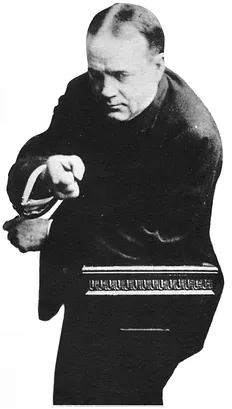
Billy Sunday (shown here on the right ), “The reign of tears is over. . .”
The Lawless Decade opened on a dreary note–unless you happened to be a Dry.
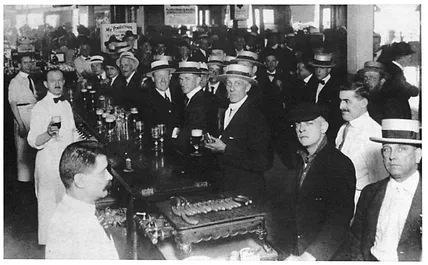
The New Year floated in on an ocean of whiskey, the last good whiskey most Americans would taste for thirteen years, but it was not a time for unconfined revelry. There was another binge in the making. The Eighteenth Amendment was going into effect at 12:01 A.M. on July 16, 1920. The more dedicated allies of the Demon Rum set aside this historic night for the “last” bender but it didn’t live up to its advance notices. There were just some maudlin scenes in the drinking emporia as men wept into their Scotch or rye and proclaimed the end of the wet and happy world they knew.
There was no weeping in the enemy camp.
In Norfolk, Virginia, the Rev. Billy Sunday presided over mock funeral services for John Barleycorn in high glee. He sent the condemned man off in a horse-drawn twenty-foot coffin and ten thousand bone-dry followers cheered his words: “Good-bye John. You were God’s worst enemy. You were Hell’s best friend . . . The reign of tears is over.”
The evangelist looked into the bright Dry future, too. “The slums soon will be only a memory,” he cried. “We will turn our prisons into factories and our jails into storehouses and corncribs. Men will walk upright now, women will smile, and the children will laugh. Hell will be forever for rent.”
The Anti-Saloon League of New York foresaw a much better America with the cork on the bottle. “Now for an era of clear thinking and clean living!” said the League. “Shake hands with Uncle Sam and board his water wagon.” In no time at all, as it happened, a great many Americans would be much too rocky on bootleg hootch to make their way aboard any kind of wagon.
The Demon Rum Indicted
“Wine is a mocker,
Strong drink is raging:
And whosoever is deceived thereby
Is not wise.”
–PROVERBS XX, 1
Drink always has been a problem–especially to the Drys. The bluenoses have traced the Poisoned Cup all the way from Noah’s Ark (can you think of a time when a man needed a shot more than that?) to Colonial America to our own vale of tears.
American Issue, a Dry organ, summed up the Puritan record very darkly: “Drink was godfather at every christening, master of ceremonies at every wedding, first aid in every accident and assistant undertaker at every funeral. It had come with the Spanish to St. Augustine in 1565. It had carried the Virginia election for John Smith in 1607. It was the ‘Dutch courage’ of Manhattan Island in 1615. It led the prayers on Plymouth Rock in 1620 . . . It was the first organized treason in the whiskey rebellion of 1791. It has been the fata morgana of many millions of immigrants to this day.”
It is sometimes said that the Puritans passed laws against almost everything a man could enjoy except liquor, but this is not so; and Virginia “outlawed” drunks in 1619, the year before the Mayflower brought all those people. That was the first liquor law in the New World. (The first all-out Prohibition went back to the ban on selling spirits to the Indians but not many palefaces observed it.) The Colonial guzzler had a nice choice of spirits–Jersey Lightning, an applejack; Strip and Go Naked or Blue Ruin, gin drinks; Kill-Devil, a rum, and some blackstrap rum-and-molasses mixtures. The stuff could knock mules down, no less mere men. Thus the Colonies became increasingly concerned about drunkenness. Governor John Winthrop of Massachusetts banned toasts in 1630, presumably because people were toasting too many things. Maryland in 1642 levied a fine of 100 pounds of tobacco on anyone caught blotto in a public place. Connecticut in 1650 limited tippling to a half hour per sitting. Maryland started putting drunkards in the stocks in 1658. New Jersey in 1668 banned all drinking after 9:00 P.M. New York in 1697 ordered all saloons closed on Sundays. New Hampshire in 1719 made it illegal to sell a drink to anyone already under the influence.
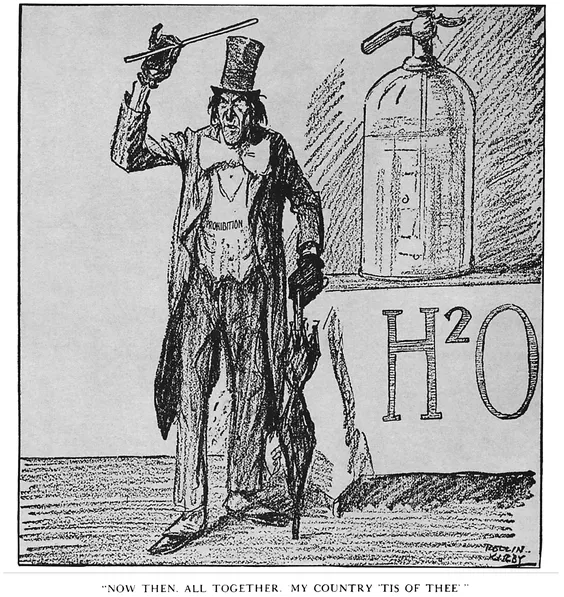
Cartoonist Rollin Kirby, in the New York World, gave the nation this lasting image of Mr. Prohibition in action. It was a devastating portrait.
The first wake for King Alcohol was held on June 30, 1919, because Wartime Prohibition–ineffective because there was no enforcement machinery until the Volstead Act was passed the following year–was going into effect the next day.
None of those laws did much good.
The American of Colonial days drank at seedtime and harvesttime and in-between. He drank to pass the time of day with a neighbor–or to pass the time of day alone. In Portland and other New England villages the town bell was sounded at 11:00 A.M. to remind him to cease his labor and have a refreshing jolt. Employers recognized the need of spirits. An advertisement in the New York Gazette of December 4,1769, offered a job to “An hostler that gets drunk no more than twelve times in a year.” Provided he came well recommended, of course.
Early-day bluenoses in Georgia managed to get a Prohibition Act on the books in 1735, but the hills ran with hootch. South Carolina rum runners and other good neighbors made up any slack the local moonshiners couldn’t fill. So Georgia’s Dry law expired in 1742.
The enemies of the bottle took heart in 1785 from a pamphlet reporting on An Inquiry into the Effect of Spirituous Liquors on the Human Mind and Body. The author was a substantial citizen–Dr. Benjamin Rush, Surgeon-General of Washington’s Continental Army–and his little essay was devastating. He found no food value (or any other value) in the hard stuff, no sir. The doctor said liquor would make a man a drunkard or something akin to an ass, a mad bull, a tiger, a hog, a he-goat–or maybe a killer. And he said it had other faults too.
The pamphlet gave such impetus to the earliest Dry movements that Dr. Rush came to be known as “The Father of Temperance Reform,” and even today the bluenoses look back on him with much longing. He was the first to furnish medical testimony against the Demon Rum. Before then (and even afterwards) some doctors prescribed a snort for practically anything that ailed a man.
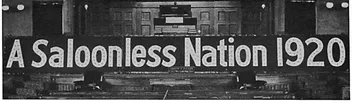
This prophetic Dry slogan–in electric lights, no less–was dedicated in a Baptist church in 1914.
“Get Away from those Swinging Doors!”
“A reformer is a guy who rides through a sewer in a glass-bottomed boat.”
–JAMES J. Walker
The first of the silver-tongued temperance orators was John Henry Willis Hawkins, a reformed alcoholic. Hawkins developed a taste for spirits in the 1830’s while apprenticed to a Baltimore hatter who dealt liquor rations to his workmen to keep them happy. This was a common practice among employers in those days.
The hatter said he reeled through fifteen years all but mad on rum but quit the habit cold one wintry day when his little daughter Hannah pleaded, “Papa, please don’t send me for whiskey today.” Hawkins said the evil of ...