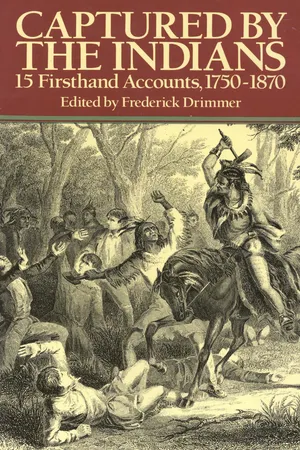
Astounding eyewitness accounts of Indian captivity by people who lived to tell the tale. Fifteen true adventures recount suffering and torture, bloody massacres, relentless pursuits, miraculous escapes, and adoption into Indian tribes. Fascinating historical record and revealing picture of Indian culture and frontier life. Introduction. Notes.
- 384 pages
- English
- ePUB (mobile friendly)
- Available on iOS & Android
eBook - ePub
About this book
Information
Topic
GeschichteSubtopic
Nordamerikanische GeschichteHo for Idaho!
FANNY KELLY
ON DECEMBER 12, 1864, escorted by eight chiefs and a band of more than a thousand Sioux warriors, Fanny Kelly rode up to the gates of Fort Sully, a small army outpost in the frozen wilderness of South Dakota. The Indians’ pretext for coming was that they were restoring the young white captive to her own people. But their true design was to use her to gain entrance to the fort and then massacre the garrison of two hundred.
No sooner had Fanny and the Indian chiefs entered the fort than the gates swung shut, locking out the horde of braves. Fanny had contrived to forewarn the soldiers of the Indians’ plot, using as her messenger a Blackfoot warrior eager to win her favor.
For two weeks the Indians camped around the fort, fretting and fuming under the noses of its well-placed cannon. They tried to persuade Fanny to visit them in their lodges, but she was not so trusting. Finally they departed, leaving presents for her. On her long journey to safety, Fanny had been severely frozen, and she was under medical treatment at the fort for two months.
One day the mail coach stopped at Fort Sully and from it stepped a familiar, well-loved figure—Josiah Kelly, Fanny’s husband. She had not seen him since that day in July when the Sioux had descended on the Kellys’ Idaho-bound wagon train, scattering and killing their party and carrying Fanny off to captivity. For months Josiah had been scouring the region in vain attempts to find and rescue Fanny.
Their dream of finding their fortune in the Far West gone, Fanny and Josiah returned to their former home in Geneva, Kansas. Then they went on to the frontier town of Ellsworth, Kansas, and opened a hotel. In 1867, Josiah died of cholera.
In 1870 Fanny appeared in Washington, to ask compensation of the government for her losses at the hands of the Indians. President Grant extended his warmest sympathies to her, and Congress awarded her five thousand dollars in recognition of her services in saving Fort Sully and Captain Fisk’s wagon train, about which she tells here.
Fanny Kelly married a second time, in 1880. She died in Washington, D.C., in 1904. Little is known of her life beyond what she reveals in this account, published in 1871. It is a harrowing, adventurous story of pioneer days and dangers, memorable for its pictures of the way the Sioux lived and battled. From its pages Fanny emerges unabashedly as a heroine—a quick-witted, courageous girl of nineteen, who must have possessed more than ordinary beauty to cause Indian chiefs to fight over her, and Jumping Bear, the Blackfoot brave, to betray his people in the hope of winning her love.
I was born in Orillia, Canada, in 1845. Our home was on the lake shore, and there, amid pleasant surroundings, I passed the happy days of early childhood.
The years 1852 to 1856 witnessed, probably, the heaviest immigration the West has ever known in an equal length of time. Those who had gone before sent back to their friends such marvelous accounts of the fertility of the soil, the rapid development of the country, and the ease with which fortunes were made, that the “Western fever” became almost epidemic. Whole towns in the Eastern States were almost depopulated.
In 1856 my father, James Wiggins, joined a colony bound for Kansas. They were favorably impressed with the country and its people, and founded the town of Geneva. Then my father returned for his family.
We had reached the Missouri River, on our way to our new home, when my father was attacked with cholera and died. In obedience to his dying instructions, my mother, with her little family, continued onward to the prairie home he had prepared for us. Here, some eight years later, I was married to Josiah S. Kelly.
My husband’s health was poor, and he decided upon a change of climate. On the 17th of May, 1864, a small train of covered wagons set out from Geneva. The party consisted of six persons—Mr. Gardner Wakefield, my husband, myself, our adopted daughter, Mary (my sister’s child), and two colored servants, Frank and Andy. We had high hopes of a romantic and delightful journey across the plains and of future prosperity among the golden hills of Idaho.
Several days after beginning our journey we were joined by Mr. Sharp, a Methodist clergyman, and then by a Mr. Taylor. A few weeks later we overtook a large wagon train of emigrants, among whom were a family we were acquainted with—Mr. Larimer and his wife and child, a boy eight years old. Preferring to travel with our small train, they became members of our party. The addition of one of my own sex to our little company was cause of much rejoicing to me, and helped relieve the dullness of the long journey.
The hours of noon and evening rest we spent in preparing our frugal meals, gathering flowers with our children, picking berries, hunting curiosities, or gazing in wonder at the beauties of the strange, bewildering country through which we passed.
We kept each Sabbath as a day of thought and rest. We had divine service performed, observing the ceremonies of prayer, preaching, and singing, which we appreciated all the more because we were far from home.
The 12th of July was a warm and oppressive day. The burning sun poured forth its hottest rays upon the great Black Hills and the vast plains of Montana.
We looked anxiously forward to the approach of evening. Our journey had been pleasant but toilsome, for we had been long weeks on the road.
Slowly our wagons wound through the timber that skirted the Little Box Elder and, crossing the stream, we ascended the opposite bank.
We had no thought of danger or misgivings on the subject of savages.
At the outposts and ranches we had been told repeatedly that the Indians would not molest us. At Fort Laramie, where information that should have been reliable was given us, we had renewed assurances of the safety of the road and friendliness of the Indians. Being persuaded that fears were groundless, our small company preferred to travel alone on account of the greater progress we made that way.
The beauty of the sunset and the scenery around us filled our hearts with joy. Mr. Wakefield’s voice was loud and strong as he sang, “Ho for Idaho!” Little Mary’s low sweet voice, too, joined in the chorus. She was happy that day, as she always was. She was the star and joy of our whole party.
Without a sound of preparation or a word of warning, the bluffs before us were covered with a party of about two hundred and fifty Indians, painted and equipped for war, who uttered their wild war whoop and fired a signal volley of guns and revolvers into the air.
We had no time to think before the main body halted and sent out a part of their force, which circled round us at regular intervals, some distance from our wagons.
Recovering from the shock our men instantly decided to resist and corralled the wagons. My husband was looked upon as leader, as he was principal owner of the train. We were just a handful, but he was ready to stand his ground.
With all the power I could command, I begged him not to fight but to attempt to make peace with the Indians. “They seem to outnumber us ten to one,” I said. “If you fire one shot, they will massacre all of us.”
Love for the trembling little girl at my side, my husband, and friends made me strong to protest against anything that would lessen our chance to escape with our lives. Poor little Mary! From the first she had entertained an ungovernable dread of the Indians. In our dealings with friendly savages, I had tried to show how unfounded it was, and persuade her they were harmless, but all in vain. Mr. Kelly bought her beads and many little presents from them which she much admired, but she would always add, “They look so cross at me, and they have knives and tomahawks, and I fear they will kill me.”
My husband advanced to meet the chief and demand his intentions.
The savage leader immediately came toward him, riding forward and uttering the words “How! how!”
His name was Ottawa, and he was a war chief of the Ogallala band of the Sioux nation.1 He struck himself on his breast, saying, “Good Indian, me.” He pointed to those around him. “Heap good Indian, hunt buffalo and deer.”
He assured us of his utmost friendship for the white people. Then he shook hands and his band followed his example, crowding around our wagons, shaking us all by the hand over and over again until our arms ached. They grinned and nodded with every demonstration of good will.
Our only safety seemed to be in delay, in hope of assistance approaching. To gain time, we allowed them to do whatever they fancied.
First, they said they would like to change one of their horses for the one Mr. Kelly was riding, a favorite race horse. Very much against his will, he gave in to their request.
My husband came to me with words of cheer and hope, but oh! what a marked look of despair was upon his face—a look such as I had never seen before.
The Indians asked for flour, and we gave them what they wanted. The flour they emptied upon the ground, saving only the sack. They talked to us partly by signs and partly in broken English. As we were anxious to suit ourselves to their whims and keep things friendly as long as possible, we allowed them to take whatever they desired, and offered them many presents besides.
It was, I have said, extremely warm weather, but the Indians remarked that the cold made it necessary for them to look for clothing, and begged for some from our stock. We gave it to them without the slightest objection. I, in a careless-like manner, said they must give me some moccasins for some articles of clothing that I had just handed them. Very pleasantly a young Indian gave me a nice pair, richly embroidered with different-colored beads.
Our anxiety to stay on good terms with them increased every instant. The hope of help arriving from some quarter grew stronger as the moments passed. Unfortunately, it was our only one.
The Indians grew bolder and more insolent in their advances. One of them laid hold of my husband’s gun. Repulsed, he gave up.
The chief at last told us to proceed on our way, promising that we should not be molested. We obeyed, without trusting them.
Soon the wagon train was again in motion. The Indians insisted on driving our herd and grew ominously familiar. My husband called a halt. He saw that we were approaching a rocky glen, in whose gloomy depths he anticipated a murderous attack. Our enemies urged us forward, but we resolutely refused to stir. Finally they asked us to prepare supper. They said they would share it with us and then go to the hills to sleep. The men of our party concluded it would be best to give them a feast.
Each man was soon busy preparing the supper. Mr. Larimer and Frank were making the fire. Mr. Wakefield was getting provisions out of the wagon. Mr. Taylor was attending to his team, Mr. Kelly and Andy were out some distance gathering wood, and Mr. Sharp was distributing sugar among the Indians. Then, suddenly, our terrible enemies threw off their masks and displayed their true natures.
There was a simultaneous discharge of arms. When the cloud of smoke cleared away, I could see the retreating form of Mr. Larimer and the slow motion of poor Mr. Wakefield, for he was mortally wounded.
Mr. Sharp was killed within a few feet of me. Mr. Taylor—I can never forget his face as I saw him shot through the forehead with a rifle ball. He looked at me as he fell backward to the ground. I was the last object that met his dying gaze. Our poor faithful Frank fell at my feet pierced by many arrows. I recall the scene with a sickening horror. I could not see my husband anywhere and did not know his fate. Actually, he and Andy made a miraculous escape but I did not learn this until long afterward.
I had but little time for thought, for the Indians quickly sprang into our wagons, tearing off covers, crushing, and smashing everything that stood between them and their plunder. They broke open locks, trunks, and boxes, and distributed or destroyed our goods with great rapidity, using their tomahawks to pry open boxes, which they split up in savage recklessness.
They filled the air with fearful war whoops and hideous shouts. I knew that an indiscreet act on my part might jeopardize our lives. I felt certain that we two women would share death by their hands, but, with as much of an air of indifference as I could command, I kept still, hoping to prolong our lives even if only a few minutes.
I was not allowed this quiet but a moment. With tomahawks in their hands, two of the most savage-looking of the party rushed up into my wagon and seized me. They pulled me violently to the ground, almost breaking my arms and legs. My little Mary, with outstretched hands, was standing in the wagon. I took her in my arms and helped her to the ground.
I turned to the chief, put my hand upon his arm, and implored his protection for my fellow-prisoner and our children. At first he seemed utterly indifferent. Partly in words and partly by signs, he ordered me to remain quiet, placing his hand upon the revolver in his belt as an argument to enforce obedience.
A short distance in the rear of our train a wagon was in sight. The chief immediately dispatched a detachment of his band to capture or to cut it off from us. They rode furiously in pursuit of the small party, which consisted only of one family and a man who rode in advance of the single wagon.
The horseman was almost instantly surrounded and killed by a volley of arrows. The man in the wagon quickly turned his team around and, starting them at full speed, gave the whip and lines to the woman, who held a young child close in her arms. He then went to the back end of his wagon and threw out boxes, trunks, everything that he possessed. His wife meantime gave all her mind and strength to urging the horses forward.
The Indians had by this time come very near. They riddled the wagon cover with bullets and arrows. But the man kept them at bay with his revolver, and finally they left him and rode furiously back to our wagon train.
I was led a short distance from the wagon with Mary and told to remain quiet. I tried to obey. A terrible yearning sprang up in my heart to escape, as I hoped my husband had done. But many watchful eyes were upon me. I realized that any effort then at escape would result in failure, and probably cause the death of all the prisoners.
Mrs. Larimer, with her boy, came to us, trembling with fear. “The men have all escaped and left us to the mercy of the savages.”
“I do hope they have. What benefit would it be to us to have them here? They would be killed, and then all hope of rescue for us would be at an end.”
Her agitation was extreme. Her grief seemed to reach its climax when she saw the Indians destroying her property. It consisted principally of articles belonging to the art of daguerreotype photography. She had indulged in high hopes of fortune from practicing this art among the mining towns of Idaho. As she saw her chemicals, picture cases, and other property being destroyed, she uttered a wild, despairing cry. It brought the chief of the band to us. With gleaming knife, he threatened to end all her further troubles in this world.
My own agony was no less than hers. But the loss of my worldly possessions—a large herd of cattl...
Table of contents
- Cover
- Title Page
- Copyright Page
- Dedication
- Contents
- INTRODUCTION: Captured by the Indians
- Prisoner of the Caughnawagas: JAMES SMITH
- Death in the Snow: THOMAS BROWN
- Massacre at Michilimackinac: ALEXANDER HENRY
- An Inch of Ground to Fight On: MOSES VAN CAMPEN
- That Is Your Great Captain: JOHN KNIGHT
- To Eat Fire Tomorrow: JOHN SLOVER
- White Indian: JOHN TANNER
- Three Came Back: CHARLES JOHNSTON
- The Headhunters of Nootka: JOHN RODGERS JEWITT
- Remember the River Raisin!: ELIAS DARNELL
- Ambush: RANSOM CLARK
- The Attack on the Lighthouse: JOHN W. B. THOMPSON
- Three Years Among the Comanches: NELSON LEE
- Revolt of the Sioux: LAVINA EASTLICK
- Ho for Idaho!: FANNY KELLY
- NOTES
Trusted by 375,005 students
Access to over 1.5 million titles for a fair monthly price.
Study more efficiently using our study tools.
Frequently asked questions
Yes, you can cancel anytime from the Subscription tab in your account settings on the Perlego website. Your subscription will stay active until the end of your current billing period. Learn how to cancel your subscription
No, books cannot be downloaded as external files, such as PDFs, for use outside of Perlego. However, you can download books within the Perlego app for offline reading on mobile or tablet. Learn how to download books offline
Perlego offers two plans: Essential and Complete
- Essential is ideal for learners and professionals who enjoy exploring a wide range of subjects. Access the Essential Library with 800,000+ trusted titles and best-sellers across business, personal growth, and the humanities. Includes unlimited reading time and Standard Read Aloud voice.
- Complete: Perfect for advanced learners and researchers needing full, unrestricted access. Unlock 1.5M+ books across hundreds of subjects, including academic and specialized titles. The Complete Plan also includes advanced features like Premium Read Aloud and Research Assistant.
We are an online textbook subscription service, where you can get access to an entire online library for less than the price of a single book per month. With over 1.5 million books across 990+ topics, we’ve got you covered! Learn about our mission
Look out for the read-aloud symbol on your next book to see if you can listen to it. The read-aloud tool reads text aloud for you, highlighting the text as it is being read. You can pause it, speed it up and slow it down. Learn more about Read Aloud
Yes! You can use the Perlego app on both iOS and Android devices to read anytime, anywhere — even offline. Perfect for commutes or when you’re on the go.
Please note we cannot support devices running on iOS 13 and Android 7 or earlier. Learn more about using the app
Please note we cannot support devices running on iOS 13 and Android 7 or earlier. Learn more about using the app
Yes, you can access Captured by the Indians by Frederick Drimmer in PDF and/or ePUB format, as well as other popular books in Geschichte & Nordamerikanische Geschichte. We have over 1.5 million books available in our catalogue for you to explore.