![]()
◊ Part 1 ◊
WHY ADULTHOOD
CAN MAKE US
ANXIOUS
Part 1 is an introduction to anxiety in adulthood and dealing with not knowing. Chapter 1 has thoughts and reflections on what is tough about adulthood (including stories from people who have been through it) and how different coping styles and ways of relating to other people might affect how you cope with the challenges of adulthood. In Chapter 2, we then think about some practical ways that you can cope with the inevitable “not knowing” when you are facing lots of changes and decisions.
![]()
◊ Chapter 1 ◊
What’s So Hard About
Being an Adult?
So, we hope that you’ve chosen this book because you want to learn how to manage the challenges of adulthood and the anxieties that often come along with it. When we talk about entering adulthood, or “new” adults, we are usually talking about people aged 18–25 years, although Sue and Bridie are still trying to convince people that they fall into this group!
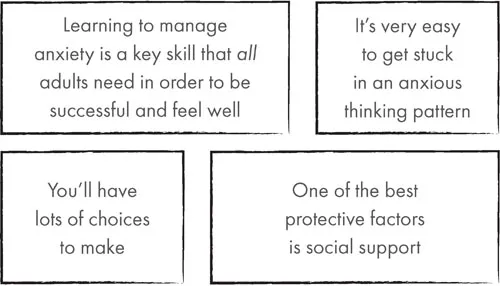
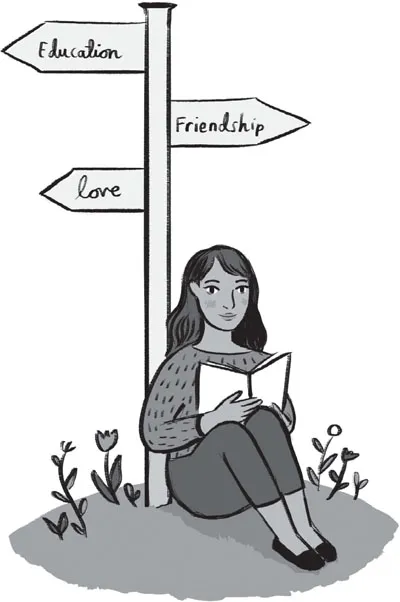
We wanted to write this book because, depending on where you live and exactly how old you are, you’ll have lots of choices to make. These might be deciding whether to live at home or move out, to stay in education or to get a job, as well as decisions about romantic relationships and friendship groups. You’ll also be facing some new responsibilities like paying bills, food shopping, or maybe caring for family members. For lots of people, this can be stressful and can cause a lot of anxiety.
Perhaps you’re not ready to make decisions at the moment or perhaps you’re just desperately trying to get through each day. Changes and feeling overwhelmed by life’s demands are common triggers for problem anxiety and so, understandably, making the transition into adulthood can be a tricky time. People who, in the past, have felt confident and haven’t struggled with anxiety before might begin to experience difficulties as the demands of adult life outstrip their ability to cope. Alternatively, you might have a history of anxiety and need some extra help to think about how to cope with the new challenges you are likely to face over the next few years.
What you will find in this book
You are likely to dip in and out of this book depending on where you are in your life and the things that are causing you to feel anxious or stressed out. This quick overview can help you to navigate around it and find what you need.
Part 1 is an introduction to anxiety in adulthood and dealing with not knowing. The chapter you are reading, right now, has thoughts and reflections on what is tough about adulthood (including stories from people who have been through it) and how different coping styles and ways of being with other people might affect how you cope with the challenges it presents. In Chapter 2, “Dealing With All The Stuff You Can’t Possibly Know”, we then think about some practical ways that you can cope with the inevitable “not knowing” when you are facing lots of changes and decisions.
In Part 2, we go on to think through some of the stuff that might be more difficult if you suffer with anxiety, such as socialising, or that might be the cause of lots of stress and anxiety even if you are really confident, like job interviews and tricky work situations. We spoke to lots of young people as we wrote this book, and this confirmed what we already suspected: that one of the biggest challenges in early adulthood is making friends and socialising. So, we made this our focus for the first chapter in Part 2, “Getting Out and Socialising With Other Adults”, where we explore social awkwardness and anxiety and talk through some top tips taken from the 18–25-year-olds who took part in our survey.
The next chapter, “What Can I Do With Anxious Thoughts?”, also focuses on social situations; however, the ideas used here can help you to manage anxious thoughts about anything! We know that anxiety can interfere with your ability to study effectively and that studying as an adult is different from studying when you are at school. In Chapter 5, therefore, we think about how anxiety might impact on your learning and we give lots of practical strategies to help you study and revise, whether it is for college, university or professional qualifications. Included in this chapter, “I Can’t Focus! How to Study With Anxiety”, is advice from a lecturer and course tutor who has been supporting students for a number of years. Studying at university or college can often mean that people move out of home at 18, so Chapter 6 is a quick guide to transitions and endings more generally, and how to deal with them. It focuses on the specifics of leaving home and moving out – “What About Moving Out?”.
One of the most anxiety-provoking things most people do is going for a job interview. In Chapter 7, “Surviving (and Thriving) in Job Interviews”, there are lots of tips for managing anxiety in an interview and also some advice from professionals who are on the other side of the table.
Now you may already have a job, but this does not mean that all the stress is over, so we also have Chapter 8, “Workplace Worries”, to think about practical ways to manage stress and anxiety at work.
Part 3 aims to give some practical advice that relates directly to the problems that anxiety can cause and the skills that you need in order to make sure anxiety doesn’t take over your life or stop you doing what you need to do.
Chapters 9, “A Quick Guide to Panic Attacks”, and 10, “A Little Bit OCD”, are introductions to these specific kinds of anxiety, offering some coping strategies but focusing on building understanding and reassuring you that you are not alone. While knowledge and reassurance can be helpful, we also point you to some good resources for more specific help and interventions if this is what’s needed. We chose to include panic and OCD as sufferers felt that they are issues that may be more stigmatised or poorly understood.
Chapter 11, “How Do I Stay Calm and Healthy in a Stressful World?”, covers a lot of practical information and advice, from getting a good night’s sleep to improving the moment, and positive coping statements to thinking about the role of alcohol and drugs. We believe strongly that getting your self-care right is key to managing stress and anxiety and that we do not always learn the skills we need to stay calm and healthy at school or from adults around us growing up, so this is a chapter everyone should read.
Similarly, Chapter 12, “What Is This Mindfulness All About?”, is helpful for anyone. There is increasing evidence that mindfulness – the ability to be present in the moment – is a skill that can help you stay calm and healthy and is especially useful when anxiety is taking over and making life difficult. Chapter 12 has lots of ideas for how you can introduce mindfulness into your daily life and how it can help to calm your mind. In Chapter 13, “Where Can I Get Some Extra Help?”, we think about how you might talk to people about anxiety and other sources of support and advice.
Adulthood: the challenges
When we were writing a book for teenagers with anxiety (My Anxiety Handbook: Getting Back on Track) we realised that things can be especially difficult for people as they move from being a teenager to becoming an adult. As an adult, you might no longer have to worry about curfews or homework, but you are likely to be facing new responsibilities and situations and there will be an increased expectation from others (and maybe yourself) to cope alone. A recent survey carried out by the Samaritans found that 40 per cent of 16–24-year-olds sometimes feel overwhelmed by their problems, but that over half feel there is significant stigma attached to talking about their feelings, so are more likely to pretend that they are coping in order to not be seen as “weird”. A big survey about loneliness in the UK, done by the BBC, also showed that 16–24-year-olds reported feeling lonely more frequently and with more intensity than any other age group. We know that the current generation of young people in the UK (“Millennials”), are going to be the first generation who are financially worse off than their parents. The media constantly highlights how stressful it is: young people pay high tuition fees, high rent costs and cannot afford to buy a house. The constant pressure of making comparisons with friends and celebrities through social media doesn’t help either. The idea that one day you’ll wake up and because you have reached some arbitrary milestone you’re an adult is part of the problem. In the eyes of the law, someone magically becomes an adult on their 16th, 18th or 21st birthday, but actually becoming a grown-up takes quite a long time and a lot more effort than this idea gives us all credit for.
This book will help you to navigate through the transitions of adulthood while also learning how to manage the anxiety that comes with it. Learning to manage anxiety is a key skill that all adults need in order to be successful and feel well. Anxiety is likely to be a problem at some stage for lots of people, with around one in five adults having anxiety that causes them significant problems at some point in their lives.
Competing goals and responsibilities
As children and teenagers, we often long for the day when we are no longer beholden to the expectations of the adults around us, whether they be parents, carers or teachers. Adulthood sounds glorious, as we can “do whatever we like”. But what do you like? What do you want to do in life? How do you keep friendships when your lives might suddenly look very different? Who are you going to live with and spend time with when you’re not at work, college or university? What part do your parents and brothers/sisters play in your life if you no longer live together, or even if you do? These are big questions and the competing demands of earning money, pursuing career goals and often living independently or contributing more to the household can feel overwhelming. Just having lots of choices can lead to anxiety, never mind making decisions about them! As an adult, there are often fewer rules and people keeping you in check; as the expectation to “cope alone” increases, you can come to rely on less helpful ways to manage your anxiety – such as trying to ignore it, drinking alcohol or avoiding things that make you anxious.
Separation and loss
This might seem like a depressing heading; however, alongside the exciting challenges that adulthood presents, we also must manage separation and loss. The process of becoming an adult involves separating from our family and finding our own place in the world, and there’s a greater focus on our friends and on our ability to manage within the wider community. Our childhood experiences of separation and loss are likely to have a significant impact on how we manage this and what coping strategies we use when things start to get tough and anxiety makes its presence felt. Separation from your parents and family might feel irrelevant to you at this point as you already feel independent and separate or, alternatively, perhaps you’re shaking your head at the idea that you will ever be anything other than inseparable from your parent or carer. You might not have felt part of a family growing up as you were apart from your family, maybe within the care system, and it could be separation from other carers and supportive organisations that you’re struggling with. It may be that you feel very little will change as you continue to rely solely on yourself as you always have or you continue to live with your family well into adult life.
You might have felt you didn’t need anyone else, you’ve coped alone, and just “got on with life” in the face of difficult ...