- English
- ePUB (mobile friendly)
- Available on iOS & Android
eBook - ePub
About this book
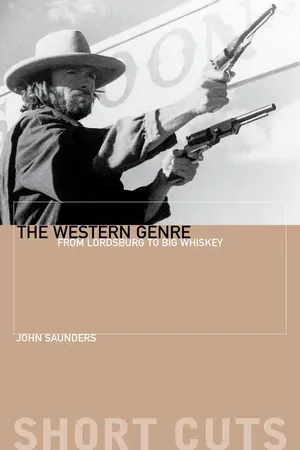
The Western Genre: From Lordsburg to Big Whiskey offers close readings of the definitive American film movement as represented by such leading exponents as John Ford, Howard Hawks, and Sam Peckinpah. In his consideration of such iconic motifs as the Outlaw Hero and the Lone Rider, John Saunders traces the development of perennial aspects of the genre, its continuity and, importantly, its change. Representations of morality and masculinity are also foregrounded in consideration of the genre's major stars John Wayne and Clint Eastwood, and such films as Shane, Rio Bravo, The Wild Bunch, and Unforgiven.
Information
Subtopic
Film & Video1 READING A WESTERN
Given the difficulties of separating the genre as concept from its actual existence in individual films we shall take an example which sets out to distil this elusive essence. Shane (1953) is often remembered as the archetypal western, a self-conscious attempt to reproduce the familiar themes and characters in a classically pure state. For our purposes it may be an advantage that the director, George Stevens, had no particular track record in westerns, nor indeed many claims to be considered more than a highly respected craftsman, expert at producing a good return for the studio’s investment. Shane was to prove the most commercially successful western of the decade. As such it qualifies for Will Wright’s attentions as an example of the ‘classical’ plot (1975: 33), and unsurprisingly, since the model is derived in large part from Stevens’ film, it fits its list of functions with some precision, thus offering an opportunity to test the validity of his thesis.
In its construction and techniques the film is an example of the so-called classical Hollywood style (see Bordwell, Staiger & Thompson 1985) – as indeed are the majority of western films – a style to which Stevens remained faithful until his last picture in 1969. The distinction between auteur and mere metteur en scène can never be absolute, and no doubt detailed study of his output would reveal consistent traits and preferences, but the voice of the genre should be more clearly audible when encountered in a relatively unmarked form.
Even the star of the picture, Alan Ladd, had made his name in other genres, and his good looks (‘like a young Greek god’ (Linet 1979: 31), as he seemed to Sue Lyon, his agent and later his wife) were not of the rugged kind the part might seem to require. Although Ladd was still coming second in popularity only to John Wayne in the fan magazines, Paramount were beginning to doubt his ability to recoup the kind of money they were spending on Shane, and his ten-year association with the studio was about to end. In retrospect it is difficult not to read something of the melancholy of his later decline (ending in death from drink and barbiturates) in his portrayal of the gunfighter who has lived too long and knows it.
A. B. Guthrie Jr’s screenplay was based on the novel of the same name by Jack Schaefer, published in 1949, often using the dialogue verbatim. However, the changes he makes repay attention. Some of them are consequent on the different medium, so that the first-person narrative of the character who becomes Joey in the film gives way to a more objective viewpoint, but even so we see events through his eyes and the camera angles ensure that, like him, we look up to Shane much of the time. Schaefer’s novel is expanded to include scenes so often central to the genre - most notably the funeral of the character who becomes Torrey, dismissed in a couple of paragraphs but which on film becomes an extended homage to John Ford.
It has been calculated that in the period 1928–60 Hollywood films usually consisted of between 14 and 35 sequences, running from two to five minutes and averaging between 12 and 30 shots (see Bordwell, Staiger & Thompson 1985). Shane, in fact, has an unusually high number of separate shots, averaging 720 per hour, but in other respects is structured conventionally. We might divide the 118 minutes of the film into 16 sequences, roughly corresponding to the 16 chapters of Schaefer’s novel.
Shane’s arrival
The duration of the action coincides with the hero’s presence, and so it begins with his arrival. ‘He rode into our valley in the summer of ‘89’, in the opening words of the novel. As the titles appear, we find ourselves looking over the shoulder of a rider, half in silhouette, as he comes down from the mountains into the frame. From the earliest days landscape has been one of the most expressive codes available to the genre, and the association of high mountains with lofty feelings and moral elevation was deeply rooted, long before the west was won. Effects of scale and perspective work both to suggest the subservience of the merely human to some larger, more permanent order and to endow the figures in the landscape with comparable stature and impressiveness. Memorable examples include the settings of several of Ford’s westerns in Monument Valley, Utah, where the gigantic sandstone bluffs, often sharing the frame with John Wayne’s equally craggy persona, create a truly monumental effect.
We cut to a pastoral scene, a buck drinking from a sheet of water, the snow-capped mountains behind rising through fleecy white cloud into a brilliant blue sky. The farmhouse, its chimney gently smoking, blends with the landscape. The next shot reveals a boy stalking the buck, a close-up of the animal succeeded by another of the boy, his shining blond hair fringed with leaves, an image of innocent freedom. Only those immune to the charms of young children in films could deny that the nine-year-old Brandon De Wilde gives a remarkable performance. In the New York Times, it was his debut that was singled out, a tribute no doubt to Stevens’ sympathetic direction.
As the distant rider moves along the far bank of the river, the buck raises its head to frame him between its antlers, a shot which encapsulates the elaborately, even excessively, composed style of the film. The deer splashes off as the boy runs to warn his father, chopping wood in front of the house, and we recognise the strong yet agreeable features of Van Heflin. ‘Let him come,’ is his response to the boy, expressing the patient fortitude which marks his character. Our first close-up of the stranger reveals Alan Ladd, leaning forward slightly, the pose of one of the best known of his publicity shots. He has been called an actor with only one expression, and this is it, but as George Stevens is reported to have said: ‘Show me an actor with one good expression and I’ll be happy’ (Linet 1979: 150). It is not the face in the novel, ‘lean and hard’, nor is this the costume, ‘dark … of some serge material, patched and faded and topped with a soft black Stetson’. Yet Ladd’s buckskins, fresh from the wardrobe department, do have the ‘kind of magnificence’ remembered by Schaefer’s narrator.
As the dialogue begins, the music - which has unobtrusively guided us so far - fades out. Provided by Victor Young, it is typical of the genre, scored for full orchestra in a mainstream late-nineteenth-century manner, with the sound painting developed for ballet and opera, often drawing on folk tunes and popular song and incorporating ethnic instruments such as the guitar and harmonica. Here it is a gentle, expansive theme, giving way to the mingled sounds of animals and a strange crooning which we eventually discover comes from the house, where a figure passing the window proves to be Marian (Jean Arthur), the farmer’s wife.
The roles allotted to women in the western are painfully circumscribed, and it is fitting that we should meet her indoors, the ‘Angel of the House’, leaving the outside world to men and their doings. The flowers on the sill and the curtains at the window testify to her aspirations to a finer life, and in this case a civilising function so insistent that it risks alienating our sympathy. She seems to hunt down her son’s lapses almost as relentlessly as Miss Watson pursues the errant Huck (‘Mr Shane, Joey’). The relationship between Joe Starrett and his wife involves both dominance and deference – ‘you heard what my little woman said’ – although ultimately, as the audience expects, the decisions are his. Indeed, the rare films which show women in stronger roles, such as Nicholas Ray’s Johnny Guitar (1954), where Joan Crawford and Mercedes McCambridge leave tough characters like Sterling Hayden and Ward Bond repeatedly nonplussed, risk being dismissed as frankly ludicrous, somehow not really westerns.
The newcomer singles out the boy in words from Schaefer’s original (‘You know I like a man who watches things going on around. It means he’ll make his mark some day’), indicating his own watchfulness and the habit of homespun philosophical reflection typical of the western hero, who is never simply a man of action. After further dialogue, with Starrett’s hospitality conveyed by the proffered dipper of water, Joey cocks the rifle with which he had stalked the deer and Shane whirls round, reaching for his gun. The momentary unease is dispelled by Marian speaking softly, if chidingly, to her son, and he comes forward, offering to show the rifle, the kind of simple but disarming gesture so telling in the cinema, and Shane, preparing to mount up, modestly admits that he can shoot ‘a little bit’.
So far we have watched about five minutes screen time, involving some sixty separate shots, and a full analysis would have to mention those details common to the language of the Hollywood film whatever the subject, and which could generally be left to the editor. One example is the decision to cut from Shane dismounting to Joey jumping down from the fence, the visual here collaborating with the continuous music, helping to create the seamless flow which preserves the narrative illusion.
The conflict explained – the threat from the Rykers
Voices calling offscreen – a recurrent feature of the film – and a descending chromatic figure from the horns signal a change of mood and an increase in tension, as Starrett steps forward to take the rifle from his son. ‘Looks like your friends are a little late,’ he says, as a bunch of horsemen appear in the middle distance. The Ryker boys come over the river, the camera lingering on the horses’ hooves ploughing up the mud and trampling the kitchen garden, emblematic of their casual destructiveness. Two of them speak – Morgan, then the older brother, Rufe – to explain their business: a new beef contract means that they need the land where Starrett has staked his claim. The stage is set for a version of Grüber’s ‘Ranch story’, one of his seven basic plots.
As voices are raised, Marian comes out of the house to join her husband and son. Rather surprisingly, she is wearing trousers, an assertion of independence perhaps, but it is tempting to read it as evidence that the domestic routine with her husband involves some repression of her natural sexuality (which, in 1953 was conventionally expressed by overtly feminine dress). Even so, with their backs to the wall they constitute the American family, united against outsiders, and it might be suggested that the names Joseph and Marian hint at a still more archetypal family. At this point Shane, last seen preparing to leave, steps from behind the cabin to take their side.
Shane accepted – the meal and the tree stump
The transition from stranger to friend occurs less dramatically in the book, where Shane intervenes to prevent Starrett being cheated over the purchase of a cultivator. It could be that the price of an agricultural implement lacked the necessary iconic power; in any case, the introduction of the Rykers gives the threat to the homesteaders a more concrete force.
After apologising for his earlier suspicions, and opening the breech of the rifle to show that it was in fact empty (another ritual gesture of submission, and for determined seekers for the sexual sub-text even a confession of impotence), at Starrett’s wife’s prompting Shane is invited to dinner and introductions are made. ‘Call me Shane’ – thus we learn the stranger’s name. Over the meal Starrett’s talk of farming leaves Shane visibly inattentive, while Joey cannot take his eyes off the gun hanging over the back of the guest’s chair.
As repayment for their hospitality, Shane takes an axe to the recalcitrant tree stump with which Starrett was struggling in the opening sequence, and is joined by his host, an important scene in the novel occupying the best part of two chapters. In a thoughtful essay on differences between book and film, James K. Folsom notes the novelist’s advantages in conveying the symbolic values which, on celluloid, emerge as ‘merely two men prosaically sweating and tugging at a large stump in a field’ (Pilkington & Graham 1979: 71). It is true that the filming of the scene, using accelerated montage cutting on each stroke of the axes to a vigorous fugal figure on the soundtrack, is a little conventional. Ladd, always in danger of being overshadowed by the bulk of Heflin – although the novel does call for a contrast between ‘lithe power’ and ‘sheer strength’ – takes his shirt off, unlike the other man, to give us the full benefit of his musculature.
Marian, in line with woman’s dual function as both an invitation to idealisation in others and the voice of realism in herself, suggests they hitch up the team, but as any student of the genre could tell her – and as Starrett does – ‘sometimes there ain’t nothing’ll do but your own sweat and muscle’.
Shane and Joey in the morning – setting out for Grafton’s
We dissolve to Joey asleep, inter-cut with the buck of the previous day, feeding in the garden. Although the presentation of photogenic children and animals may call for no justification, something more is going on here. Through their contiguity in the opening scene, and through his buckskin shirt, we associate Shane and the animal; both shy visitors from the wild. Yet as its hooves tangle with the strings protecting Marian’s vegetables we make the connection with the threatening Rykers of the day before.
As roosters crow and what we come to recognise as the ‘Shane theme’ surfaces on the soundtrack, Joey discovers their guest walking in the barn. The next scene shows that Shane has agreed to help out and we see him leaving for town with the wagon to pick up some fence wire and some ‘sure-enough work clothes’, leaving his gun behind. In the novel Shane only puts on his gun for the final showdown; until then it remains in his blanket roll, an emblem of concealed violence. In the film it has to be visible for his intervention with the Rykers in the second sequence and because, as Joey says, it ‘goes with him’: the western hero is essentially a man with a gun. The conversation between father and son finds Joey still fascinated by the weapon and introduces the choice between alternative models of masculinity. This is a central theme of both novel and film. Joan Mellen finds the whole sequence embarrassing since it ‘rabidly endorses’ violent criteria of manhood (1978: 22) but this is to pre-judge the issue. It is true of course that Starrett’s own qualities are inseparable from physical courage, nor can one imagine even the most revisionist western seeing it differently. John Ford’s The Man Who Shot Liberty Valance (1962) – which raises the issue more explicitly than most – shows that although James Stewart’s Rance Stoddard may be no expert with a gun he can throw a good punch, and it is this, rather than his law books, which wins him respect.
The sequence ends with the arrival of another homesteader, Ernie Wright, and more evidence of the Rykers’ attempts to force them all to pull out. In an effort to rally the others, Starrett calls for a meeting at his farm that night.
Soda pop and the confrontation with Chris
A dissolve takes us to Shane’s arrival in front of Grafton’s store, with a background of imposing mountain scenery and apprehension in the musical score, with the muted ‘Ryker’ horn calls. Shane’s purchase of new work clothes leaves him ‘kind of pale’ at the two dollars two cents they cost, and his arrival attracts the attention of Chris Calloway (Ben Johnson) who is playing cards with more of Ryker’s men in the adjoining barroom. The ‘new sod-buster’ provokes the predictable taunts, although a brief shot of Chris watching appreciatively, but not disrespectfully, as Lewis’ daughter tries on a new hat has already hinted that he may not be as bad as the part he is playing. When Shane enters the bar to collect the soda pop he had promised Joey, there is general laughter, followed by an open challenge as Chris throws a glass of whiskey over the new blue shirt.
At this point in the novel we read that ‘every line of his body was taut as stretched whipcord, was alive and somehow rich with an immense eagerness’, but none of this is visible in Ladd’s impassive features. What tension the scene has is situational; Shane’s face expressing neither fear nor any effort of self-control, almost as if he has put off violence with his buckskins. The store clothes, which retain their newness for the rest of the film, separate him from his past without allowing him to merge with his n...
Table of contents
- Cover
- Series List
- Title Page
- Copyright
- Contents
- Dedication
- introduction
- 1. reading a western
- 2. the established classics
- 3. development and change: three films about jesse james
- 4. new directions
- 5. the indians
- 6. breaking the mould
- filmography
- bibliography
Trusted by 375,005 students
Access to over 1.5 million titles for a fair monthly price.
Study more efficiently using our study tools.
Frequently asked questions
Yes, you can cancel anytime from the Subscription tab in your account settings on the Perlego website. Your subscription will stay active until the end of your current billing period. Learn how to cancel your subscription
No, books cannot be downloaded as external files, such as PDFs, for use outside of Perlego. However, you can download books within the Perlego app for offline reading on mobile or tablet. Learn how to download books offline
Perlego offers two plans: Essential and Complete
- Essential is ideal for learners and professionals who enjoy exploring a wide range of subjects. Access the Essential Library with 800,000+ trusted titles and best-sellers across business, personal growth, and the humanities. Includes unlimited reading time and Standard Read Aloud voice.
- Complete: Perfect for advanced learners and researchers needing full, unrestricted access. Unlock 1.5M+ books across hundreds of subjects, including academic and specialized titles. The Complete Plan also includes advanced features like Premium Read Aloud and Research Assistant.
We are an online textbook subscription service, where you can get access to an entire online library for less than the price of a single book per month. With over 1.5 million books across 990+ topics, we’ve got you covered! Learn about our mission
Look out for the read-aloud symbol on your next book to see if you can listen to it. The read-aloud tool reads text aloud for you, highlighting the text as it is being read. You can pause it, speed it up and slow it down. Learn more about Read Aloud
Yes! You can use the Perlego app on both iOS and Android devices to read anytime, anywhere — even offline. Perfect for commutes or when you’re on the go.
Please note we cannot support devices running on iOS 13 and Android 7 or earlier. Learn more about using the app
Please note we cannot support devices running on iOS 13 and Android 7 or earlier. Learn more about using the app
Yes, you can access The Western Genre by John Saunders in PDF and/or ePUB format, as well as other popular books in Media & Performing Arts & Film & Video. We have over 1.5 million books available in our catalogue for you to explore.