A look at a prize-winning documentarian whose work with aboriginal Australians and others united the fields of film and anthropology in the 1960s and '70s.
In
Roger Sandall's Films and Contemporary Anthropology, Lorraine Mortimer argues that while social anthropology and documentary film share historic roots and goals, particularly on the continent of Australia, their trajectories have tended to remain separate. This book reunites film and anthropology through the works of Roger Sandall, a New Zealand–born filmmaker and Columbia University graduate, who was part of the vibrant avant-garde and social documentary film culture in New York in the 1960s.
Mentored by Margaret Mead in anthropology and Cecile Starr in fine arts, Sandall was eventually hired as the one-man film unit at the newly formed Australian Institute of Aboriginal Studies in 1965. In the 1970s, he became a lecturer in anthropology at the University of Sydney. Sandall won First Prize for Documentary at the Venice Film Festival in 1968, yet his films are scarcely known, even in Australia now. Mortimer demonstrates how Sandall's films continue to be relevant to contemporary discussions in the fields of anthropology and documentary studies. She ties exploration of the making and restriction of Sandall's aboriginal films and his nonrestricted films made in Mexico, Australia, and India to the radical history of anthropology and the resurgence today of an expanded, existential-phenomenological anthropology that encompasses the vital connections between humans, animals, things, and our environment.
eBook - ePub
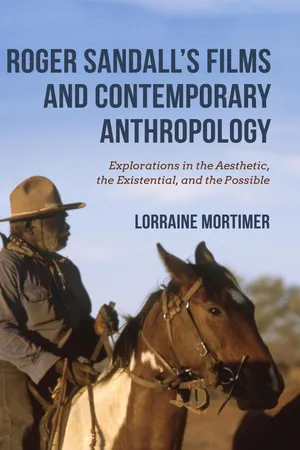
Roger Sandall's Films and Contemporary Anthropology
Explorations in the Aesthetic, the Existential, and the Possible
- 352 pages
- English
- ePUB (mobile friendly)
- Available on iOS & Android
eBook - ePub
Roger Sandall's Films and Contemporary Anthropology
Explorations in the Aesthetic, the Existential, and the Possible
About this book
Information
1
TRUSTING THE MATERIAL
Maíz (1962)
Of all our photographic endeavors, few aroused the distaste of the Indians so much as our attempts to show them eating their food. The reason is not obscure. Meal-time was the one occasion in each day when we became equal with our hosts. Squatting on the floor eating our tortillas and beans and salt, we were taking part in a deeply symbolic ceremony, an egalitarian rite. Though we might spend eleven hours a day as detached observers of Indian life, in this twelfth hour we were participants, we shared. It was meal-time which joined us, and to introduce the separating distance of the camera at this point, to become aloof eyes looking on, was to neglect an essential display of fellowship.
Roger Sandall, “Maíz: A Production History”1
Rhythm and Respect
Maíz is a modest nine-minute film, made for the partial fulfilment of the requirements for a degree of master of fine arts at Columbia University. Yet when we enter its world, we could think we were in the hands of one of the great Russian directors—on the slopes of mountains, with people and animals worthy of respect, all vaulted under a magnificent sky. And it’s a world that is worked. Along with strong, sculpted faces recalling those seen in Eisenstein’s Que Viva Mexico! (1931), there are endless processes—shots of oxen’s legs and hooves in the soil, expending effort, balancing, and plowing.2 There’s water, forest, flowers, fire, and the sun flaring primordially through black smoke. Many of the elements that fascinated the earliest filmmakers are here. “It’s spring in the mountains of Mexico,” a narrator tells us, and the fires are burning because “men are clearing the land, making it ready for planting maíz.” Central to the film, there are women making tortillas from the staple, not only “Mexico’s daily food,” but for “the Indian peasant, it’s more than food: it’s his work and his life.” As children with big smiles play at helping the women, we absorb the scarce narration and music as organic, and it’s hard to believe this finely crafted presentation was someone’s first film.
After his grounding in anthropology at the University of Auckland and encouragement by American postgraduates on Fulbright scholarships in New Zealand, Roger Sandall took up a fellowship to complete a master’s degree at Columbia University in New York. He was immersed in anthropology and worked with Margaret Mead, with whom he would form a friendship until the time of her death, but he transferred to the fine arts program where his passion for film, nourished by the North American and French cinema verité directors, could bear fruit.
It was with the anthropologist Dorothy Cinquemani—who had known a group of Indians, spoken their language, and shared portions of their lives—that Sandall went to southwest Mexico in the Sierra Madre mountains to make the short film that became Maíz. Cinquemani’s fieldwork research was “orthodox,” Sandall tells us in his production history (submitted as part of his fine arts degree), but what interest the film he created holds as a “human document,” its “human aspect,” came from her shared intimacy and friendship with those filmed.3 Completing the team on location were Cinquemani’s husband, Frank, as production assistant, and Jennifer Chatfield as stills photographer.
The anthropologist planned a modest documentary on peasant life. She expected “data”—illustration that might accompany the adult education course on Mexican Indians she gave at the American Museum of Natural History. The museum, in exchange for camera equipment and raw film stock, expected an “educational film.”4 Sandall tells us that he had something different in mind—something more along the lines of the sketch of rural life that appeared in Georges Rouquier’s 1946 film, Farrebique (2–3).5
Sandall’s production history comes with full admission of his scarce personal experience in filmmaking and with all humility about his first rough cut of the film amounting to “a compound of crass beginner’s errors.” He had the revelation that he’d basically failed to understand “the sheer plasticity of film,” that the hundreds of shots he returned with “were able to say hundreds of different things in hundreds of different ways.” Whatever the truth and realism of the images, he realized that only when he knew what he wanted to say could he make first a selection and then “a dramatically satisfying arrangement” of images (20). He was nevertheless already well aware of something he would address at the Institute of Aboriginal Studies years later, when he noted that the anthropological list of things to be shot is comprehensive but that “the film-making anthropologist who finds it both natural and desirable for a native, carving a dug-out from the trunk of a tree, to lop off all the branches in order to reveal the form of the boat, seems rarely able to lop and prune his celluloid branches and twigs” (3).
Sandall’s real learning curve began on arriving on location, when he found how little could be counted on in the making of a documentary film. The life of the family Cinquemani knew couldn’t be pictured in their village. The family had made the summer migration to the cornfields they worked on at that time; so, it was in a socially detached “field house,” miles from the village, that the proposed protagonists had gone to live. This was far from their nearest neighbors, surrounded by “air and sky,” and on top of a high mountain ridge. Just as important, the family members, consisting of Don Nacho, Doña Jacoba, their son, Ramón, and his wife, Filomena, were unwilling to play themselves. So the pictured family was a “fictional composite.” Fortunately, another young man who was living in the household agreed to play Ramón, while a widow with five children, Antonia, agreed to take Filomena’s place. How lucky they were to have Antonia and her children was finally made clear, said Sandall, by the fact that they were to give the film “whatever warmth it had” (4–5).
While the camera was set up for the participants and others to become used to it, it wasn’t used immediately. Rather, a “friendlier machine,” a new model Polaroid that offered “instant portraiture,” was used to break down apprehension. It delighted people, and Ramón himself learned to use it. However, while distrust could be lessened, it couldn’t entirely be overcome. For the colonized indigenes there was an understandable suspicion of all white people. Whites speaking Spanish were viewed as members of the Mexican elite—culturally, economically, and racially different from the Indians themselves. English-speaking white people like Sandall himself were “gringos, … more legendary, mythical, and dangerous” (6).
Cinquemani had been alone when she first visited the family. On subsequent visits, no more than one other person had accompanied her. And as any guests, foreign filmmakers or otherwise, can attest to, numbers make a difference. Says Sandall, in his account: “For the Indians two gringos were tolerable: but four was another matter, and throughout our stay in the mountains there was always the danger that we should be regarded less as visitors than as an occupying force” (6). To ask something of people in such situations, both diplomacy and ordinary human respect for others’ feelings are needed. Sandall wrote:
It was for this reason that when shooting began it was in the corn field rather than near the house. A fine field of growing corn is a thing all men rejoice in. It implies knowledge, ability and success, and to picture a man in this setting is to give him a stature equal to other men. A dirt-floored windowless hut of tattered thatch is not something all men rejoice in. It implies ignorance, incapacity and failure, and to picture a man in this setting is to stamp his poverty on his brow, to set him apart and below. And these things the Indians well know (6–7).
While at the location and questioning how he would build this first film, Sandall’s thinking already related to the way music works with themes and patterns. And the theme that consciously developed in the field was that of manual labor: “The basic tool in the pre-mechanical society is the human hand, and the abundance of close-ups of hands at work in the finished film reflects this early preoccupation.” This is unsurprising, since this is indeed how the Indian hosts sustain themselves, but manual labor on the land was also an early preoccupation in Sandall’s own life that would stay with him personally and in his work (8–9).
Since he was also keeping open the possibility of a final document composed of a series of consecutive events, along with filming various pieces of work from start to finish, he composed “bridges” to link them—so, he concluded in his account, “some amazingly awkward and obvious ‘connecting’ scenes were shot.” “Phoneyness” was the result whenever he “tried to arrange things within the frame.” On the other hand, something as natural and pleasing as the final tortilla-making scenes that appeared in the film needed artfulness to get them, and they illustrate the kind of common and banal difficulties often involved in filmmaking. Since the grinding of corn and tortilla making was usually work that went on inside the house, and the only hole in the small building was the door, Sandall used aluminum foil reflectors to throw in light that was needed through that entrance. But when they did this, they made the women, who’d only reluctantly agreed to the intrusion, wince from the glare. The scenes, processed in Mexico City during the time of the shoot, turned out to be unusable, however, not because of the “pained grimaces” but because Sandall had brought the wrong type of film, and “everything from white teeth to brown tortillas was uniformly blue”! When he returned from Mexico City, the widow Antonia, though “not overjoyed” when Sandall told them that the whole sequence would have to be done again in the open air, agreed to help once more. Large stones were placed around an outdoor fire, an iron griddle placed across it and the tortillas cooked on top. Antonia’s work was “more than justified by the results,” said Sandall. She gave them “one of the best sequences of the film” (9, 11).
Watching Maíz, it’s not hard to agree with this. The graciousness of “handsome and hardworking” Antonia comes across in her communication with the camera. The first we see of her is a close-up of her hands, shelling brown and yellow corn, with a huge basket and kids on either side “working” too. She’s photogenic, her smile is easy, and her face pleasing, with jet-black hair and golden earrings framing it. There are chickens clucking in the background and pipes and guitar on the soundtrack, all carrying us over to corn being poured and then being ground with a hand-operated mill, and we pull out to see behind her spindly white trees and immediately beyond that green valleys. Dough is then being rolled on a stone surface, and patties are being made, and we soon see Antonia in close-up on the left of the screen, with a big full smile as she works. We see flattened patties laid out on the griddle and her hand turning them over. And soon we catch a tiny bit of movement in the patties, like they’re coming alive. When we cut to the little girls with unkempt but cute dresses, their faces show curiosity but no intimidation before the camera, to which they look directly when they choose. Antonia is rolling again, and after we cut to her from behind, to her neck and red comb in that black hair, we cut back to the tortillas and everyday alchemy—one tortilla rises before our eyes. Sandall completes the sequence by cutting to a fine green corn plant growing. It’s as if this whole sequence were shot to the accompaniment of the guitar and pipes that for us are all part of the picture, along with the noisy chickens. The craft and beauty—of Antonia being and working and of Sandall’s cinematography and later editing—are all part of learning about people’s days, lives, and sustenance.
Having originally decided to do without music (the early attempt to dispense with it, he says in his account, “arose from a grotesque misunderstanding of its possibilities”), Sandall nicely described the music finally used in relation to the splendid tortilla-making sequence, where “strong chords on the guitar coincide both with a cut to a close-up of hands patting a tortilla and to the subsequent rhythm of the work. When the tortilla rises on the griddle, swelling with steam, a final note on the flute seems to thrust it bodily up” (30). When he realized wild sound or effects would be far too difficult to assemble well, he knew he needed to find a musician. The music needed to sound “simple and unsophisticated,” like “the Indians and their way of life.” It would preferably be based on a Mexican folk theme, but he didn’t want “folk music,” which for his purposes, he believed, could be “too structurally rigid, too monotonous, too emotionally uniform.” He decided a guitarist “able to improvise flexibly to the picture” was needed, and after months of searching and hours of listening he was introduced to John Duffy, who wrote a score in ten days, adding...
Table of contents
- Cover
- Title Page
- Copyright
- Dedication
- Contents
- Acknowledgments
- Introduction
- 1. Trusting the Material: Maíz (1962)
- 2. Environments Fit for the Spirit: The Flahertys, Sandall, and Some Anarchist Anthropology
- 3. They Were Still Participants: The Ritual Films (1966–76)
- 4. The Colors of the Infinite: Camels and the Pitjantjara (1969)
- 5. “What You Thinkin’ About, Little Horse?”: Coniston Muster: Scenes from a Stockman’s Life (1972)
- 6. Harmony and Fire: Making a Bark Canoe (1969) and A Walbiri Fire Ceremony: Ngatjakula (1967 and 1977)
- 7. More Optional and More Fragile: Weddings (1976)
- 8. In the Floating Desert with Jayasinhji Jhala, Part 1: The Tragada Bhavai: A Rural Theater Troupe of Gujarat (1981), A Zenana: Scenes and Recollections (1982), and The Bharvad Predicament (1987)
- 9. In the Floating Desert with Jayasinhji Jhala, Part 2: Close Encounters of No Kind (2002) and Nomads (1984)
- A (Relative) Conclusion
- Appendix 1: The Australian Institute of Aboriginal and Torres Strait Islander Studies’ List of Roger Sandall’s Filmed Material
- Appendix 2: Roger Sandall’s List of Films He Made (Produced, Directed, and Edited), Film Awards, and Special Screenings
- Appendix 3: Innovation in Sound Recording Made during the Filming of the AIAS Ritual Films according to David MacDougall
- Appendix 4: Availability of Sandall’s Nonrestricted Films
- Filmography
- Bibliography
- Index
- About the Author
Trusted by 375,005 students
Access to over 1.5 million titles for a fair monthly price.
Study more efficiently using our study tools.
Frequently asked questions
Yes, you can cancel anytime from the Subscription tab in your account settings on the Perlego website. Your subscription will stay active until the end of your current billing period. Learn how to cancel your subscription
No, books cannot be downloaded as external files, such as PDFs, for use outside of Perlego. However, you can download books within the Perlego app for offline reading on mobile or tablet. Learn how to download books offline
Perlego offers two plans: Essential and Complete
- Essential is ideal for learners and professionals who enjoy exploring a wide range of subjects. Access the Essential Library with 800,000+ trusted titles and best-sellers across business, personal growth, and the humanities. Includes unlimited reading time and Standard Read Aloud voice.
- Complete: Perfect for advanced learners and researchers needing full, unrestricted access. Unlock 1.5M+ books across hundreds of subjects, including academic and specialized titles. The Complete Plan also includes advanced features like Premium Read Aloud and Research Assistant.
We are an online textbook subscription service, where you can get access to an entire online library for less than the price of a single book per month. With over 1.5 million books across 990+ topics, we’ve got you covered! Learn about our mission
Look out for the read-aloud symbol on your next book to see if you can listen to it. The read-aloud tool reads text aloud for you, highlighting the text as it is being read. You can pause it, speed it up and slow it down. Learn more about Read Aloud
Yes! You can use the Perlego app on both iOS and Android devices to read anytime, anywhere — even offline. Perfect for commutes or when you’re on the go.
Please note we cannot support devices running on iOS 13 and Android 7 or earlier. Learn more about using the app
Please note we cannot support devices running on iOS 13 and Android 7 or earlier. Learn more about using the app
Yes, you can access Roger Sandall's Films and Contemporary Anthropology by Lorraine Mortimer in PDF and/or ePUB format, as well as other popular books in Social Sciences & Film & Video. We have over 1.5 million books available in our catalogue for you to explore.