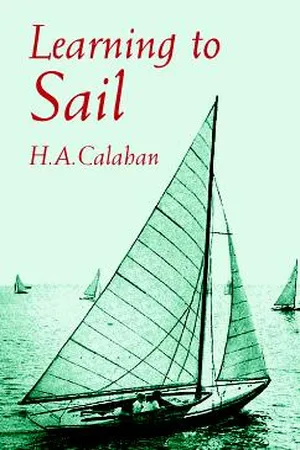
This classic guide for the first-time sailor centers on the small sailboat. The author, who assumes no prior knowledge on the part of the reader, begins with the selection of a first boat and conveys enough information to enable anyone to take out a small boat and bring her in safely. 111 black-and-white figures.
- 346 pages
- English
- ePUB (mobile friendly)
- Available on iOS & Android
eBook - ePub
Learning to Sail
About this book
Trusted by 375,005 students
Access to over 1.5 million titles for a fair monthly price.
Study more efficiently using our study tools.
Information
Subtopic
Marine TransportationCHAPTER I
WHAT IT’S ALL ABOUT
HERE, on shore, life is a hurly-burly.
Out there on the water is escape.
Here, “the world is too much with us.” Out there we are alone. A mile from shore, and we are in a world of our own. And what a world! A world of water and wind and sky. A world of ever-changing, inexhaustible beauty. A world, moody and capricious, perhaps; but always fair and square. Sometimes soothing and benign, sometimes boisterous and gay, sometimes lowering, threatening, mad, and dangerous; but always giving fair warning, always playing the game with all the cards on the table if we but know them when we see them.
You cannot find that world of waters in a motor boat. The motor boat carries part of the shore with it; and at the approach of the shore, the gods of the deep go into hiding. The motor boat stinks of the highway and the factory. It roars with the noise of the city. It vibrates to the tempo of a mechanical age.
And, worst of all, you lose the thrill of the gambling when you play with loaded dice.
No, you cannot find the world of waters in a motor boat. You cannot help but find it in a sailboat, for that world of water and sky, wind and tide, is not only about you but part of you. If it fights you, it drives you as well. It is your motor as well as your resistance—your safeguard as well as your enemy.
Of all man-made things there is nothing so lovely as a sailboat. It is a living thing with a soul and feelings—responsive as a saddle horse, loyal as a dog, and thoroughly downright decent. Every sailboat has a character all its own. No builder has ever succeeded in turning out two boats exactly alike. Their measurements may be identical, but the difference is in their character.
Sailing boats are wise. They display a sound shrewdness born of the wind and the wave. And they will impart that wisdom to a sympathetic and attentive helmsman.
Yes, they are wise. If you are mean or niggardly, cowardly or slovenly, selfish, overbearing or cruel, rest assured your boat will find you out.
Yet in stress of storm or adversity, no boat has ever failed to give her best when called on by her master. It may be a poor best. She may be old and rotten and leaking like a basket. The odds against her may be overwhelming. But she will always, always go gallantly into battle, win through if possible, and, if not, die fighting.
To sail this glorious creature, to be her master and her friend, to enter with her into the challenging, whimsical realm of the sea—that is the noblest and the best-compensated of all the arts.
For it gives so much that can never be bought by money. Humility—and self-confidence; courage—and kindness; strength—and gentleness; these are the gifts to the sailor.
And there are other gifts too numerous to mention: long, lazy, sunny hours ghosting through a silent calm; crashing, smashing drives to windward with the lee rail buried, the stinging spray tossed high, the wide wake smoking behind you; tense, sharp battles with eager, ingenious squalls when you must fence with sheet and tiller to parry every thrust and lunge of your gusty opponent. And triumph! That rocky point you weather after a long battle with the tide. It is yours —you have earned it. The landfall you make in a fog, sailing out of the nowhere right up to your mooring—that is better than the solution to the finest mystery story. The gun that announces your victory when you romp first across the finish line in a hard-fought race —that is music divine. The snug warmth of your cabin with a mile of cold gray sea outside is the coziest of homes. Out there, when you are on your own, alone with your ship and the stars, the petty annoyances of life ashore are swiftly dwarfed to their real proportions.
And the sport of the sailor never ends. It is enjoyed by age as well as youth. It is with you in winter as well as in summer, for ice and snow are no barriers to dreaming and planning. A larger boat, a change in rig, a new bottom paint, an alteration here or there, new cruises planned—this is your winter yachting.
You can never learn it all. If you live to be a thousand, you can never learn it all. The art of sailing is as old as mankind and as new as the cat’s-paw you see scurrying down from windward. This book is just the barest beginning.
CHAPTER II
THE SELECTION OF A BOAT
A CHARMING young couple of my acquaintance determined to learn to sail. Therefore they set out to buy the sort of boat that would be “just right for a beginner.” Their purchase was a dory, about nine feet over all, with a very short rig. It was represented to them as the right boat for a beginner for the following reasons:
First, it was small.
Second, there was not enough sail to get them into trouble.
They spent the summer in Mamaroneck Harbor where there is more than a seven-foot rise and fall of tide and where the current is just what might be expected with a tide of that character. Furthermore, the harbor is very well sheltered, so that in ordinary weather the breeze is extremely light. They spent the summer trying to get a hundred feet from their mooring and finally gave up in disgust. I sailed their boat one day in an endeavor to encourage them, and learned in five minutes why they were giving up the idea of sailing and were taking to gardening instead. The boat was too small.
It had a sail that was useful only in a gale of wind, and a gale is no time for a beginner. When it was blowing hard, they dared not sail; when it was not blowing hard, they could not sail. My first advice in the selection of a boat is to get one that is neither too large nor too small, and it is better to get a boat that is too large than a boat that is too small. My second advice is to get a boat that is properly rigged. And it is better to get a boat that is over-rigged than to get a boat that is under-rigged.
Most beginners seek a safe boat. They would do better to get a dangerous boat. To my mind, the safest boat for a beginner is about twenty-one or twenty-two feet over all, and preferably a boat that has been built in a one-design racing class. The majority of one-design boats are generally pretty safe. A racing boat in an open class—that is to say, a boat that is built to certain restrictions of size and sail area—is generally cut down in the factor of safety to make for the factor of speed. But when a number of boats are built from the same designs and specifications, the class usually tries to turn out a safe, able, workable boat, and the speed factor is left to take care of itself. The winner in a one-design racing class usually wins because of the care and the proper tuning up of his boat and his judgment and helmsmanship in the course of the race.
In general, a boat should not be less than twenty-one feet over all because it is impossible to build a boat much smaller that will behave like a real boat and will have the stability and dependable qualities particularly necessary to a beginner. A boat should not be much larger than twenty-one feet over all, because of the difficulty presented in the physical handling of a large sail area.
Most small boats on the Atlantic seaboard are either cat-rigged or sloop-rigged. The true catboat is recognized by her excessive beam or width. She has a single large mast located in the very bows of the boat. On that mast she carries a single large sail. In the development of the catboat for racing purposes, there have been many deviations from the original catboat hull. The boats have been built longer and narrower. They have developed long overhangs forward and aft, and the mast has crept aft to a point sometimes five feet from the bow. They are still catboats in that they carry a single large sail and in that the mast is directly over the forward end of the water line. If you must have a catboat, try to select the old type with the straight stem and the broad beam.
In my opinion, however, the catboat is not the boat for a beginner for the following reasons:
1. The single large sail is very hard to handle in that it is all in one piece.
2. A catboat running before the wind in anything like a sea has a bad habit of rolling. Inasmuch as the sail is almost at right angles to the boat on this point of sailing, the end of the boom is quite likely to get into the water, with dire consequences.
3. A catboat is more likely to jibe accidentally, for it has no jib or small forward sail to give warning of this danger.
4. The catboat is very likely to broach to in altering her course from a run before the wind to any course to windward. Unless the sheet is skillfully trimmed at this time, capsizing is likely to result.
5. The catboat is a poor teacher. Generally they carry very heavy weather helms, so that it is as difficult to acquire good helmsmanship with a catboat as it is to develop the “good hands” of horsemanship with a hard-mouthed horse.
So my vote would be against the catboat.

FIG. 1. A boat with a Marconi, or jib-headed, mainsail

FIG. 2. A boat with a gaff-headed mainsail
My preference for the beginner is a small sloop. Most sloops, which can be readily found, are of the knockabout type. That is to say, they have a jib (a small triangular sail in front of the mast) and a mainsail. They have no bowsprit, but their jib stay (the wire rope on which the jib is hoisted) runs from the head of the mast to the very bow of the boat. The mainsail may be of the Marconi type (see Figure 1) or of the gaff-rig type (see Figure 2).
The word Marconi is a misnomer. A triangular or jib-headed sail is by no means new. It was formerly called the leg-of-mutton rig, but some years ago when the present vogue for the Marconi sail was started, the masts were made very tall and were all curved. It was so difficult to keep a tall, curved mast in the boat that a very elaborate system of wire stays was necessary. These wire stays made the mast look more like a radio tower than anything else, and the nickname “Marconi” mast was applied, and for some reason has stuck ever since.
For the beginner, I strongly urge the selection of a gaff-headed sail. The gaff rig is not so fast on the wind as the Marconi rig, but the mast is shorter and therefore handier. Many maintain that the weight of the gaff (the spar at the top or head of the sail) more than overcomes the leverage of the mast. In my own sailing, I have not been able to detect any material difference. But the gaff rig has certain definite advantages so far as the beginner is concerned.
In the first place, the beginner can probably make his sail set much better with the aid of a gaff, and the ability to hoist a sail properly is no small part of one’s success in learning to sail. In the second place, the mainsail can be shortened very quickly on all points of sailing except to windward by simply lowering the peak—or the end of the gaff farthest away from the mast. In the third place, a gaff-headed sail is secured to the mast by hoops, while a Marconi sail, because of the necessity for elaborate stays, is fastened with slides that work along a track on the after side of the mast. These slides not infrequently catch in the track, and when that happens it is very difficult to get the sail either up or down. This is often embarrassing even to an old salt and may cause no end of difficulty to the beginner.
Let us, then, start looking for a boat about twenty-one or twenty-two feet over all, sloop rigged, with a gaff-headed mainsail. Let us look for a good average boat, not one that is too fast, and certainly not one that is too safe. To a certain extent, speed and safety go together. A boat that is under-rigged or over-ballasted or otherwise slow and logy is the sort of boat in which a beginner gets into trouble.
It is essential that the boat selected shall be suitable for the waters to be sailed. It is impossible to sail a deep-draft boat in shallow waters. If you are sailing on Great South Bay, Barnegat Bay, shoal waters in certain parts of the Chesapeake, it is most necessary that the boat shall draw very little water and shall provide lateral resistance to the water by means of a centerboard. The centerboard is the sliding keel which works up and down in a narrow box known as the centerboard trunk.
If, on the other hand, you are sailing such waters as Long Island Sound, Buzzards Bay, Peconic Bay, or any of the deeper waters of the New England coast, the boat with the deep keel is more suitable. It is possible, of course, to sail a shoal-draft boat in deep water, whereas the reverse is not possible. If you are limited by the depth of water to a shoal-draft boat, by all means choose a gaff rig. With very few exceptions, the Marconi rig has proved unsatisfactory in centerboard boats.
In general, the boat should be designed and built by men who have intimate knowledge of local conditions, and the best type of boat for any particular locality is the boat most nearly resembling the majority of other boats in that locality.
CHAPTER III
THE MOORING
MORE damage is usually done to a boat in the first few days in the hands of a beginner than in several years of its normal life. So right at this point let us consider that you have bought your boat and must take care of her even before you have learned to sail. She should be delivered to you by the vendor, or you should have her sailed to your anchorage by someone who knows how. Do not attempt to sail a boat until you are thoroughly familiar with everything about her.
The first consideration, then, is the anchorage. Your anchorage should be in a spot as well protected as possible from the heaviest storms which you are likely to get. On the Atlantic seaboard of the North American continent, most of the bad storms come from the east or northeast or southeast. If possible, therefore, select an anchorage that is protected from this wind. Do not lie too near to other boats, and before you select your anchorage watch the way the other boats swing when the wind changes.
A large boat anchored to a long line will describe the extremity of a very large circle. If you anchor your small boat on a shorter line within the radius of that circle, you may swing perfectly clear on most winds; but there may be one quarter from which the wind will blow in which you will be uncomfortably close to the other boat. Your position should be such that the other boat will s...
Table of contents
- DOVER MARITIME BOOKS
- Title Page
- Copyright Page
- Dedication
- FOREWORD
- Table of Contents
- Table of Figures
- CHAPTER I - WHAT IT’S ALL ABOUT
- CHAPTER II - THE SELECTION OF A BOAT
- CHAPTER III - THE MOORING
- CHAPTER IV - ACQUIRING A VOCABULARY
- CHAPTER V - LOOKING HER OVER—PRELIMINARY WARNINGS
- CHAPTER VI - THREE USEFUL KNOTS
- CHAPTER VII - BENDING AND HOISTING SAIL
- CHAPTER VIII - REEFING
- CHAPTER IX - THEORY OF SAILING
- CHAPTER X - BEFORE THE WIND
- CHAPTER XI - SAILING TO WINDWARD
- CHAPTER XII - REACHING
- CHAPTER XIII - MAKING AND CLEARING A DOCK OR MOORING
- CHAPTER XIV - HELMSMANSHIP
- CHAPTER XV - BALLAST AND TRIM
- CHAPTER XVI - SEVENTEEN WAYS TO GET INTO TROUBLE
- CHAPTER XVII - SEVENTEEN OR MORE WAYS TO GET OUT OF TROUBLE
- CHAPTER XVIII - CAPSIZING
- CHAPTER XIX - WHAT TO DO IN A THUNDERSTORM
- CHAPTER XX - SAILING IN A TIDEWAY
- CHAPTER XXI - LAYING TO
- CHAPTER XXII - WAVES
- CHAPTER XXIII - COASTWISE NAVIGATION
- CHAPTER XXIV - MARLINESPIKE SEAMANSHIP
- CHAPTER XXV - STANDING AND RUNNING RIGGING
- CHAPTER XXVI - LIGHT SAILS
- CHAPTER XXVII - RULES OF THE ROAD—RIGHT-OF-WAY
- CHAPTER XXVIII - HANDLING THE DINGHY
- CHAPTER XXIX - CARE OF THE HULL
- CHAPTER XXX - CARE OF SAILS
- CHAPTER XXXI - WINTER STORAGE AND CARE
- CHAPTER XXXII - FITTING OUT
- THE HAUL-OUT - AN APPENDIX
- A CATALOG OF SELECTED DOVER BOOKS IN ALL FIELDS OF INTEREST
Frequently asked questions
Yes, you can cancel anytime from the Subscription tab in your account settings on the Perlego website. Your subscription will stay active until the end of your current billing period. Learn how to cancel your subscription
No, books cannot be downloaded as external files, such as PDFs, for use outside of Perlego. However, you can download books within the Perlego app for offline reading on mobile or tablet. Learn how to download books offline
Perlego offers two plans: Essential and Complete
- Essential is ideal for learners and professionals who enjoy exploring a wide range of subjects. Access the Essential Library with 800,000+ trusted titles and best-sellers across business, personal growth, and the humanities. Includes unlimited reading time and Standard Read Aloud voice.
- Complete: Perfect for advanced learners and researchers needing full, unrestricted access. Unlock 1.5M+ books across hundreds of subjects, including academic and specialized titles. The Complete Plan also includes advanced features like Premium Read Aloud and Research Assistant.
We are an online textbook subscription service, where you can get access to an entire online library for less than the price of a single book per month. With over 1.5 million books across 990+ topics, we’ve got you covered! Learn about our mission
Look out for the read-aloud symbol on your next book to see if you can listen to it. The read-aloud tool reads text aloud for you, highlighting the text as it is being read. You can pause it, speed it up and slow it down. Learn more about Read Aloud
Yes! You can use the Perlego app on both iOS and Android devices to read anytime, anywhere — even offline. Perfect for commutes or when you’re on the go.
Please note we cannot support devices running on iOS 13 and Android 7 or earlier. Learn more about using the app
Please note we cannot support devices running on iOS 13 and Android 7 or earlier. Learn more about using the app
Yes, you can access Learning to Sail by H. A. Calahan in PDF and/or ePUB format, as well as other popular books in Technology & Engineering & Marine Transportation. We have over 1.5 million books available in our catalogue for you to explore.