![]()
CHAPTER I.
APPEARANCES OF OBJECTS.
ON viewing any object except a sphere, we find its appearance not only differing from its actual form, but varying with every change of position. Thus we have a variety of objects represented in the following plates, in which we observe many of their edges or bounding lines seemingly tending upwards, downwards, or sideways, which we know in reality to be perfectly level, and others apparently converging towards certain points though actually parallel; so, also, surfaces equidistant in nature, approaching each other and diminishing as their distance from us increases, and circular forms appearing as ellipses, or merging into right lines; yet so familiar are their appearances as there represented, that we recognize in each one the object intended. Now, the chief end of drawing is to give such a representation of an object that it may convey to the eye as nearly as possible the same appearance as that of the object itself. Accustomed, however, as we are from childhood to the exercise of our sense of sight, so intuitive may be said to be its results, that we are rarely led to enquire into the differences subsisting between the forms and appearances of objects, and to acquaint ourselves with the causes of such changes. This investigation, nevertheless, constitutes the basis of all correct drawing, since we are thereby enabled to deduce the rules for our guidance in the pictorial representation of objects. We shall, therefore, after a brief summary of the principal definitions, proceed to consider the circumstances under which objects are seen.
![]()
CHAPTER II.
DEFINITIONS.
FREQUENT misconceptions having arisen in treatises on perspective, from the incompleteness of a few definitions. relative to lines and angles, together with the conventional terms and figures applied to them, we shall briefly enumerate, in this place, the most essential points to be observed in connection with them.
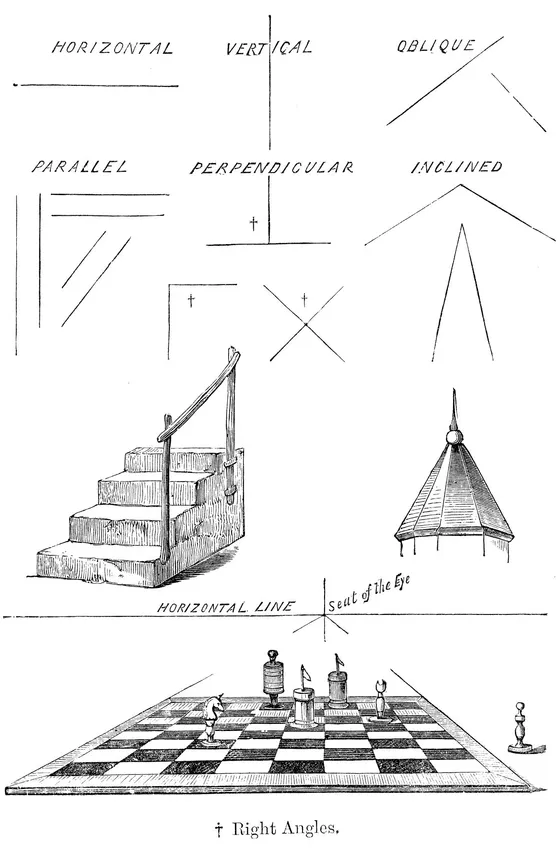
Lines represent the extremes of the intersection of surfaces; their positions abstractedly considered are three: viz., HORIZONTAL, VERTICAL, and Oblique (see plate 1). But their positions to one another, also three in number, are distinguished by the terms, PARALLEL, PERPENDICULAR, and INCLINED—terms, it will be seen, different in their signification from the former three, though too often confounded with them.
PARALLEL LINES are such as are equidistant from each other in every part, whether they be horizontal, vertical, or oblique. Lines are said to be PERPENDICULAR to each other when they meet or intersect so that the angles on either side are equal to each other, and these angles being right angles, the lines are also said to be at right angles to each other: it will be seen by the illustration that the perpendicularity of the lines is mutual, and that an oblique line may be perpendicular to another oblique line. Lines INCLINED to each other are those which meet or intersect at an angle greater or less than a right angle.
In illustration of the above terms, the front edges of the flight of steps in the same plate would, in nature, be parallel to one another, but at right angles to the upright edges, in the same manner that the treads of each step are parallel to one another, but perpendicular or at right angles to their sides and fronts. The walls of an apartment are, in like manner, at right angles to the floor; in a pyramidal roof, however, all the lines or edges as well as the surfaces are oblique to each other. Mention being frequently made in perspective works of the position of lines and surfaces to the eye or to the spectator, to which the above terms of parallel, perpendicular, and inclined, could not strictly apply (seeing that the eye is considered as a point)—a classification somewhat analogous is adopted in its stead. Thus, a line or a surface is said to be square to the spectator, in lieu of parallel, when it is so situated as to preserve its true shape and proportions; it need not, however, to this end be directly fronting us. Again, a line or surface is said to go direct from the spectator, or be at right angles to us, when not inclined to the horizon, or to either side. Of this description, consequently, are all level surfaces, as the Chess-board (plate 1), also the fronts of the buildings in the Street view (plate 2), and the walls of the Interior (plate 3), which only apparently incline towards each other, but are in nature parallel. If we stand with our back against one side of a room of the ordinary square form, the side opposite would be square to us, the floor, ceiling, and two remaining sides going off direct.
The walls of the Observatory (plate 2) exhibit a familiar example of surfaces oblique to the spectator; next to these may be instanced roofs, which are also inclined to the horizon.
HORIZONTAL LINE.
The HORIZONTAL LINE is a level line crossing the drawing from side to side, the exact height of the eye, and corresponding with our horizon or line of distance, and in a marine view with the junction of sky and ocean. The height of it on the drawing will depend upon the na...