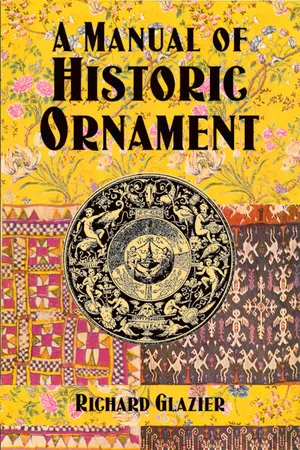
Exceptionally comprehensive, easy-to-use guide surveys the evolution of historic ornament in architecture and the applied arts — from primitive ornaments of Oceania, Egypt, and Assyria to a Gothic doorway in Amiens, the tomb of Lorenzo de Medici, and a classic early-19th-century sofa by Thomas Hope. Over 700 black-and-white illustrations. 16 plates of photographs.
- 230 pages
- English
- ePUB (mobile friendly)
- Available on iOS & Android
eBook - ePub
A Manual of Historic Ornament
About this book
Information
Topic
ArtSubtopic
Architecture GeneralPart I
The History and Development of Architecture & Ornament
Plate 2
PRIMITIVE ORNAMENT
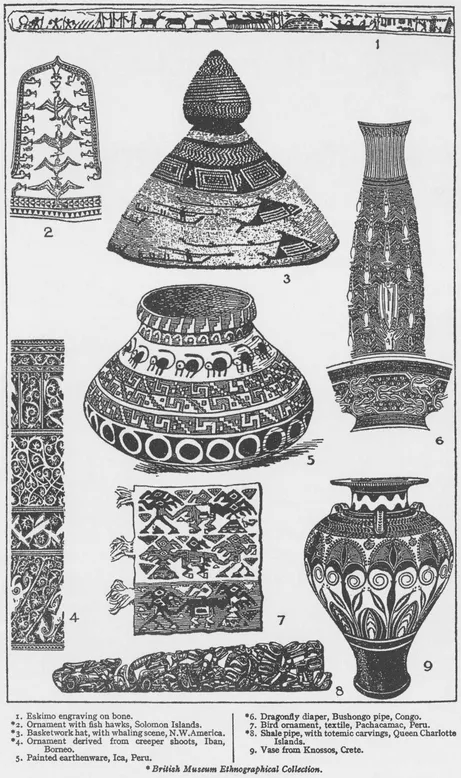
The ornament of primitive races presents a vast field for study, which it is difficult to focus adequately, and which has not yet been fully investigated. It is only possible here to note a few isolated instances. Some of its manifestations have a distinct degree of kinship to the scanty remains which have survived of the work of the long prehistoric eras, and also show similarities with departments of decorative art in such highly-developed yet self-contained civilizations as Crete and Peru. Examples of the work of these two latter styles are here included for comparison, figs. 5, 7 and 9. The first patterns were probably the simple rows of roughly incised diagonal lines on early vessels such as the beakers. Geometrical patterning on pottery naturally originates readily and spontaneously, and is found with a considerable degree of similarity in many parts of the world. These naturally develop after ages into chevrons, frets, scrolls and wave-like forms, which can be effectively combined, distributed and coloured, as in vases from Istria, and Cypriote work. One mask from Benin has interlacements markedly reminiscent of Celtic ornament. Geometrical design is used with much effectiveness by the Indians of the Americas, as in wampum beadwork, basketry, and blankets, and also in the leather-work and palm-cloth of Central Africa. In metal and ceramic work of the Iron Age abstract design is found with naturalistic or conventional figures, which are used in panel or frieze form. But widely distant peoples have sometimes succeeded in the effective conventionalization of animal and plant forms, as in a dragonfly diaper wood-carving on a Congo pipe (fig. 6), and the hawk-ornament from the Solomon Islands (fig. 2). The sea forms of Cretan pottery are vigorous if naturalistic. From Borneo comes some effective floral ornament derived from the shoots of a creeper (fig. 4), and the Kenyak-Kayan tribes have mixed with the scrolls of their carved houseboards humanistic figures and dog-like forms. The Eskimo have graphically and ingeniously represented the activities of a whole settlement by engraving in narrow strips on ivory or bone (fig. 1). The Indians of North-west America have inserted a version of a whale hunt on a hat of basketwork (fig. 3), and like many other peoples, can turn the human face to account. by varied repetition. The totem poles of British Columbia are crowded with figures and other devices, in a style which is applied to various objects, and often rises, as in a shale pipe of the Haida of Queen Charlotte Island, to a Breughel-like grotesqueness (fig. 8). Tribal ornament ranges from a few casual scrappy patterns, like those of peoples of such low type as the aboriginal Australians, to vigorous pattern, well distributed, and carried out with feeling for the character of the material. The craftsman has generally made use of his chances, and produced achievements among races of widely differing culture and many periods all over the globe.
Plate 3
ORNAMENT OF OCEANIA
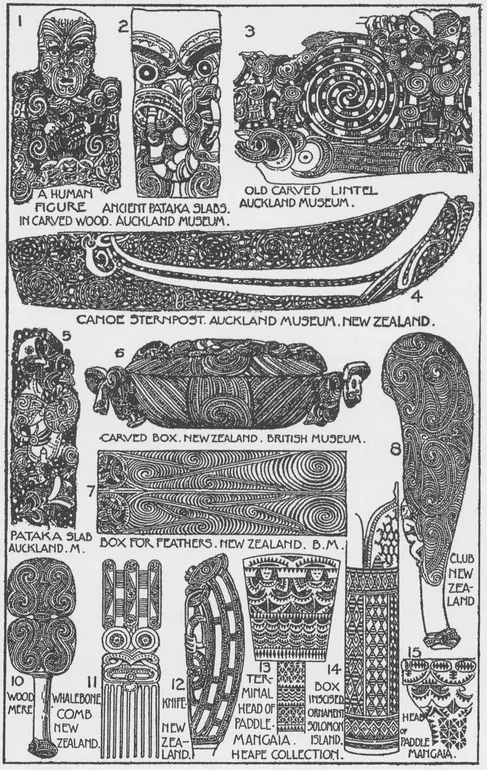
The ornamentation of the people of the Pacific Isles is full of interest, and is remarkable for the evolution and perfecting of an ornamental style by a primitive people, with myths and traditions purely local, and in no way influenced by other nations. It is a style of ornament full of meaning and symbolism, yet simple in detail and arrangement, not founded upon the beautiful vegetation and flora of their islands, but upon abstract forms derived from the human figure, and arranged with a pleasing geometrical precision remarkable for a primitive people.
The ornamental art of these people may be broadly divided into provinces, each with its distinct ornamental characteristics and traditions, New Zealand showing the highest development and Australia the lowest in the ornament of Polynesia and Melanesia.
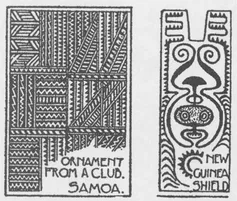
Much of the ornament is purely linear, consisting of parallel and zig-zag lines ; that of Australia consists almost entirely of these lines incised in the ground and occasionally filled in with colour. In New Guinea a higher development is reached, the ornament, of straight and curved lines, being carved in flat relief. In the province of Tonga-Samoa, the surface is divided into small fields, and the linear ornament runs in a different direction on each of the fields. The Hervey and Austral Islands are distinguished by their remarkable adaptations of the human female figure, the illustrations given here showing the original type and its ornamental development. These examples, together with the circular eye pattern, form the elements of the Hervey province, of which the Heape collection contains many fine examples. In the Solomon Islands the linear ornament is occasionally interspersed with an inlay of angular pieces of mother of pearl. The New Zealand province is distinguished by its skilful pierced carving, the beauty of its spiral forms adapted from the human figure (figs. 1-12), and the constant use of the border here given. No preliminary design was used, nor was the pattern outlined upon the object of the decoration. It was, so to speak, evolved from the artist’s head as he worked, much as a musician improvises at the piano. This art, once general, now appears to be falling rapidly into oblivion.
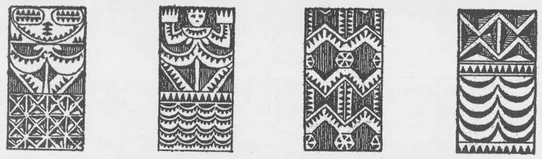

Plate 4
EGYPTIAN ORNAMENT
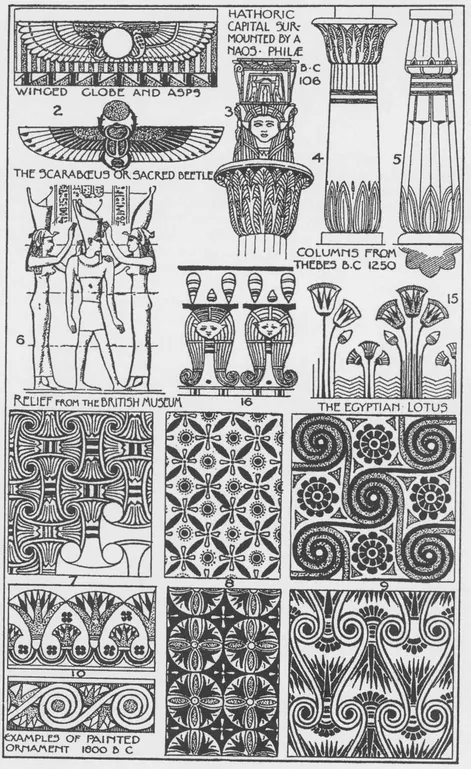
The history of Egypt extends from nearly 4000 B.C. to 340 B.C.
The capitals of the Ancient Empire comprised Memphis and Abydos ; of the Middle Empire, Thebes, Luxor and Tanis ; and of the New Empire, Sais and Bubastes. The remarkable civilization of these early dynasties is attested by the many fine remains of architecture, sculpture, and decorative arts that enrich our national museums. The three great periods of Egyptian art are Memphite (fourth, fifth, and sixth dynasties) in which figure sculpture appears somewhat heavy, but accurate ; the Theban Age (from the eleventh to the twenty-first dynasty) ; and the Sait or Neo-Memphite Age. The sculptures of the second Theban Empire are important and numerous.
The Sphinx, half animal and half human, is probably of the VI. dynasty, yet it is singular that all the earliest sculptures of the III. and IV. dynasties with which we are acquainted were realistic portraiture, remarkable for fidelity to nature. Kings, queens, and individuals of note were finely sculptured, frequently of a colossal size. But the Deities, Amen Sekhet, Horus, Hathor, Isis, and Osiris were represented in the later dynasties by small votive statuettes, noticeable for their number rather than for their artistic qualities, never reaching the excellence or vitality of the earlier period. Much of the architectural enrichment was in Cavo Relievo, a peculiarly Egyptian mode of ornamentation, the outline of the figures, birds, or flowers being sunk into the surface of the granite or basalt, and then carved within this sunk outline, leaving the ground or bed raised, these reliefs being invariably painted red, blue, green, and yellow. The frieze, which in the hands of the Greeks, at a later period, became their principal ornamental field, was used by the Egyptians in superposed bands, showing, in cavo relievo, the industrial arts and pursuits—weaving, glass blowing, and the making of pottery; ploughing, sowing, and reaping ; also hunting and fishing. The composition and sculpture of these incidents was simple, refined, and purely decorative, with a naïveté and unaffectedness appropriate to the architectonic conditions. Mingled with these incidents were the beautiful hieroglyphs, or picture writing of the Egyptians. Figs. 7-13 are examples of painted decorations showing the spiral construction of lines, together with the symbolic treatment of the Lotus, the latter being regarded by the Egyptians as a symbol of fertility and of a new life, hence the profusion with which it was used in their decorative work. Great fertility of invention was displayed in enriching their architectural capitals with the Lotus, the Papyrus, and the Palm. A singular feature introduced during the XVIII. dynasty was the Hathor Capital, surmounted by a small Naos. During the Ptolemaic period—300 B.C.—the Hathor Capital was placed upon the vertical bell-shaped capital (fig. 3).
Plate 5
ASSYRIAN ORNAMENT
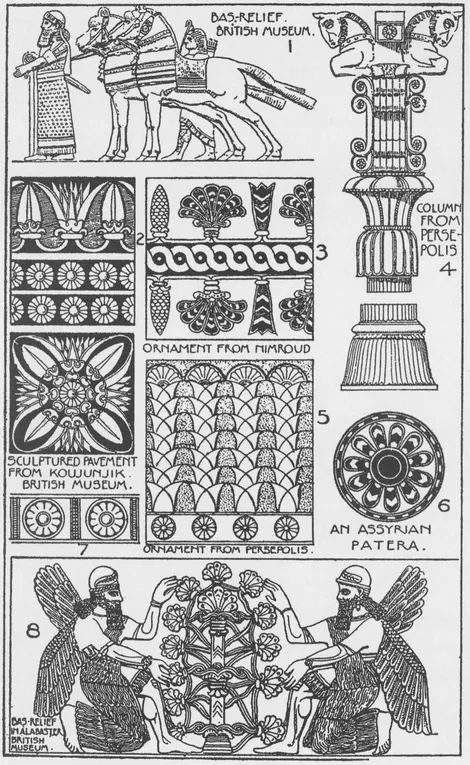
The early history of Babylonia and Assyria is one long series of wars and conquests. Originally one nation, they became divided, and the younger Assyria in the north became the most powerful empire of that period, under Tiglath-Phalasar I., 1100 B.C., Ashur-nasir-pal, 885-60 B.C., Shalmaneser IL, 860-25 B.c., Tiglath-Phalasar III., 745-27 B.C., the Great Sargon, 722-705 B.C., Sennacherib, 705-681 B.C., Esarhaddon, 681-668 B.c, and Ashur-ban-pal, 668-626 B.C. In 609 B.C.. the Capital, Nineveh, was destroyed by Cyaxares the Mede, and Babylon arose again to power under Nebuchadnezzar, 604-562 B.c. : this city was destroyed by Cyrus the Persian, 539 B.C.
Assyrian art, with its racial influences, religious beliefs, and climatic conditions, differs in a remarkable degree from Egyptian art. Though stone is found is Assyria, the great cities were built of brick, no doubt owing to the fact of the arts and civilization coming from Chaldea, where stone was scarce and clay plentiful. Both at Babylon in Chaldea and Nineveh in Assyria the traditional type of building was rectangular, with arched openings and vaults, built of sun-dried bricks. The lower part of the wall was covered with large alabaster slabs, carved in low relief with scenes representing the king and his warriors engaged in hunting or fighting (fig. 1). The upper part of the wall was in enamelled brick, or in coloured stucco, with details of the Lotus and the bud, together with the rosette, which was often carried round the archivolt. The representation of the industrial arts and the pursuits of agriculture, which is so admirably illustrated upon the Egyptian reliefs, is entirely absent in Assyria. The enamelled bricks of Chaldea were modelled in low relief, with enamels of turquoise blue, yellow, white, and black, of fine quality and colour—one splendid example of enamel ...
Table of contents
- DOVER BOOKS ON FINE ART
- Title Page
- Copyright Page
- NOTE TO THE FIFTH EDITION
- PREFACE TO FOURTH EDITION
- PREFACE
- Table of Contents
- Part I - The History and Development of Architecture & Ornament
- PART II - The Applied Arts
- INDEX
Trusted by 375,005 students
Access to over 1.5 million titles for a fair monthly price.
Study more efficiently using our study tools.
Frequently asked questions
Yes, you can cancel anytime from the Subscription tab in your account settings on the Perlego website. Your subscription will stay active until the end of your current billing period. Learn how to cancel your subscription
No, books cannot be downloaded as external files, such as PDFs, for use outside of Perlego. However, you can download books within the Perlego app for offline reading on mobile or tablet. Learn how to download books offline
Perlego offers two plans: Essential and Complete
- Essential is ideal for learners and professionals who enjoy exploring a wide range of subjects. Access the Essential Library with 800,000+ trusted titles and best-sellers across business, personal growth, and the humanities. Includes unlimited reading time and Standard Read Aloud voice.
- Complete: Perfect for advanced learners and researchers needing full, unrestricted access. Unlock 1.5M+ books across hundreds of subjects, including academic and specialized titles. The Complete Plan also includes advanced features like Premium Read Aloud and Research Assistant.
We are an online textbook subscription service, where you can get access to an entire online library for less than the price of a single book per month. With over 1.5 million books across 990+ topics, we’ve got you covered! Learn about our mission
Look out for the read-aloud symbol on your next book to see if you can listen to it. The read-aloud tool reads text aloud for you, highlighting the text as it is being read. You can pause it, speed it up and slow it down. Learn more about Read Aloud
Yes! You can use the Perlego app on both iOS and Android devices to read anytime, anywhere — even offline. Perfect for commutes or when you’re on the go.
Please note we cannot support devices running on iOS 13 and Android 7 or earlier. Learn more about using the app
Please note we cannot support devices running on iOS 13 and Android 7 or earlier. Learn more about using the app
Yes, you can access A Manual of Historic Ornament by Richard Glazier in PDF and/or ePUB format, as well as other popular books in Art & Architecture General. We have over 1.5 million books available in our catalogue for you to explore.